
สตรีนิยมกับความมั่นคงระหว่างประเทศ: จากความมั่นคงของรัฐสู่ความมั่นคงมนุษย์
คำสำคัญ:
ความมั่นคงระหว่างประเทศ, สตรีนิยม, ความมั่นคงของมนุษย์, ยุทธาภิวัตน์, เพศสภาพบทคัดย่อ
บทความนี้เป็นบทความวิชาการที่อธิบายแนวคิดความมั่นคงระหว่างประเทศผ่านกรอบสตรีนิยม โดยวิพากษ์แนวคิดกระแสหลักที่มีรัฐและอำนาจทางทหารเป็นศูนย์กลาง ซึ่งได้รับอิทธิพลจากสำนักสัจนิยมและสัจนิยมใหม่ แนวคิดดังกล่าวสะท้อนค่านิยมชายเป็นศูนย์กลางและละเลยประเด็นทางเพศสภาพ นักสตรีนิยมจึงเสนอให้ขยายกรอบแนวคิดความมั่นคงไปสู่ระดับปัจเจกบุคคล ผ่านกรอบ “ความมั่นคงของมนุษย์” ที่พิจารณาปัจจัยทางสังคม เศรษฐกิจ และเพศสภาพ นอกจากนี้บทความยังอภิปรายบทบาทของกระบวนการยุทธาภิวัตน์และวาทกรรมด้านความมั่นคงที่ส่งผลต่อการกำหนดบทบาทของผู้หญิงในงานด้านความมั่นคงโดยที่พวกเธอไม่มีอำนาจในการต่อรอง โดยสตรีนิยมเชื่อว่าการบูรณาการแนวคิดสตรีนิยมสามารถช่วยขยายขอบเขตของการศึกษาความมั่นคงระหว่างประเทศให้ครอบคลุมมากขึ้นและนำไปสู่แนวทางความมั่นคงที่คำนึงถึงมิติของเพศสภาพและความเป็นธรรมทางสังคม
เอกสารอ้างอิง
Arendt, H. (1969). On Violence. New York: Harcourt, Brace and World.
Buzan, B. (1983). People, states, and fear: the national security problem in international relations. Brighton, Sussex: Wheatsheaf Books.
Carver, T. (2017). Cynthia Enloe. In B. E. Carver, Histories of Violence: Postwar Critical Thought (p. 215-231). London: Zed Books.
Cohn, C. (1987). Sex and death in the rational world of defense intellectuals. Signs: Journal of Women in Culture and Society, 12(4), 687-718.
Cohn, C. (1993). Wars, Wimps, and Women: Talking Gender and Thinking War. In M. C. Woollacott, Gendering War Talk (pp. 227-246). New Jersey: Princeton University Press.
Connell, R. &. (2005). Hegemonic Masculinity: Rethinking the Concept. Gender and Society, 19(6), 829-859.
Detraz, N. (2012). International Security & Gender. Cambridge: Polity Press.
Eisenstein, Z. (2007). Sexual Decoys: Gender, Race and War in Imperial Democracy. New York: Zed Books.
Enloe, C. (2000). Maneuvers: The International Politics of Militarizing Women's Lives. London: University of California Press.
Enloe, C. (2010). Nimo's War, Emma's War: Making Feminist Sense of the Iraq War. London: University of California Press.
Enloe, C. (2014). Bananas, Beaches, and Bases: Making Feminist Sense of International Politics (Updated Edition). California: University of California Press.
Gregoratti, C. (2018, December 14). human security. In Encyclopedia Britannica. https://www.britannica.com/topic/human-security
Hansen, L. (2015). Ontologies, Epistemologies, Methodologies. In L. J. Shepherd, Gender Matters in Global Politics (pp. 17-27). New York: Routledge.
Hartsock, N. (1983). Money, Sex, and Power: Toward a Feminist Historical Materialism. Boston: Northeastern University Press.
Hooper, C. (1999). Masculinities, IR and the ‘gender variable’:a cost-benefit analysis for (sympathetic) gender sceptics. Review of International Studies, 25, 475-491.
Hooper, C. (2001). Manly States: Masculinities, International Relations, and Gender Politics. New York: Columbia University Press.
Jaquette, J. (1984). Power as Ideology: A Feminist Analysis. In J. H. Stiehm, Women's Views of the Political World of Men (pp. 9-29). New York: Transnational Publishers.
Mearsheimer, J. J. (2014). The tragedy of great power politics. New York: WW Norton.
Moon, K. H. (1997). Sex among Allies: Military Prostitution in U.S./Korea Relation. New York: Columbia University Press.
Morgenthau, H. J. (1948). Politics among nations : the struggle for power and peace. New York: A.A. Knopf.
Pitipat, S. (2010). saphāwa pen - yū - khư̄ khō̜ng ir. [The state of be-being-is of ir] In W. Mahattanobol (Ed.), rat khadī withī lōk hoksip pī chai wat Khamchū. [State Case, Way of the World: 60 Years, Chaiwat Kamchu] (pp. 95-115) Bangkok: Faculty of Political Sciences, Chulalongkorn University.
Sjoberg, L. (2010). Gender and International Security: Feminist Perspectives. New York: Routledge.
Sylvester, C. (1994). Feminist theory and international relations in a postmodern era. Cambridge: Cambridge University Press.
Synne L. Dyvik, J. S. (2017). What's the Point of International Relations. New York: Routledge.
Tickner, J. A. (2006). Feminism Meets International Relations: Some Methodological Issues. In M. Stern, B. A. Ackerly, & J. True, Feminist Methodologies for Internatonal Relations (pp. 19-41). New York: Cambridge University Press.
Tickner, J. A. (2011). Gender in World Politics. In J. Baylis, The Globalization of World Politics: An Introduction to International Relations (pp. 262-292). United Kingdom: Oxford University.
Tickner, J. A. (2014). A Feminism Voyage through and International Relations. New York: Oxford University Press.
UNDP. (1994). Human Development Report 1994: New Dimensions of Human Security. New York: Oxford University Press.
Waltz, K. (1959). Man, State and War: A Theoretical Analysis. New York: Columbia University Press.
Wilkinson, C. (2018). Mother Russia in Queer Peril: The Gender Logic of the Hypermasculine Stat. In J. A. Swati Parashar, Revisiting Gendered States: Feminist Imaginings of the State in International Relations (pp. 105-121). Oxford: Oxford University Press.
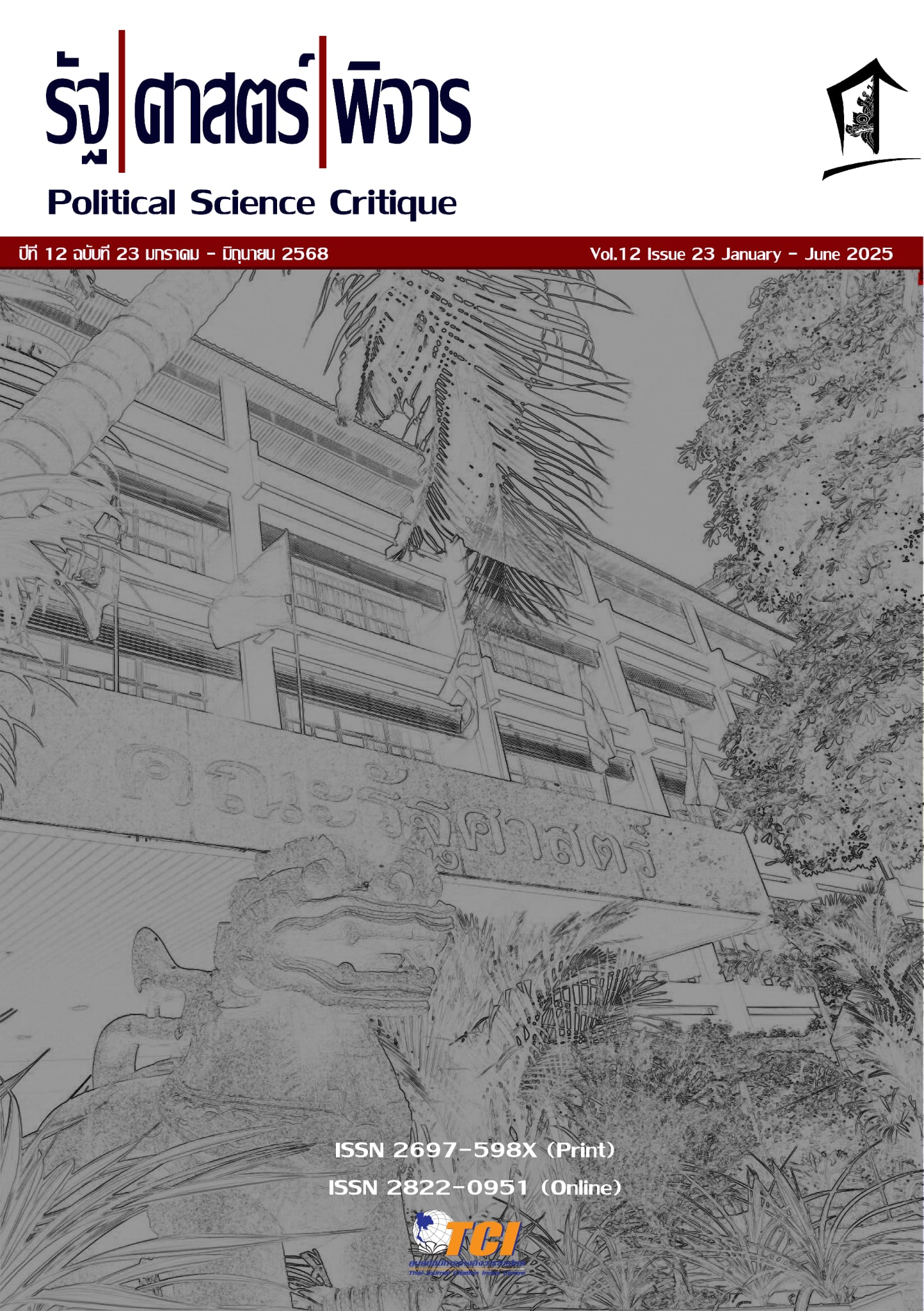
ดาวน์โหลด
เผยแพร่แล้ว
รูปแบบการอ้างอิง
ฉบับ
ประเภทบทความ
สัญญาอนุญาต
ลิขสิทธิ์ (c) 2025 รัฐศาสตร์พิจาร

อนุญาตภายใต้เงื่อนไข Creative Commons Attribution-NonCommercial-NoDerivatives 4.0 International License.
All contents and information in the manuscripts published by Journal of Political Science Critique are the authors’ opinions; thus, the authors take sole responsibility for any contents. The editorial board does not agree with or accept responsibility for the manuscripts.
All published articles, information, contents, pictures, or other things in Journal of Political Science Critique are Copyright by the Journal. All Rights Reserved. All contents may not be copied or duplicated in whole or part by any means without the prior written permission of Journal of Political Science Critique.

