
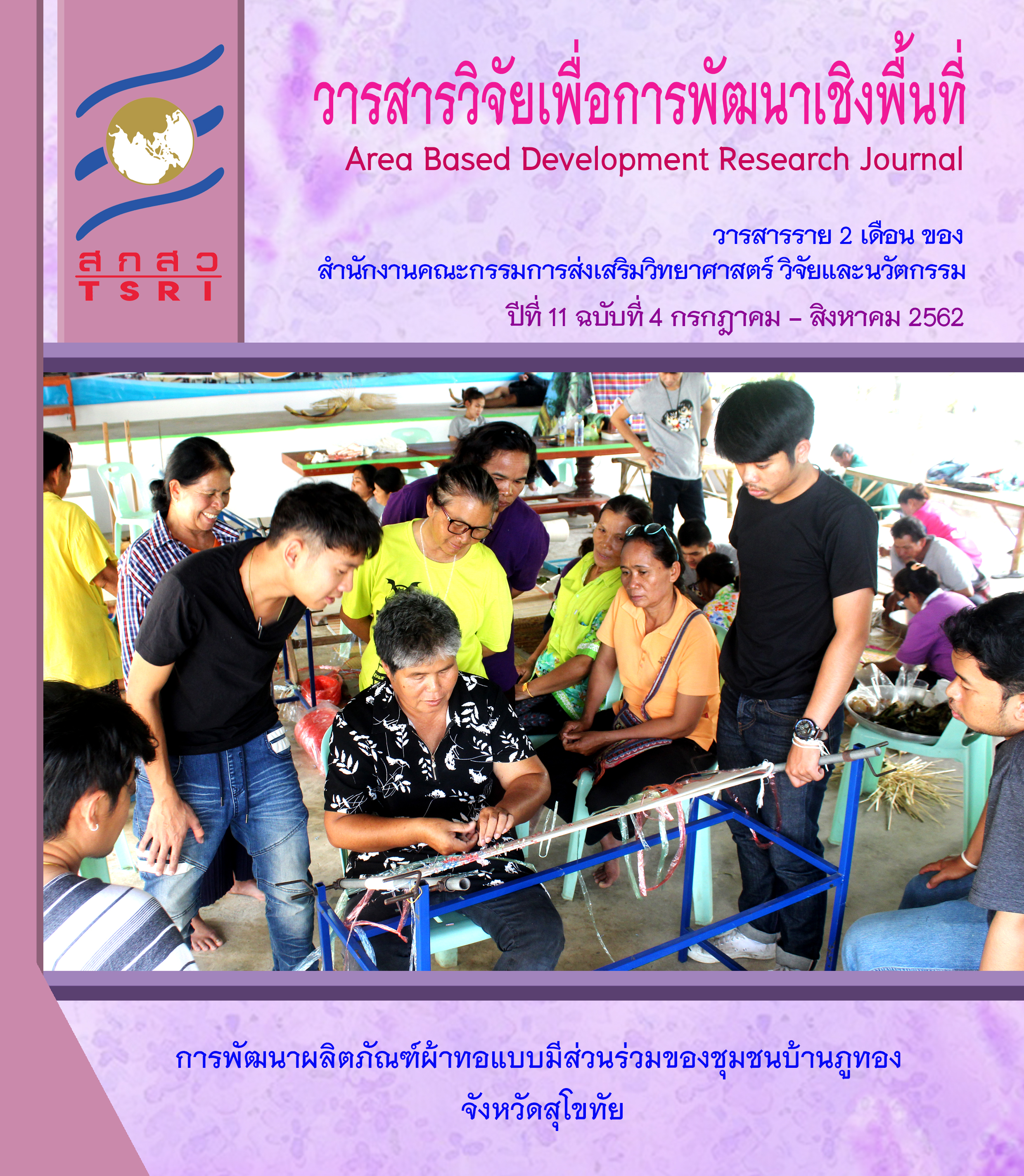
Participatory Development of Textile Products of Ban Phu Thong Community, Sukhothai Province
Article Sidebar
Main Article Content
Abstract
This research aims to 1) develop woven products by community participation, and 2) raise the standard of community’s products. This research is a combination of qualitative and quantitative approaches. Two steps in developing the textile consist of textile pattern design and transfer of knowledge and skills in the textile production. The sample group is the 10 textile manufacturers in Ban Phu Thong community, Wang Nam Khao sub-district, Ban Dan Lan Hoi district, Sukhothai province. Three developed patterns reflect the community identity. The research findings reveal textile patterns inspired by the local items known to tourists visiting Ban Phu Thong. The emerged patterns that symbolize the local identity are included a mushroom, a 700-year-old teak, and a bat. The textile manufacturers have learned the guidelines in woven pattern design and dyeing techniques. The local manufacturers are able to form a group to establish a learning hub for textiles production to those interested. Additionally, their textile products have now registered upon OTOP Standard.
Article Details

This work is licensed under a Creative Commons Attribution-NonCommercial-NoDerivatives 4.0 International License.
Area Based Development Research Journal values copyright protection and licensing to safeguard author rights and facilitate the appropriate dissemination of research. Our policies ensure openness, accessibility, and attribution. Authors retain copyright ownership, and articles are published under a Creative Commons Attribution License (CC BY), allowing sharing, adaptation, and proper attribution. Authors have the freedom to publish under the CC BY license, granting broad reuse and distribution permissions. The journal supports posting articles on third-party repositories, adhering to institutional and funding restrictions. Author guidelines detail copyright and licensing requirements, empowering authors with knowledge about their rights and responsibilities. These policies cultivate an environment of collaboration, openness, and responsible sharing, benefiting authors and the research community while honoring intellectual property rights.
References
กรมการพัฒนาชุมชน กระทรวงมหาดไทย. (2561ข). โครงการOTOP นวัตวิถีเชื่อมโยงภูมิปัญญา วิถีชุมชน. สืบค้นเมื่อวันที่ 20 มีนาคม 2562, จาก https://nawatwithi.com/about/.
จุรีวรรณ จันพลา, วลี สงสุวงค์, เพ็ญสินี กิจค้า และสุรีรัตน์ วงศ์สมิง (2559). การพัฒนารูปแบบผลิตภัณฑ์ผ้าทอไทยทรงดำเพื่อสร้างมูลค่าเพิ่มตามแนวทางเศรษฐกิจสร้างสรรค์. Veridian E-Journal, Silpakorn University, 9(2), 82-98.
ณปภัช จันทร์เมือง, ชัชวาล รัตนพันธุ์ และเปมิกา แซ่เตียว (2561). ผลิตภัณฑ์ชุมชนจากวัสดุยางพาราแปรรูป อำเภอพิปูน จังหวัดนครศรีธรรมราช. วารสารวิจัยเพื่อการพัฒนาเชิงพื้นที่, 10(5), 351-364.
บุญเกียรติ ไทรชมพู. (2555). การพัฒนาผลิตภัณฑ์ภูมิปัญญาท้องถิ่นพื้นที่คุ้งบางกะเจ้า (กระเพาะหมู) 6 ตำบลเพื่อการท่องเที่ยว และรองรับการเข้าสู่ประชาคมอาเซียน. วารสารวิชาการมหาวิทยาลัยราชภัฏพระนคร, 5(2), 1-10.
สรัญญา ภักดีสุวรรณ. (2553). การออกแบบลวดลายผ้าไหมมัดหมี่ของจังหวัดมหาสารคามในบริบทวัฒนธรรมร่วมสมัย. วารสารช่อพะยอม, 21,(1), 17-35.
สิริพร รอดเกลี้ยง และนงลักษณ์ ก้งเซ่ง. (2559). การพัฒนาผลิตภัณฑ์ผ้าทอเกาะยอโดยกระบวนการมีส่วนร่วมของชุมชน: กรณีศึกษาชุมชนบ้านท่าไทร ตำบลเกาะยอ อำเภอเมืองสงขลา จังหวัดสงขลา. สารอาศรมวัฒนธรรมวลัยลักษณ์, 16(2), 95-111.
