
Value Chain of Eri Cocoon Production to Innovative Product from Eri Pupae in Thap Sadet District, Sa Kaeo Province, Thailand
Article Sidebar
Main Article Content
Abstract
Thap Sadet Subdistrict in Ta Phraya District, Sa Kaeo Province, Thailand, is a border community where agriculture is the main occupation. Eri silkworm farming is practiced as a supplementary livelihood during the agricultural off-season. Farmers in four villages cultivate Eri silkworms, yielding an average of 20–30 kilograms of fresh cocoons per production cycle. However, the community faces persistent challenges including the production of small, low-quality cocoons, a shortage of Eri silkworm eggs, inconsistent yields, and limited market access for Eri pupae.
To address these challenges, a multi-faceted community development project was implemented with five strategic components:
1) Sustainable Community Group Formation: A participatory forum was organized with local stakeholders, including community leaders and the Ta Phraya District Community Development Office, to identify needs and formulate a strategic plan for sustainable development.
2) Supply Chain and Production Process Management: A comprehensive approach was adopted to improve the Eri silkworm farming value chain, from breeding to final products.
3) Learning and Product Development: Through food processing technologies, value-added products such as dried Eri pupae noodles, rice seasoning powder, and Eri pupae chocolate were developed. Organic liquid fertilizers and zero-turn composts were also created from silkworm waste. Product packaging was enhanced, and a community enterprise group was registered.
4) Marketing and Network Promotion: Partnerships with the Sa Kaeo Sericulture Promotion Center enabled market linkages. Training in branding, e-commerce, and participation in trade fairs expanded both online and offline sales channels.
5) Partnership and Community Collaboration: Continuous support from partner organizations fostered knowledge-sharing, innovation, and sustainable community development. Farmers gained expertise in Eri silkworm breeding and processing, producing golden-colored cocoons that met Grade A standards. The newly bred Sa Kaeo Tapioca Eri Silkworm was registered with the Department of Sericulture.
Further developments included simplified methods for egg production and breeding, helping reduce dependency on external sources. Farmers adopted innovative feeding techniques—replacing whole-cassava stem feeding with small-branch feeding—to optimize space, ensure uniform worm growth, and improve cocoon quality. Cassava leaf preservation methods were also introduced to prolong freshness and ensure a consistent food supply. Training sessions and collaborations with nearby sericulture groups enabled the integration of six breeding cycles from three different silkworm strains, under technical guidance from the Sa Kaeo Sericulture Promotion Unit. Additionally, semi-patented food products such as Eri pupae noodles were created, increasing monthly household income from an average of 2,000 Baht (61 USD) to 5,000–6,000 Baht (153–184 USD). The revenue from dried noodle sales alone added approximately 2,000 Baht (61 USD) monthly per household.
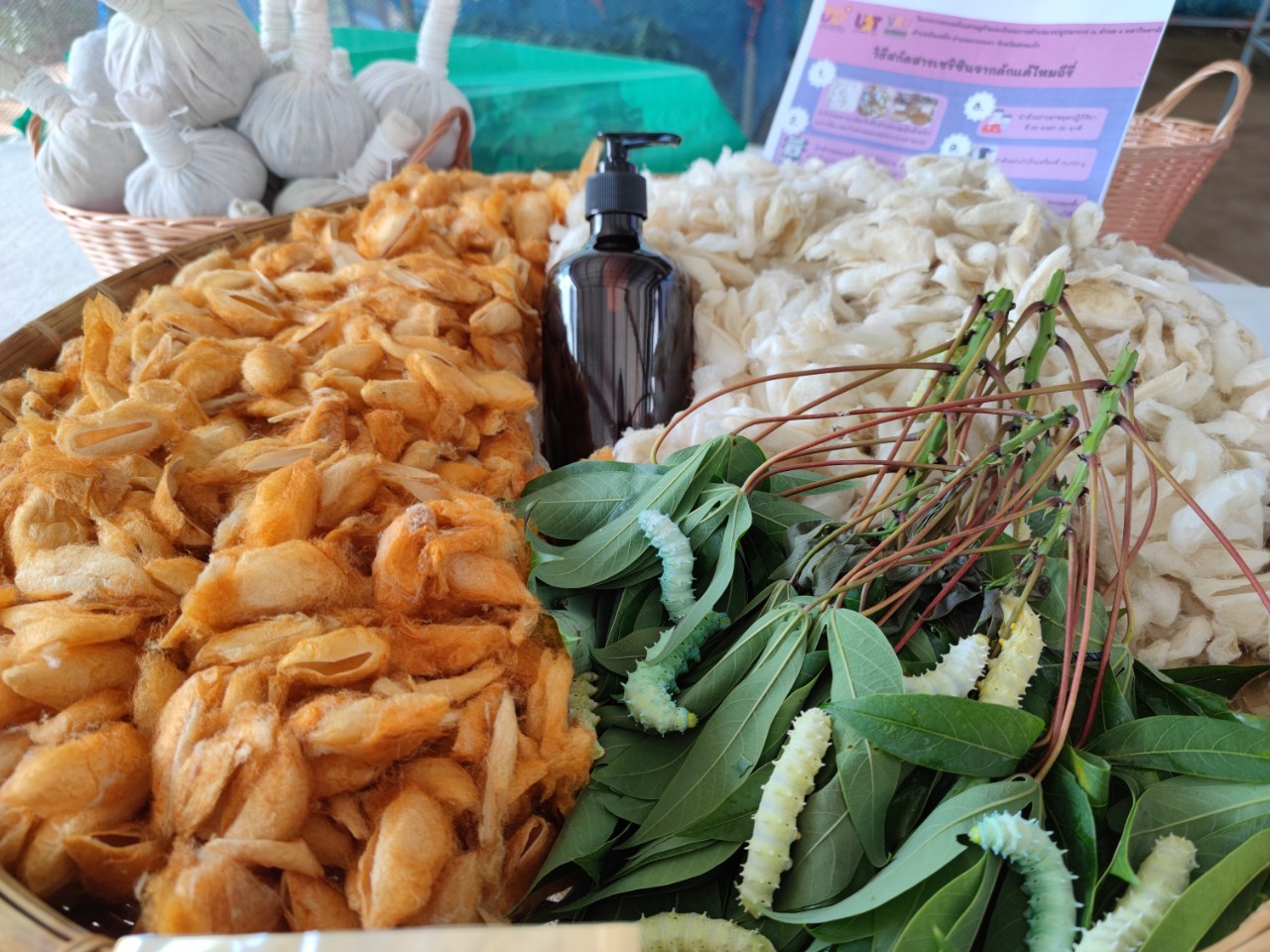
Silkworm waste was used to produce organic fertilizers, contributing to a zero-waste model and creating supplementary income. Eri cocoon waste was also developed into sericin extract for potential use in cosmetic products, opening doors to new markets in the beauty industry. The establishment of the Thap Sadet Eri Silkworm Farming and Processing Community Enterprise Group and a learning center in Ban Thap Seree created long-term support infrastructure. The community now belongs to the provincial Eri silkworm network, allowing better access to knowledge, funding, and trade opportunities.
This initiative transformed the local community through skill development in silkworm breeding, integrated farming, product processing, and sustainable waste utilization. Farmers achieved standard-compliant cocoon production, developed breeding techniques for golden cocoons, and adopted eco-friendly farming practices. A silkworm egg bank was established to preserve genetic diversity and prevent inbreeding. Community innovators emerged as local trainers and knowledge disseminators. With sustained institutional support and increased community participation, this model presents a replicable approach to rural economic empowerment, capacity building, and sustainable agro-industrial development in Thailand.
Article Details

This work is licensed under a Creative Commons Attribution-NonCommercial-NoDerivatives 4.0 International License.
Area Based Development Research Journal values copyright protection and licensing to safeguard author rights and facilitate the appropriate dissemination of research. Our policies ensure openness, accessibility, and attribution. Authors retain copyright ownership, and articles are published under a Creative Commons Attribution License (CC BY), allowing sharing, adaptation, and proper attribution. Authors have the freedom to publish under the CC BY license, granting broad reuse and distribution permissions. The journal supports posting articles on third-party repositories, adhering to institutional and funding restrictions. Author guidelines detail copyright and licensing requirements, empowering authors with knowledge about their rights and responsibilities. These policies cultivate an environment of collaboration, openness, and responsible sharing, benefiting authors and the research community while honoring intellectual property rights.
References
Akai, H. (2010). Development and contributions of the international society for wild silkmoths. International Journal of Wild Silkmoth and Silk, 15, 1-22.
Attathom, T., Kunhasut, V., & Areekul, S. (1992). Rearing of eri silkworm by different host plants. In Proceedings of the 30th Kasetsart University Annual Conference: Plants (pp. 291-300). Ministry of Science, Technology and Energy, Kasetsart University, Bangkok. (in Thai).
Attathom, T. (2011). Eri silk: A new type of silk that eats cassava leaves. Retrieved January 12, 2025, from: https://www.goto-know.org/posts/441496. (in Thai).
Attathom, T. (n.d.). Raising Eri silkworms as a new alternative career. Department of Entomology, Faculty of Agriculture, Kasetsart University, Kamphaeng Saen Campus, Nakhon Pathom (in Thai).
Attathom, T., Saksirirat, S., Phatthanasetthanon, W., & Phromchana, N. (2002). Production cost analysis of Eri silkworm for the development toward industrialization. (Research report). Thailand Science Research and Innovation. (in Thai).
Food Intelligence Center. (2023). Insect protein alternative food for sustainability. Retrieved January 12, 2025, from: https://fic.nfi.or.th/upload/market_overview/pdf385.pdf. (in Thai).
Jaifong, C., Seerasarn, N., & Puttamuk, T. (2022). Extension of cassava mosaic disease management in Taphraya District, Sakaeo Province. Journal of Roi Kaensarn Academi, 7(10), 67-82. (in Thai).
Jarimopas, B., Areekul, P., Saksoong, P., Attathom, T., & Areekul, S. (1993). Eri silk rearing for economic development of North-Eastern Thailand. Kasetsart University Research and Development Institute. Bangkok. (in Thai).
Khamchuenwong, N. (2020). Guidelines for enhancing the potential of Eri silk farmers. Retrieved January 12, 2025, from https://researchcafe.tsri.or.th/guidelines-to-promote-the-industrial-potential-of-eri-farmers/ (in Thai).
Lichanporn, I., Nanthachai, N., & Tunganurat, P. (2023). Effect of Eri silkworm pupa powder on quality changes of brownies. Research Journal Phranakhon Rajabhat : Science and Technology, 18(1), 69-83. (in Thai).
Matichon Online. (2019). Rain shadow area of Ta Phraya District, Sa Kaeo Province is dry, while many other provinces are hit by storms. Retrieved January 12, 2025, from: https://www.matichon.co.th/region/news_1655607 (in Thai).
Mishra, N., Hazarika, N. C., Narain, K., & Mahanta, J. (2003). Nutritive value of non-mulberry and mulberry silkworm pupae and consumption pattern in Assam, India. Nutrition Research, 23(10), 1303-1311. DOI: https://doi.org/10.1016/S0271-5317(03)00132-5
Office of Agricultural Economics. (2023). Office of Agricultural Economics visits the area to monitor the situation of cassava and sugarcane for the year 2023/24. Retrieved January 12, 2025, from: https://www.oae.go.th. (in Thai).
Phromboon, A., Saksung, S., & Phatrakon, T. (2007). Cyanide residue and lecithin content from Eri silkworms. (Research Report). Department of Biochemistry, Kasetsart University. (in Thai).
Pimpasalee, S., Hemathulin, S., Ittarat, R., Klaoliang, K., Wonrawongsomkam, K., Dokkang, S., & Phomtu, P. (2022). Development of a prototype method for extraction of proteins from eri silkworms for health food products developing Eri silkworm cocoon and pupae processing. Retrieved January 12, 2025, from: https://qsds.go.th/newosrd/wp-content/uploads/sites/115/2022/07/silk-2565-9.pdf (in Thai).
Saennamwong, K., Sukritanont, Y., Nopsenee, P., Wilai, S., Raksang, W., Junpoon, S., ..., & Suttachana, S. (2006). The research and development project of Eri silk in the Northeast. (Research Report). Department of Agriculture. (in Thai).
Sakunphun, S., Uppapong, K., Junkawee, T., Palas, P., & Roonreangjai, R. (2024). Enhancing community economy through a new value chain of red tilapia in Lum Nam Nan, Uttaradit Province, Thailand. Area Based Development Research Journal, 16(4), 329-345. (in Thai).
Sarkar, D. C. (1988). Eri culture in India. Central Silk Board, Ministry of Textiles, Government of India. Grafo Printers.
Sirimungkararat, S., Saksirirat, W., Nopparat, T., & Narkdang, T. (2010). Eri textile product development for registration to Thai community product standard (TCPS). International Journal of Wild Silkmoth and Silk, 14, 39-48.
Sirimungkararat, S. (2012). Eri silkworm products and current status of wild silkmoths in Thailand. The 7th International Conference on Wild Silkmoth and Silk: Southeast Asian Silk, Mahasarakham, Thailand, November 22-24, 2012.
Sirimungkararat, S. (2013). Eri silk: An economic insect worth watching. Retrieved January 12, 2025, from: https://www.stou.ac.th/study/sumrit/10-58/page2-10-58.html (in Thai).
Sirimungkararat, S., Saksirirat, W., Wongsorn, D., & Maskhao, S. (2013). Use of castor commercial line for increasing yield of Eri silkworm. Khon Kaen Agriculture Journal, 41(Suppl. 1), 185-191. (in Thai).
Srinual, O., Maneepitaksanti, W., Tapingkae, W., Ponjaruen, S., Senawong, T., Apinyanuwat, S., …, & Seepai, A. (2022). Replacement of fishmeal by Eri silkworm (Samia ricini) or Thai crossbreed (j108 x Nhaglai) silkworm in goldfish (Carassius auratus) diet on growth performance, pigmentation, and health status index. King Mongkut’s Agricultural Journal, 40(3), 260–271. (in Thai).
Suthira, P. (2020). Research approaches for adding value to Eri silkworm pupae. Retrieved January 12, 2025, from: https://qsds.go.th/newosrd/wp-content/uploads/sites/115/2020/12/Eri-Silkworm.pdf. (in Thai).
Suttisan, P., Sukrichaya, H., Roongrat, I., Khanittha, K., Kanokwan, W., Suttikai, D., & Phianphon, P. (2022). Development of a prototype method for extraction of proteins from Eri silkworms for health food products: Developing Eri silkworm cocoon and pupae processing. Retrieved January 16, 2025, from: https://qsds.go.th/newosrd/wp-content/uploads/sites/115/2022/07/silk-2565-9.pdf. (in Thai).
The Support Arts and Crafts International Centre of Thailand (SACICT). (2023). Eri silk handicrafts. Retrieved January 12, 2025, from: https://sacit.or.th/uploads/items/attachments/956936879f66f5cf4ffbf3aefffd56ca/_d9c828d53e9a176bb883c0ee-1d35378a.pdf. (in Thai).
Valaya Alongkorn Rajabhat University under the Royal Patronage. (2018). Raising Eri silkworms (man thor yod). Retrieved January 12, 2025, from: https://ppi.psu.ac.th/project/1487. (in Thai).
Wongtong, S., Areekul, P., Onlamoon, A., & Tragoolgarn, S. (1980). Research on wild silkworm cultivation in the highlands of northern Thailand. (Research Report), Highland Agriculture Project 1976-1980, Bangkok. (in Thai).
