
Enhancing the Capacity of Farmers in Peanut Seed Production under the Community Legume Seed Production Center in Khao Suan Kwang Subdistrict, Khon Kaen Province, Thailand
Article Sidebar
Main Article Content
Abstract
The Community Legume Seed Production Center located in Khao Suan Kwang Subdistrict, Khao Suan Kwang District, Khon Kaen Province, Thailand, is a grassroots initiative comprised of local peanut farmers working collectively to produce and distribute high-quality peanut seeds. This Center plays a crucial role in supporting the community’s agricultural productivity, aiming to provide reliable, locally-produced peanut seeds. However, despite the organized effort, the yield of the Khon Kaen 6 peanut variety has remained below the standard benchmarks set by the Department of Agriculture. Recognizing this limitation, twenty active members of the Center collaboratively engaged in a structured capacity-building process with the goal of enhancing both the quality and productivity of peanut seed production.The process adopted a participatory learning and action (PLA) framework, emphasizing knowledge sharing, experiential learning, and practical implementation. The initiative unfolded in five systematic phases:
1) Participatory planning through group meetings:
The first step involved organizing group discussions and planning sessions among Center members. These meetings served as platforms for exchanging ideas, identifying key production problems, and co-developing solutions. During this stage, the group recognized several critical issues affecting their seed quality and yield, including low seed purity, inadequate pest management, poor soil conditions, and insufficient post-harvest processing practices. These insights laid the foundation for a collective action plan aimed at improving their practices through collaborative learning.
2) Knowledge acquisition through expert training:
The second phase centered on acquiring technical knowledge. The Center invited specialists from the Khon Kaen Seed Research and Development Center to conduct comprehensive training sessions. The workshops covered a range of topics crucial for improving peanut seed production, including land preparation, soil fertility management, pest control, seed selection, and post-harvest handling. Of particular interest was the use of gypsum to improve soil structure and calcium availability, a technique especially beneficial for the Khon Kaen 6 variety. The training also emphasized the importance of using Rhizobium inoculation, dolomite application, and balanced fertilization (16-16-8), which are proven strategies to enhance peanut growth and yield after rice harvests in the region.
3) Experiential learning through field visits:
To deepen understanding, the third phase involved experiential learning through field visits. Members traveled to successful peanut farms within the district, observing effective farming techniques implemented by local farmers. These field visits provided practical exposure to pest prevention methods, such as crop rotation and biological control, as well as best practices for soil amendment and seed drying. Observing real-world success stories helped participants internalize the theoretical knowledge acquired in earlier training.
4) Implementation on individual learning plots:
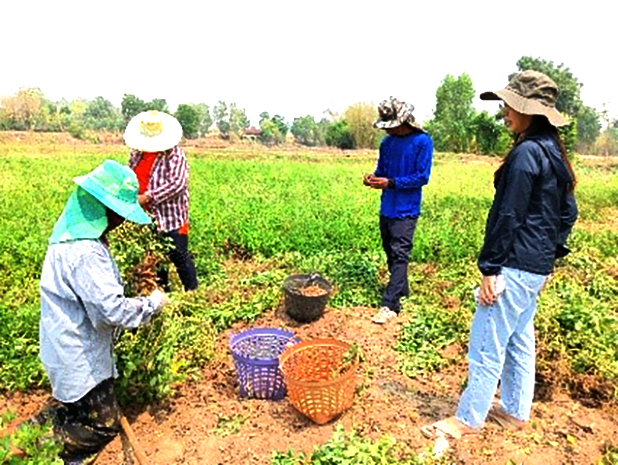
Following the capacity-building activities, members were encouraged to apply their new knowledge through practice. Each participant established a personal learning plot on their own land, using the recommended practices to cultivate Khon Kaen 6 peanuts. This hands-on experience served as both a trial and demonstration for improved techniques, including the use of gypsum and lime to adjust soil pH and calcium levels, and proper drying methods to reduce seed moisture to the ideal level of 7-8%, thus maintaining seed viability and minimizing fungal contamination.
5) Monitoring, evaluation, and knowledge sharing:
Regular peer visits and group reflections were conducted to monitor progress, exchange experiences, and address emerging challenges. This ongoing cycle of feedback allowed members to learn from one another and refine their practices. Particular attention was paid to maintaining varietal purity through consistent monitoring, field inspection, and rogueing of off-type plants during key growth stages such as flowering, pod development, and harvest. Laboratory tests were also conducted to assess moisture content, germination rate, seed vigor, and purity, following ISTA guidelines. Accelerated aging tests were performed to evaluate seed vigor under stressful storage conditions.
The collaborative efforts resulted in a significant improvement in both the quantity and quality of peanut seed production. The average yield of Khon Kaen 6 peanuts increased to 557 kilograms of dry pods per rai, a marked improvement compared to previous years. Moreover, the purity of the harvested seeds improved, with a noticeable reduction in contamination by off-types and malformed or shriveled pods. Farmers reported a decline in the number of pods producing a hollow sound when pressed, indicating better seed development. The initiative also promoted post-harvest improvements. Members adopted standardized drying practices, using mesh trays and regularly turning the pods to ensure even drying and reduce the risk of fungal infection. Seed cleaning and grading were performed using mechanical equipment to remove impurities and damaged pods, ensuring seed lots met quality certification standards.
Beyond immediate production gains, this initiative fostered a spirit of innovation and experimentation among Center members. Encouraged by the success of improved Khon Kaen 6 seed production, several farmers began experimenting with other peanut varieties to diversify their seed-saving activities. Furthermore, enhanced soil fertility through organic matter incorporation and the use of crop residues as green manure has led to improved growth of subsequent crops in rotation systems. The project also highlighted the importance of combining indigenous knowledge with scientific guidance. The integration of local experience and expert advice created a robust knowledge system that was both accessible and practical for small-scale farmers. As a result, the Community Legume Seed Production Center is now better positioned to serve as a local hub for sustainable seed production, knowledge dissemination, and community-based agricultural development.
In summary, this case demonstrates that participatory, experiential, and knowledge-based approaches can significantly enhance seed production among smallholder farmers. By leveraging group collaboration, technical training, and practical field application, the Community Legume Seed Production Center has achieved tangible improvements in seed quality, yield, and sustainability. This model holds promise for replication in other regions where smallholder farmers seek to enhance seed security and agricultural resilience through community-driven innovation.
Article Details

This work is licensed under a Creative Commons Attribution-NonCommercial-NoDerivatives 4.0 International License.
Area Based Development Research Journal values copyright protection and licensing to safeguard author rights and facilitate the appropriate dissemination of research. Our policies ensure openness, accessibility, and attribution. Authors retain copyright ownership, and articles are published under a Creative Commons Attribution License (CC BY), allowing sharing, adaptation, and proper attribution. Authors have the freedom to publish under the CC BY license, granting broad reuse and distribution permissions. The journal supports posting articles on third-party repositories, adhering to institutional and funding restrictions. Author guidelines detail copyright and licensing requirements, empowering authors with knowledge about their rights and responsibilities. These policies cultivate an environment of collaboration, openness, and responsible sharing, benefiting authors and the research community while honoring intellectual property rights.
References
Amnaruang, P., Wichaiwong, R., Polsena, C., Phakdee, C., Panyasit, S., Polsena, T., & Lephon, S. (2018). Improving production efficiency and product development from peanuts in Ban Nong Phak Waen Community, Laodokmai Subdistrict, Chuen Chom District, Maha Sarakham Province. (Research report). Thailand Science Research and Innovation, Bangkok. (in Thai).
Ampansirirat, A., & Wongchaiya, P. (2017). The participatory action research: Key features and application in community. Journal of Humanities and Social Sciences, Mahasarakham University, 36(6), 192-202. (in Thai).
Bureau of Agricultural Commodities Promotion and Management. (2023). Agricultural promotion project manual for the fiscal year 2023. Retrieved August 13, 2023, from: http://www.agriman.doae.go.th/home/agriman62/66_Website_Project/Appendix-08Lagume.pdf. (in Thai).
Cohen, J. M., & Uphoff, N. T. (1981). Rural development participation: Concept and development. USA: Cornell University Press.
Department of Agriculture. (2018). Research and development of peanut production technology. Department of Agriculture, Bangkok. (in Thai).
Department of Agriculture. (2022). Manual for seed production of soybean, fresh pod soybean, mung bean, and peanut. Department of Agriculture, Bangkok. (in Thai).
Department of Agricultural Extension. (2017). 20-year agricultural promotion strategic plan (2017-2036). Retrieved August 14, 2023, from: https://infocenter.doae.go.th/wp-content/uploads/2018/06/20-Year-Agricultural-Promotion-Strategic-Plan.pdf. (in Thai).
Department of Agricultural Extension. (2023). Seed quality inspection manual. Department of Agricultural Extension, Bangkok. (in Thai).
Duangpattra, P. (2010). Soil amendments. Bangkok: Kasetsart University Press. (in Thai).
Fakthongphan, J. (2016). Seed priming for unfavorable condition tolerance. Thai Agricultural Research Journal, 34(2), 196-210. (in Thai).
ISTA. (2021). International rules for seed testing. International Seed Testing Association, Bassersdorf, Switzerland.
Jaipala, S., Phunchaisri, J., & Pavadee, P. (2021). Yield potential evaluation of fresh pod peanut varieties in Chiang Mai Province. Thai Agricultural Research Journal, 39(3), 284–292. (in Thai).
Jensantikui, N. (2021). Community-based learning process: Reflections on experience and learning. Journal of Humanities and Social Sciences Mahamakut Buddhist University Isan Campus, 2(3), 78-85. (in Thai).
Kaewwongsri, P., Peaksantheah, B., Inkumnerd, S., Daengchanthuek, M., & Wachirasereechai, W. (2022). Instructional materials CE634409: Participatory Action Research (PAR). (1st edition). Samut Songkhram: Faculty of Liberal Arts, Institute of Lifelong Learning Promotion. (in Thai).
Kowsuvon, K. (2021). Guidelines for production and marketing management of peanut total-processing by community enterprise: A case study of Ban Ton Phueng, Maepong Sub-District, Doi Saket District, Chiang Mai Province. Journal of Community Development Research (Humanities and Social Sciences), 14(1), 93-103. (in Thai).
Land Development Department. (2013). Soil improvement. Department of Land Development, Ministry of Agriculture and Cooperatives, Bangkok. (in Thai).
Office of Agricultural Economics. (2021). Agricultural economic information by product 2021. Retrieved August 14, 2023, from: https://www.oae.go.th/assets/portals/1/ebookcategory/67_commodity2564. (in Thai).
Office of Agricultural Economics. (2022). Agricultural economic information by product 2022. Retrieved August 14, 2023, from: https://www.oae.go.th/assets/portals/1/ebookcategory/97_commodity2565final. (in Thai).
Onthanee, A. (2021). The effectiveness of participatory learning to promote occupational competency for secondary school students. Journal of Education Naresuan University, 23(2), 336-350. (in Thai).
Supama, Y., Rueankaew, W., Thueansombat, S., Boonlert, C., Bowonmethee, S., & Thinwichai, S. (2023). Testing and technology improvement for peanut production in specific area. Khon Kaen Agriculture Journal, 51(Suppl. 2), 312-323. (in Thai).
Thinkham, P., Chumsuwan, N., Chinnasaen, T., Thinkham, P., Rujinarong, M., & Changjai, R. (2024). Development and expansion of peanut seed producer networks in Nam Phong District, Khon Kaen Province. In the 16th National Academic Conference, Nakhon Pathom Rajabhat University, July 4-5, 2024. (in Thai).
Thongkanporn, W. (2014). Community-based participatory learning process in environmental management to reduce haze pollution from burning in Ban Kwang community, Han Kaeo Subdistrict, Hang Dong District, Chiang Mai Province. (Master’s thesis). Social Development Program, Faculty of Social Sciences, Chiang Mai University. (in Thai).
Woraganjanaboon, W., Sainthanu, B., Promphanjai, P., Ngernmun, P., & Saenpluem, K. (2014). Increasing peanut production after rice harvest through soil management in Ubon Ratchathani Province. Khon Kaen Agriculture Journal, 42(Suppl. 2), 354–358. (in Thai).
