
Developing of Indigenous Textile Products to Enhance Product Design of Anong Mo Hom Group, Nong Bua Lamphu Province, Thailand
Article Sidebar
Main Article Content
Abstract
Introduction
Mo Hom, an indigo–dyed cotton traditionally worn in northern and northeastern Thailand, embodies local identity, hand‑crafted skill, and cultural memory. Yet, many producer groups still offer only the classic “farmer shirt,” limiting their customer base to middle‑aged buyers and local tourists. The Anongmohom Group in Mueang District, Nong Bua Lamphu Province, faced exactly this challenge: a narrow product line, dated aesthetics, and stagnant sales despite a growing national appetite for culture‑infused fashion. The research project described here therefore sought to transform the group’s design capability, diversify its product portfolio, and equip members with business and digital‑marketing skills—while preserving the authentic Mo Hom look and the distinctive khit (weft‑float) motifs that distinguish local cloth.
Methodology
A five‑step action‑research process, framed by the participatory action research (PAR) model, guided implementation:
1) Needs analysis and capacity mapping: Twenty group members analysed internal strengths—hand‑loom skill, natural‑dye mastery, community cohesion—and weaknesses such as limited design experience, outdated patterns, and lack of brand story. External opportunities (growing demand for eco‑craft fashion) and threats (intense regional competition) were also recorded.
2) Design and product‑development training: Professional fashion designers delivered sequential workshops on trend research, mood‑board creation, pattern sketching, prototype sewing, and costing.
A parallel stream covered business planning, online branding, and social‑media merchandising to ensure that design innovations could reach target customers.
3) Prototype creation: Guided by workshop outputs, members produced three women’s‑wear prototypes—a sleeveless dress, a relaxed work blouse, and tapered trousers—each blending Mo Hom indigo with cotton‑khit panels. Emphasis was placed on flattering urban cuts, precise sizing, and discreet but recognisable local motifs.
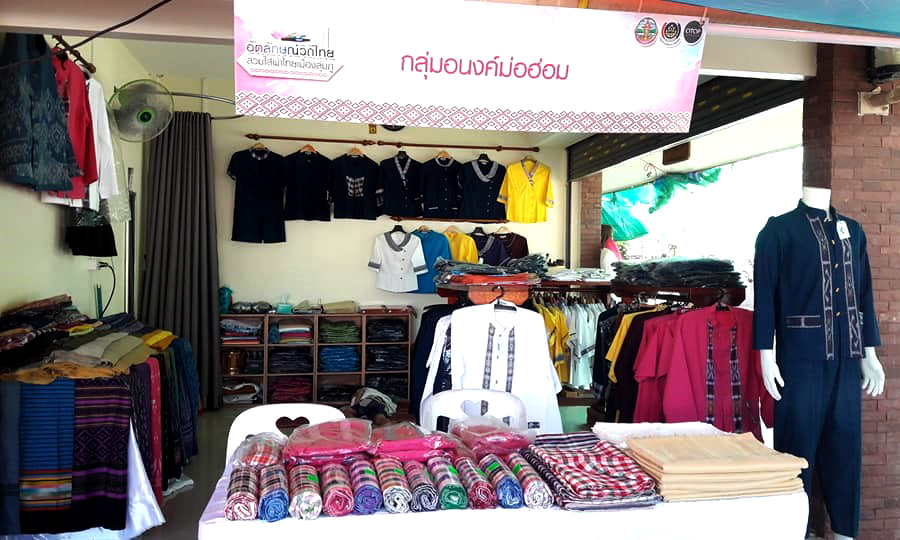
4) Market testing and iterative refinement: Prototypes were displayed in a local boutique, at a provincial craft fair, and on a dedicated Facebook page. Structured questionnaires captured feedback on fit, style, fabric feel, and perceived uniqueness from 120 respondents aged 18‑45.
Dress and blouse designs scored highest (mean satisfaction = 4.6/5) on craftsmanship and overall appeal; suggested price points were roughly 25 % above the group’s older garments. Comments then fed into a second design round that adjusted neckline depth, pocket placement, and colour accents.
5) Scaling up and knowledge diffusion: A production run of 60 dresses, 80 blouses, and 50 pairs of trousers was completed for broader launch. Digital promotion through an upgraded Facebook page and provincial OTOP fairs widened exposure. Monthly review meetings documented sales data, trouble‑shooting, and skill gaps—creating a feedback loop for continuous improvement.
Results
Design and technical skills—All members can now read and modify commercial patterns, match Mo Hom panels with khit in complementary hues, and use industrial sewing machines for clean finishing.
Product diversity—The collection expanded from two basic shirts to at least six SKUs, including the new women’s line and a unisex overshirt, providing greater choice and enabling bundle offers.
Economic impact—Average profit margins rose by 25 % on dresses, 33 % on blouses, and 25 % on trousers. Online enquiries and craft‑fair orders climbed so rapidly that the dress line went into back‑order, prompting plans to train additional seamstresses from the village.
Market reach—Sales channels now span three retail outlets in Nong Bua Lamphu, a Facebook shop with nationwide shipping, and regular booths at regional trade fairs, giving the brand steady visibility.
Environmental stewardship—Fabric offcuts are up‑cycled into sachets and small gifts, reducing waste and reinforcing an eco‑friendly brand message aligned with consumer expectations for sustainable craft.
Social sustainability—Youth inclusion has become explicit policy: daughters and sons of existing members manage social‑media content and learn cutting and stitching, ensuring inter‑generational transfer of skills.
Community identity—By weaving khit stripes into modern silhouettes, the group maintains a tangible link to local heritage even as it courts new, younger consumers.
Discussion
Key success factors include: (1) anchoring innovation in the authentic idiom of Mo Hom and khit, avoiding superficial “modernisation”; (2) coupling design workshops with business‑planning modules to translate creativity into income; (3) using rapid market‑test loops so designs evolve with real consumer data; and (4) retaining a participatory ethos so every member feels ownership of the new direction.
Challenges remain. Production capacity must rise without diluting quality; consistent natural‑dye batches require tighter process control; and brand storytelling across digital channels needs refinement to stand out in a saturated slow‑fashion market. The group therefore plans a micro‑studio for colour testing, a shared online calendar for production scheduling, and quarterly photo‑shoots to refresh content.
Conclusion
The Anongmohom Group’s journey illustrates how indigenous textile enterprises can thrive by marrying traditional craft with contemporary design and market intelligence. Through participatory training, iterative prototyping, and strategic branding, the group moved from a stagnant two‑product offering to a versatile collection that commands higher prices and attracts new demographics. The approach—rooted in local wisdom, enriched by expert input, and driven by systematic market validation—provides a replicable model for similar craft communities seeking relevance in today’s fashion landscape while safeguarding their cultural essence.
Article Details

This work is licensed under a Creative Commons Attribution-NonCommercial-NoDerivatives 4.0 International License.
Area Based Development Research Journal values copyright protection and licensing to safeguard author rights and facilitate the appropriate dissemination of research. Our policies ensure openness, accessibility, and attribution. Authors retain copyright ownership, and articles are published under a Creative Commons Attribution License (CC BY), allowing sharing, adaptation, and proper attribution. Authors have the freedom to publish under the CC BY license, granting broad reuse and distribution permissions. The journal supports posting articles on third-party repositories, adhering to institutional and funding restrictions. Author guidelines detail copyright and licensing requirements, empowering authors with knowledge about their rights and responsibilities. These policies cultivate an environment of collaboration, openness, and responsible sharing, benefiting authors and the research community while honoring intellectual property rights.
References
Burapajatana, J. (2023). Cultural product development: Yok Dok Woven Textiles of Lum Poon. Journal of Fine Arts Research and Applied Arts, 10(1), 111-125. (in Thai).
Cleaver, D. G. (1972). Art: An introduction. Michigan: Harcourt Brace Jovanovich.
Kongpanjittima, C., & Khaenamkhaw, D. (2018). Conservation and development of the profession of weaving Maung Nakhon: A case study of Ban Mamuangplaikhan Community, Tha Ngew Municipality, Muang District, Nakhon Sri Thammarat Province. Arts of Management Journal, 2(2), 133-142. (in Thai).
Kotler, P. (2003). Marketing management (11th edition). Upper Saddle River, NJ: Prentice –Hall.
McCarthy, E. J., & Perreault, W. D. (1991). Essentials of marketing. Pennsylvania: Irwin.
National Economic and Social Development Board. (2017). National strategy 20 year period (2017-2036). Retrieved April 16, 2018, from: https://www.nesdc.go.th/download/document/SAC/NS_SumPlanOct2018.pdf. (in Thai).
Nuansara, M., Pengsiri, J., Teypinsai, N., & Chutinatphuwadon, C. (2021). Development of natural fibers woven fabrics in Chiang Rai Province. Humanities and Social Sciences Journal, Chiang Mai Rajabhat University, 3(2), 42-58. (in Thai).
Office of the National Economic and Social Development Council. (2022). The 13th national economic and social development plan (2023-2027). Retrieved April 16, 2018, from: https://www.nesdc.go.th/article_attach/article_file_20230307173518.pdf. (in Thai).
Pantung, P., Sirisan, P., Wanphet, T., & Inprasit, U. (2024). Participatory development of Batik bags product by the Ban Phunok Community Enterprise Group in Ban Tuek Subdistrict, Si Satchanalai District, Sukhothai Province. Humanities and Social Sciences Journal, Ubon Ratchathani Rajabhat University, 15(2), 176-188. (in Thai).
Phichanapaiboon, W. (1984). Modern furniture design. Bangkok: Chulalongkorn University. (in Thai).
Pokaew, T., Tumthong, T., Na Takuathung, C., Kulnuy, O., Heemiad, S., & Sulum, H. (2023). Design and development guidelines for Batik products, Ban Na Toei, Thai Muang District, Phang Nga Province. Phranakhon Rajabhat Research Journal Humanities and Social Sciences, 18(1), 239-254. (in Thai).
Prajonsant, S. (2019). The graphic printed scarf products which used decorative motif patterns of ancient Khmer sanctuary and customer acceptance. Silpakorn University e-Journal (Social Sciences, Humanities, and Arts), 39(3), 20-32. (in Thai).
Rattanaphan, R. (2019). Fabric pattern design to further creative products of local culture in Phetchabun Province. Research and Development Journal Suan Sunandha Rajabhat University, 11(1), 32–38. (in Thai).
Thailand Textile Institute (2020). Project to develop Thai fabric products for the world market with the concept of circular economy. Retrieved March 4, 2025, from: https://www.thaitextile.org/th/service/detail.2149.1.0.html. (in Thai).
Uthitwankul, P. (2018). Local cultural capital international art business. UNISEARCH (Unisearch Journal), 5(2), 5. DOI: https://doi.org/10.58837/CHULA.UNISEARCH.5.2.4
