
Developing a Creative Tourism Process through Cultural Capital to Promote Active Ageing: A Case Study of Noen Hom Community, Prachinburi Province, Thailand
Article Sidebar
Main Article Content
Abstract
Background
Noen Hom Subdistrict in Prachinburi Province, Thailand, is a rural community nestled along the foothills of Khao Yai National Park. The region boasts a rich biocultural landscape, encompassing both natural resources and vibrant cultural heritage. Its cultural capital includes traditional knife forging, herbal processing, angkalung musical instrument craftsmanship, and unique agricultural practices. These elements provide immense potential for developing immersive and creative tourism experiences. However, the community faces socio-demographic shifts, notably an aging population, economic vulnerabilities, and the decline of intergenerational knowledge transfer. This research responds to these challenges by exploring a creative tourism framework rooted in local cultural capital, aiming to promote active aging through a participatory process.
Objectives and Methodology
The study set out to design and implement a community-based tourism (CBT) model that leverages the cultural and natural assets of Noen Hom, while promoting health, engagement, and self-worth among elderly residents. Grounded in a participatory action research framework, the project followed a seven-phase methodology:
1) Cultural Asset Mapping: Identification and documentation of tangible and intangible local assets.
2) Development of Tourism Routes: Co-creation of tourism circuits highlighting community wisdom and lifestyle.
3) Infrastructure Readiness: Upgrading physical facilities and improving service capabilities.
4) Pilot Route Implementation: Trial operation of planned routes with controlled participant groups.
5) Tourist Engagement: Hosting actual visitor groups to test and refine offerings.
6) Service Evaluation: Gathering feedback from tourists to improve service quality.
7) Dissemination: Use of digital platforms and social media to promote the initiative and scale up the model.
Community members, particularly the elderly, were involved at each stage to ensure relevance, ownership, and sustainability.
Key Findings and Outcomes
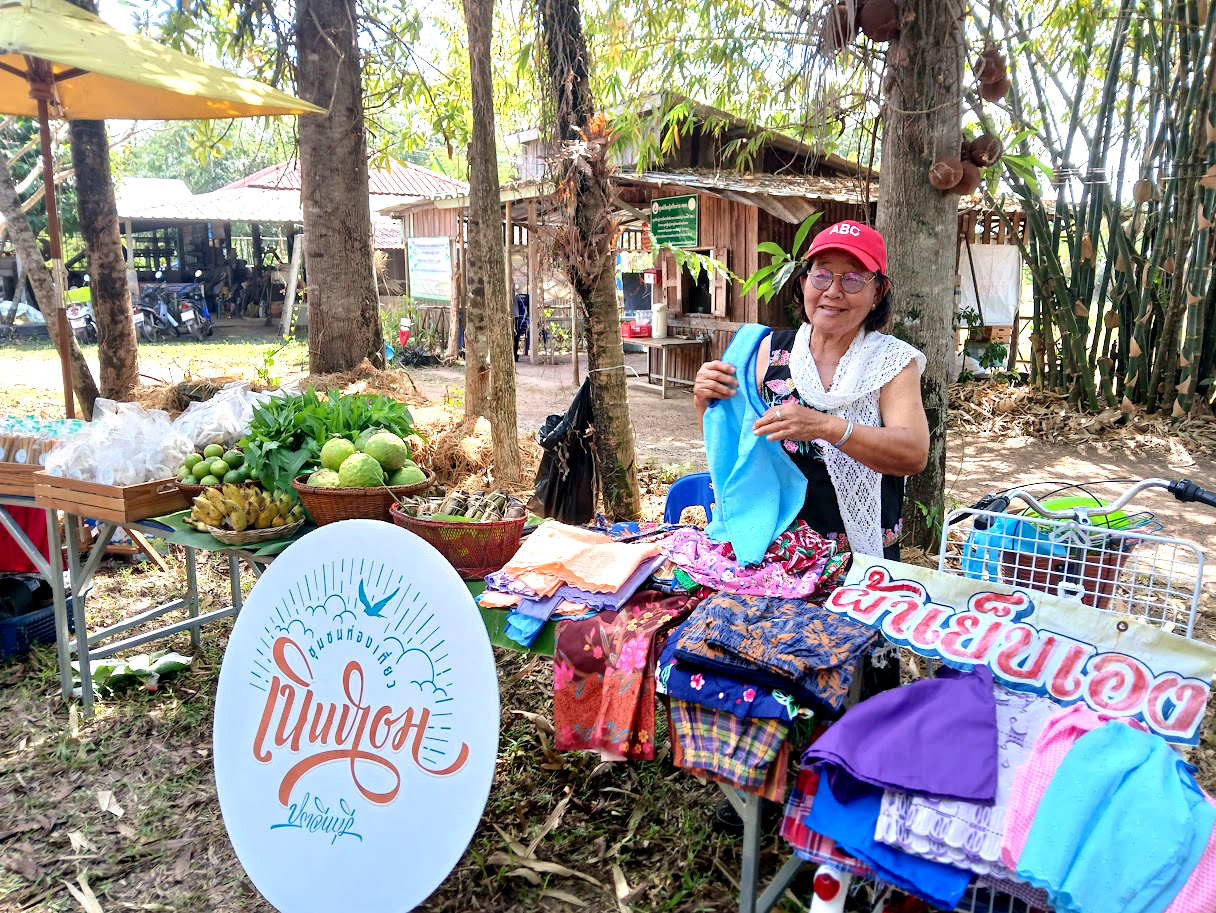
1) Transformation of Elderly Roles. Prior to the project, many elderly community members lived in social and economic dependency with limited social roles. The intervention facilitated a significant transformation in their status. From passive observers, they became cultural leaders—demonstrating traditional crafts, cooking local dishes, and guiding tourists along newly developed routes. Their participation grew from 40 to 80 individuals, with half assuming leadership or facilitative roles. This shift provided a new sense of purpose and revived social identity for the elderly.
2) Economic Empowerment. The economic benefits of the tourism activities, though modest, were meaningful. Elderly participants earned on average over 500 Baht per visitor session through services and product sales. While not a primary income source, this supplement helped reduce family burdens and boosted self-esteem. Fourteen local products—primarily herbal-based goods, handicrafts, and eco-friendly souvenirs—were successfully incorporated into the tourism offerings, adding economic diversity.
3) Community Infrastructure and Capacity Building. Six sites within the subdistrict were enrolled as community tourism destinations. One of them, the multipurpose pavilion at Wat Naprue, was fully upgraded to host tourist and training events, including workshops on artificial flower crafting. In response to infrastructure challenges, the local municipality initiated improvements, including plans to construct two accessible public toilets under the 2026 development budget. Training programs for tourism service delivery were organized, covering local guiding, basic hospitality, video editing with CapCut, and photography. These upskilling sessions led to high visitor satisfaction scores, affirming the quality and professionalism of the services offered.
4) Establishment of Sustainable Structures. To institutionalize the initiative, the community established the "Noen Hom Community Tourism Club," structured similarly to a village administrative committee. With dedicated roles for culinary services, hospitality, finance, music, and overall management, the club set four-year operational terms. Advisory support came from local government authorities and King Mongkut's University of Technology North Bangkok (Prachinburi Campus).
The club has since actively promoted Noen Hom as a creative tourism destination at the provincial level. It has welcomed educational and cultural exchange groups, such as faculty and students from Singapore Polytechnic. Such engagement demonstrates both the project's scalability and its relevance in broader contexts.
Discussion and Implications
The results demonstrate the effectiveness of participatory creative tourism as a tool for community revitalization, particularly in aging societies. Through inclusive engagement, the project managed to:
1) Bridge traditional knowledge with modern service practices.
2) Transform elderly residents from dependents into active contributors.
3) Promote sustainable income generation and community pride.
4) Build community-based organizational structures to maintain and scale tourism development.
These outcomes align with global frameworks on healthy aging and inclusive development. Moreover, the integration of cultural sustainability and economic empowerment positions the project as a model for similar rural or ethnically diverse communities.
Summary
This study contributes to a replicable, community-driven tourism framework that fosters active aging, strengthens local identity, and addresses socio-economic vulnerabilities. It underscores the value of using cultural capital not merely for preservation but as a living, evolving resource for sustainable development. Continued investment in community capacity, infrastructure, and intergenerational knowledge exchange will be vital for long-term success.
Article Details

This work is licensed under a Creative Commons Attribution-NonCommercial-NoDerivatives 4.0 International License.
Area Based Development Research Journal values copyright protection and licensing to safeguard author rights and facilitate the appropriate dissemination of research. Our policies ensure openness, accessibility, and attribution. Authors retain copyright ownership, and articles are published under a Creative Commons Attribution License (CC BY), allowing sharing, adaptation, and proper attribution. Authors have the freedom to publish under the CC BY license, granting broad reuse and distribution permissions. The journal supports posting articles on third-party repositories, adhering to institutional and funding restrictions. Author guidelines detail copyright and licensing requirements, empowering authors with knowledge about their rights and responsibilities. These policies cultivate an environment of collaboration, openness, and responsible sharing, benefiting authors and the research community while honoring intellectual property rights.
References
Boonto, P., Hongsakul, S., & Kasornbua, T. (2015). The rural tourism management on Thai home stay standard case study: Ban Dong, Tambol Dong Krathong Yam, Amphoe Si Maha Phot, Prachinburi Province. Srinakharinwirot Research and Development Journal, 7(14), 52–63. (in Thai).
Boonyanmethaporn, W., Pusiran, A. K., & Janin, Y. (2024). Towards tourists’ perspective: Creative tourism and its main characteristics. NIDA Development Journal, 64(1), 96-115. (in Thai). DOI: https://doi.org/10.14456/ndj.2024.4
Changsanoh, C. (2019). Universal design for museum and auditorium: Case study of Siam Niramitr and Museum of Contemporary Art. Sarasatr: Journal of Architecture and Design, 3(1), 27-40. (in Thai).
Chumkhet, S., Emphandhu, D., Kulachol, K. (2017). Guidelines of facilities design for all in national park. Built Environment Inquiry Journal, 16(2), 95-117. (in Thai).
Department of Provincial Administration. (2024). Population statistics from the civil registration, 2024. Retrieved October 10, 2024, from: https://stat.bora.dopa.go.th. (in Thai).
Kasornbua, T., & Sukpreeprem, P. (2024). Application of deming cycle in tourism management of Ban Noenhom Community, Muang District, Prachinburi Province. Suratthani Rajabhat Journal, 11(1), 58–97. (in Thai).
Kumruan, J., Chittithaworn, C., Chairat, P., & Phuripakdi, S. (2021). A study of the potential tourism attractions in Prachinburi Province. Journal of Nakhon Lampang Buddhist College’s Journal, 10(2), 189–198. (in Thai).
Kongkaew, P. C. (2024). Development of a construction model and utilization of biodiversity wisdom in temples and communities in Prachin Buri Province. Journal of MCU Peace Studies, 12(6), 2552–2563.
National Statistical Office. (2023). Number of tourists in Prachinburi Province, 2023. Retrieved June 12, 2025, from: https://prachinburi.gdcatalog.go.th/dataset/dataset_30_03/resource/f1c0c737-0b5c4baa-9ef3-4fd5e8ed94aa. (in Thai).
National Statistical Office. (2024a). Percentage of the elderly in Prachinburi Province. National Statistical Office. Retrieved April 30, 2025, from: https://pchburi.nso.go.th/statistical-information-service/key-indicators-of-the-province/percentage-of-theelderly.html. (in Thai).
National Statistical Office. (2024b). Population report of Noen Hom Subdistrict, 2024. Retrieved October 10, 2024, from: https://stat.bora.dopa.go.th. (in Thai).
Richards, G. (2021). An impact self-assessment tool for creative tourism with insights from its application to the CREATOUR project. In G. Richards & N. Duxbury (Eds.), Creative tourism: A global conversation (pp. 215–230). Retrieved April 30, 2025, from: https://www.researchgate.net/publication/355660457_An_impact_self-assessment_tool_for_creative_tourism_with_insights_from_its_application_to_the_CREATOUR_R_project.
Rueangsuk, V., Thongkaew, S., & Boonthawee, A. (2024). Cultural capital: Identity, beliefs, and local wisdom in Ban Pho District, Chachoengsao Province. Journal of the Association of Researchers, 29(4), 293–308. (in Thai).
Seaengthamthawee, K., & Panmaen, B. (2023). Universal design guidelines for facilities at Nonthaburi pier, Nonthaburi Province. The Journal of King Mongkut's University of Technology North Bangkok, 33(2), 648-659. (in Thai). DOI: https://doi.org/10.14416/j.kmutnb.2022.10.006
Sricharit, N., Na Thalang, C., Wongmontha, S., & Techakana, C. (2024). The development of creative tourism potentiality in Phatthalung Province. Journal of Business Administration and Social Sciences Ramkhamhaeng University, 7(2), 58-74. (in Thai).
Sukkasem, M. (2016). The guidelines of potential development of agro-tourism Tambon Dong Khilek, Muang District, Prachinburi Province. FEU Academic Review Journal, 10(4), 97–112. (in Thai).
Sukkasem, M., Jaroenwisan, K., & Pooripakdee, S. (2020). Knowledge management model of Prachinburi Province herbal city for wellness tourism. Dusit Thani College Journal, 14(2), 86–102. (in Thai).
Sukmaitree, J., Sangchan, B., Jakkapattarawong, S., & Rodjam, C. (2022). The active aging of elderly people in Mueang Ranong District, Ranong Province. Journal of MCU Social Science Review, 11(6), R155–R167. (in Thai).
Suriyothin, P., Katawandee, P., & Chotipanich, R. (2025). Leveraging cultural heritage to promote tourism through the historical tree trail on Sichang Island, Chonburi Province, Thailand. Area Based Development Research Journal, 17(1), 72–90. (in Thai).
Thahom, U., & Senarat, S. (2018). Application of cultural capital and local community development In the Northeastern region. Journal of Buddhist Studies Vanam Dongrak, 5(1), 15-24. (in Thai).
Thongdet, K., Ngammeerit, N., & Anusatsananon, S. (2021). A development of active aging indicators for Thai elderly. MBU Education Journal, 9(1), 83–92. (in Thai).
Turee, S., Jantararangsee, R., Chanthanasut, S., Chhinnasota, P., Boonsuk, T., & Rawichawakorn, T. (2024). Value creation of cultural capital through the imagery of Thung Luang Rangsit. Journal of Fine and Applied Arts Khon Kaen University, 16(2), 317–344. (in Thai).
United Nations. (2002). World population ageing: 1950–2050. New York: United Nations.
Vitsuthilak, S., Saipan, P., Tephalakul, O., & Sindetsarak, T. (2013). Creative tourism (Creative Tourism 21 Thailand). Designated Areas for Sustainable Tourism Administration (Public Organization). (in Thai).
Wongmonta, S. (2021). Creative tourism: An innovative movement of cultural tourism. Journal of Liberal Arts (Wang Nang Leng) RMUTP, 1(1), 1–24. (in Thai).
World Health Organization. (2002). Active ageing: A policy framework. Geneva: WHO.
