
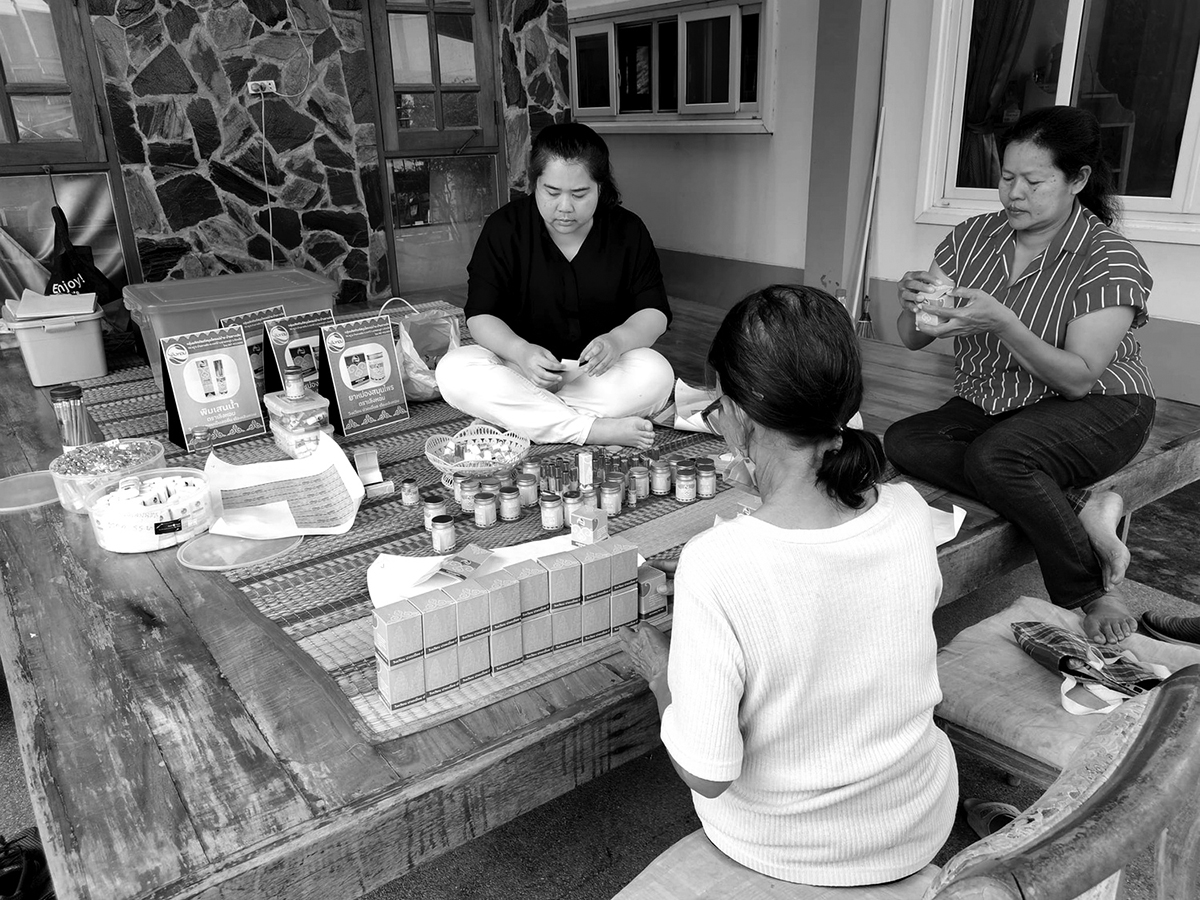
Design and Development of Packaging and Branding Applying the Thung Kula Ronghai Cultural Capital: Herbal Product Group Satri Maeban, Ban Yang Leng, Suwannaphum District, Roi Et Province, Thailand
Article Sidebar
Main Article Content
Abstract
Background: The Ban Yang Leng Housewives Herbal Product Community Enterprise, located in Dokmai Subdistrict, Suwannaphum District, Roi Et Province, northeastern Thailand, consists of 20 local women producing herbal products such as balm sticks and camphor oil under the “Leng Hom” brand. Products are distributed through the community enterprise office and at local festivals across Suwannaphum District. However, the enterprise faced several product and marketing limitations that hindered competitiveness and sustainability. The balm stick packaging was inadequately sealed, leading to melting and leakage under high regional temperatures (often exceeding 35°C). The camphor oil was packaged in fragile roll-on glass bottles prone to breakage during transport. Additionally, the packaging design was conventional and failed to reflect the unique cultural identity, traditional wisdom, and craftsmanship of the Thung Kula Ronghai region.
Objectives and Methodology: This research aimed to enhance the market value and identity of Leng Hom herbal products through innovative packaging and branding that draw upon the cultural capital of Thung Kula Ronghai. A participatory action research (PAR) approach was employed to ensure community engagement throughout. Data were collected through interviews with six community leaders and enterprise members, four local cultural experts, three packaging design specialists, and 80 tourists representing potential consumers.
The research comprised six phases:
1) Documenting the tangible and intangible cultural capital of Thung Kula Ronghai, including the Ku Ka Sing Ancient Monument, Si Phum silk patterns, Bun Bang Fai motifs, Leng Khi Tun tourist attraction, and the legend of the Samang flower field;
2) Identifying key cultural identities suitable for integration into branding;
3) Designing packaging and branding concepts derived from these identities, including logo creation and container redesign;
4) Registering the “Leng Hom” trademark (No. 251117285);
5) Producing and testing prototypes for usability, durability, and quality protection; and
6) Conducting market testing at the OTOP (One Tambon One Product) Center in Mueang District, Roi Et Province.
Results and Findings: The new packaging effectively preserved product quality while conveying local identity through colors, patterns, and motifs inspired by Thung Kula Ronghai’s landscape and traditions. The Leng Hom logo integrated local symbolism, creating emotional resonance with producers and consumers alike. The redesigned containers were more durable, practical, and visually appealing, enhancing product recognition and shelf presence. Following trademark registration and redesign, profits rose substantially—camphor oil by 350% per month and balm sticks by 37.25%.
Participatory workshops deepened members’ understanding of community identity and its value as cultural capital. Members actively contributed to packaging design, color selection, slogans, and brand development, fostering a strong sense of ownership and unity. Monthly meetings were institutionalized for decision-making, progress tracking, and conflict resolution, strengthening group cohesion and accountability.
The Leng Hom products are now continuously sold through OTOP centers and social media, expanding their market reach. Customers report improved satisfaction and higher brand recognition, resulting in increased repeat purchases. The enterprise has become a model for rural women’s empowerment through the creative use of local wisdom and design innovation.
The project’s outcomes can be categorized into social, economic, and cultural dimensions.
1) Social Impacts: The initiative enhanced members’ confidence, self-worth, and leadership. Women who once viewed themselves as economically inactive are now central to production, marketing, and management. The strengthened sense of ownership and shared responsibility fostered greater participation in community activities and social welfare. Monthly meetings, transparent communication, and rotating committee roles helped maintain engagement and resolve conflicts, building long-term resilience. The enterprise is now positioned to transfer knowledge to younger generations and neighboring communities, ensuring continuity of local wisdom and sustainable development.
2) Economic Impacts: Integrating design knowledge into product development allowed the enterprise to translate Thung Kula Ronghai’s cultural motifs into marketable packaging. The distinctive branding increased product visibility, expanded market access, and diversified income streams through OTOP and online sales channels. The group achieved stable profit growth and now serves as a benchmark for rural microenterprises using cultural capital for value creation. Future directions include developing new herbal products, optimizing costs, and protecting brand authenticity. Strategic digital marketing and cost management will further sustain profitability and strengthen the community’s economic foundation.
3) Cultural Impacts: The creative adaptation of Thung Kula Ronghai’s cultural heritage—through motifs, storytelling, and indigenous herbs—preserves and revitalizes local identity while generating economic and social value. By linking local narratives to branding and educational activities, the project demonstrated that culture can serve as both an economic and intellectual asset. However, cultural commercialization requires sensitivity to prevent misrepresentation or loss of authenticity. Sustainable development should emphasize community consent, fair benefit-sharing, and ethical branding to maintain cultural integrity.
Conclusions: The Ban Yang Leng Housewives Herbal Product Community Enterprise exemplifies how local cultural capital, when creatively applied through participatory design and branding, can generate social empowerment, economic vitality, and cultural sustainability. The Leng Hom brand stands as a testament to the potential of rural Thai communities to integrate tradition and innovation—transforming pride in place into prosperity and resilience for future generations.
Article Details

This work is licensed under a Creative Commons Attribution-NonCommercial-NoDerivatives 4.0 International License.
Area Based Development Research Journal values copyright protection and licensing to safeguard author rights and facilitate the appropriate dissemination of research. Our policies ensure openness, accessibility, and attribution. Authors retain copyright ownership, and articles are published under a Creative Commons Attribution License (CC BY), allowing sharing, adaptation, and proper attribution. Authors have the freedom to publish under the CC BY license, granting broad reuse and distribution permissions. The journal supports posting articles on third-party repositories, adhering to institutional and funding restrictions. Author guidelines detail copyright and licensing requirements, empowering authors with knowledge about their rights and responsibilities. These policies cultivate an environment of collaboration, openness, and responsible sharing, benefiting authors and the research community while honoring intellectual property rights.
References
Asawangkura, C. (2005). Design that delights. Bangkok: Supporting Industries Development Division, Department of Export Promotion. (in Thai)
Braun, V., & Clarke, V. (2006). Using thematic analysis in psychology. Qualitative Research in Psychology, 3(2), 77-101. DOI: https://doi.org/10.1191/1478088706qp063oa
Chankitchanyo, T. (2022). An engaging logo and packaging design: The case study of Sang Tawan Community Enterprise Group, Sam Khok District, Pathum Thani Province. Burapha Arts Journal, 25(1), 35–51. (in Thai).
Janklab, E. (2020). Cultural capital management guidelines for promoting creative economic development: A case study of the Nakhon Si Thammarat Provincial Cultural Office. (Master’s thesis) Faculty of Political Science, Chulalongkorn University. (in Thai).
Kaewkamon, K., Thaotong, N., Rosruen, S., Pechchan, A., Ratanasupa, A., & Phutiariyawat, J. (2021). Manipulation of cultural capital for sustainable community development. Journal of Humanities and Social Sciences Academic, 11(1), 75–91. (in Thai).
Kasemsuk, C. (2018). Public participation approach for sustainable community development. Journal of Humanities and Social Sciences, 26(50), 169-186. (in Thai).
Kiansawathana, K. (2024). Souvenir business management for the tourism industry (1st ed.). Bangkok: Siam Chulalamondol Publishing. (in Thai)
Lunlalin Thaisilk. (2024). Sri Phumi pattern silk. Retrieved March 16, 2024, from: https://www.facebook.com/photo?fbid=784592880118840&set=pcb.784592940118834 (in Thai)
National Economic and Social Development Council. (2022). The 13th National Economic and Social Development Plan (2023–2027). Bangkok: NESDC. (in Thai)
Paklamjeak, M. (2015). Packaging knowledge. Bangkok: Jindasan Printing Co., Ltd. (in Thai)
Pinkaeo, K. (2011). Creative economy, cultural capital, and business opportunities. Executive Journal, 31(1), 32-37. (in Thai)
Prathet Roi Et. (2024). Adisak Sasiri was mentioned in a simulated image of "Ku Ka Sing", Kaset Wisai District, Roi Et Province. Retrieved February 15, 2024, from: https://www.facebook.com/Roiet.Station101/posts/pfbid0FyoU2mB714R68LpJ4pPWnxMrE4pfH6S6HCSguFn6EDvz83xe7upv9qbktY1fqFKil (in Thai)
Panpaisarn, U., & Morathob, N. (2024). Development process of brand identity and community participatory packaging of Ban Sao Luang Weaving Group Community Enterprise, Bo Suak Sub-district, Mueang District, Nan Province. Sripatum Review of Humanities and Social Sciences, 24(1), 68–81. (in Thai).
Roi Et Provincial Office. (2023). Roi Et Province 20-Year Development Plan (2023–2042). Roi Et: Roi Et Provincial Office. (in Thai)
Saengngam, A. (2015). Ku Ka Sing: Community-based tourism (1st ed.). Kalasin: Prasan Kanphim. (in Thai)
Sukkapap Didi. (2024). Water caltrop: A medicinal herb for all genders and ages. Retrieved February 15, 2024, from: https://sukkrapab.blogspot.com/2018/03/blog-post_47.html (in Thai)
Suwanthada, P., & Sikha, S. (2018). Community product design and development applying the cultural capital and wisdom: In the Upper Northeastern region. Art and Architecture Journal Naresuan University, 9(2), 137-155. (in Thai).
Tangpornprasert, P. (2024). Visual arts: Graphic design. Bangkok: Samlada. (in Thai)
Talaluck, M., Sonyon, T., & Intum, P. (2019). Design of local identity on the packages for the community enterprise of Ban Soa Luang, Bor Suak subdistrict, Nan province. RMUTL Journal Socially of Engaged Scholarship, 3(1), 11-18. (in Thai).
Tiwasing, W. (2017). Graphic design on cosmetic package for promoting silk innovation center (SIC) of Mahasarakham University. Art and Architecture Journal Naresuan University, 8(2), 10-22. (in Thai).
Vanichakorn, A. (2016). Local product design (1st ed.). Bangkok: Chulalongkorn University Press. (in Thai)
Wiwithrukunkasem, K., & Chaiupala, S. (2017). The development of souvenirs to represent the Luang Prabang local identity. Asian Creative Architecture, Art and Design, 24(1), 65-77. (in Thai).
