
IoT Technology Proactive Disaster Prevention Prototype in 999 Herbal Learning Center, High-Tech Khok Nong Na Bamboo Garden for Developing Livelihoods in Laokhwan District, Kanchanaburi Province, Thailand
Article Sidebar
Main Article Content
Abstract
Background and Objectives: Nongsano Subdistrict, Lao Khwan District, Kanchanaburi Province, Thailand, is a recurring disaster area frequently affected by droughts and windstorms, which cause severe damage to agricultural yields and livelihoods. In response to these challenges, this research transformed the arid land into the 999 Herbal Learning Center, High-Tech Khok Nong Na Bamboo Garden for Developing Livelihoods—a model area integrating Internet of Things (IoT) technology for natural disaster prevention and sustainable agricultural development. The project aimed to demonstrate how modern technology, combined with the Khok Nong Na model and New Theory Agriculture principles, could restore degraded land, improve self-reliance, and strengthen local livelihoods.
Methodology: The project employed a participatory action research (PAR) approach to engage local farmers, community leaders, and administrative organizations in technology-driven adaptation for disaster resilience. The process consisted of five key stages:
1) Design and Development of IoT Systems for Disaster Prevention: IoT technologies were developed and installed to monitor and mitigate environmental risks. These included (a) a disaster warning system using the Blynk mobile application, (b) a cloud-attraction system for artificial rainfall induction, (c) a misting system to reduce dust and atmospheric temperature, (d) a drip irrigation system for soil cooling and drought prevention, and (e) a water-level monitoring system to prevent reservoir depletion. An Ecowitt automatic weather station was also installed to record real-time weather data for comparison with IoT sensor data, ensuring accurate environmental tracking.
2) Web Application Development: A web-based dashboard was created to display real-time weather data from the learning center, integrated with radar information from the Thai Meteorological Department’s platform (weather.tmd.go.th). The system enables both local residents and the general public to access up-to-date environmental data, facilitating timely responses to sudden climatic changes.
3) Knowledge Transfer and Capacity Building: Training sessions and workshops were conducted to transfer knowledge about IoT applications for disaster prevention to community leaders, subdistrict and district administrators, and local farmers. These sessions raised awareness about the potential of technology to mitigate drought and wind damage while promoting the adoption of modern agricultural innovations.
4) Integration into Local Development Plans: The IoT installation project was formally incorporated into the Nongsano Subdistrict development plan, ensuring long-term institutional support and expanding the use of technology across the entire subdistrict and neighboring areas.
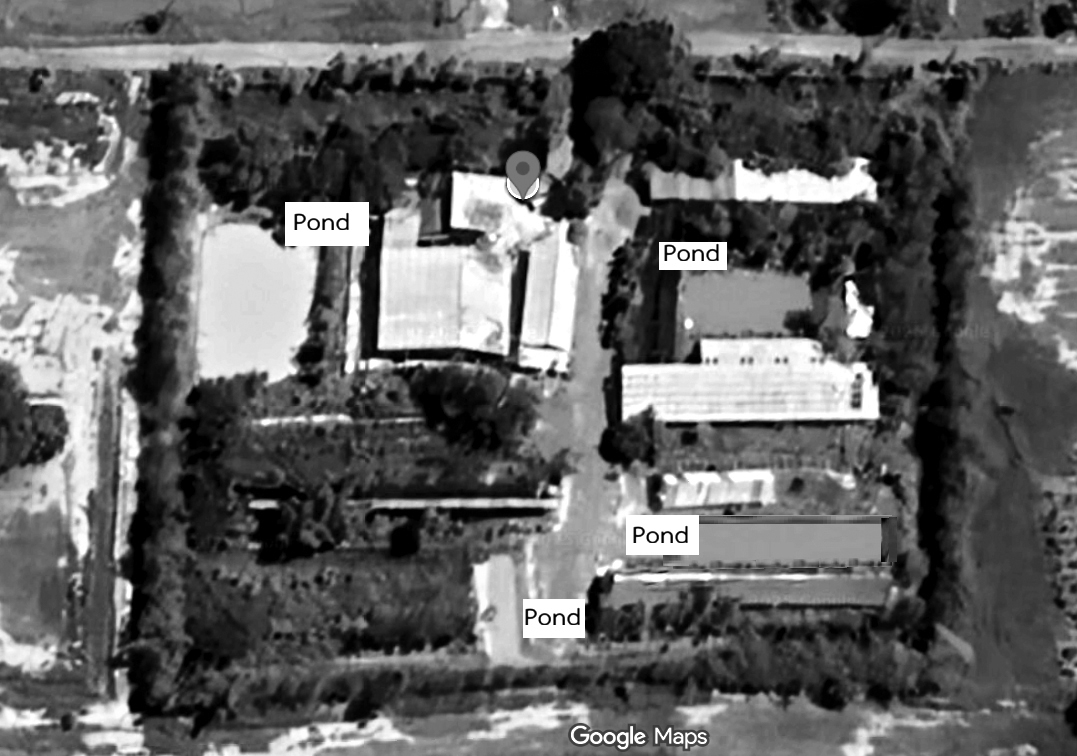
5) Transformation of Degraded Land into a Learning Center: The 999 Herbal Learning Center was established on four rai (1.6 acres) of previously barren land that had no trees in 2021. A 4-meter-deep reservoir covering approximately 1.2 rai (30% of the total area) was excavated, with a storage capacity of 7,000 cubic meters—sufficient to collect rainwater during heavy rainfall and supply irrigation throughout the dry season. Around the reservoir, 999 species of herbs (approximately 1,000 plants) were cultivated using precision drip irrigation. The surrounding bamboo belt helped reduce ambient temperature by 3°C, increased relative humidity by 10%, and served as a natural windbreak against summer storms.
Results and Findings: The integration of IoT with the Khok Nong Na model successfully improved microclimatic conditions, soil moisture stability, and ecosystem resilience. During the summer storm season of 2025, the learning center suffered no structural damage—demonstrating the protective efficiency of its bamboo buffer and drip irrigation system. The project became a district-level model learning center in 2023 under the “One District, One Royal Initiative Learning Center” program and was later recognized as a provincial model in 2024.
Thirty households adopted the model, each converting one rai of land from monoculture to integrated farming, creating a total of 30 rai of sustainable green space. Members applied New Theory Agriculture principles by dividing land for reservoirs, mixed-crop cultivation, and herbal planting. The project improved year-round water availability, diversified household income, and enhanced food and medicinal self-sufficiency.
To sustain the IoT system, the community established a maintenance fund by allocating 10% of income from all product sales to support equipment repair, upgrades, and technological expansion. Over 3,000 people from Lao Khwan District and other provinces have since participated in hands-on learning visits, gaining knowledge applicable to their local contexts. The center now serves as a national model for integrating smart agriculture and local wisdom to build community resilience.
Impacts and Sustainability: The impacts of this initiative can be summarized in three interrelated dimensions:
1) Social Impacts: The project enhanced local participation and collective responsibility. Farmers developed positive attitudes toward sustainable land use, water conservation, and forest restoration following the “five-layer forest” principle. Women and youth gained new vocational skills in herbal processing, packaging, and online marketing, contributing to daily, weekly, and monthly income streams. The learning center was formally registered as a farmer organization under the Kanchanaburi Provincial Farmers Council, signifying institutional recognition of community leadership.
2) Economic Impacts: Through integrated herbal and mixed farming, household incomes increased measurably. The diversification of crops and the introduction of value-added herbal products helped reduce production risks and create steady income sources. The model has been identified by the Kanchanaburi Provincial Farmers Council (2025) as a Success Case for agricultural disaster prevention and innovation-driven rural enterprise development.
3) Environmental Impacts: The project restored degraded land, improved biodiversity, and reduced the local temperature and dust levels. The efficient use of water and energy through IoT-controlled systems exemplifies climate-smart agriculture. By balancing technology with ecological principles, the center became a sustainable food and herbal production site resilient to climate variability.
Conclusions: The 999 Herbal Learning Center, High-Tech Khok Nong Na Bamboo Garden for Developing Livelihoods demonstrates how the integration of modern IoT technology with traditional agricultural wisdom can transform disaster-prone drylands into productive, self-reliant learning ecosystems. The initiative not only revitalized the landscape and strengthened livelihoods but also established a replicable model of sustainable community-based disaster prevention and smart farming for Thailand’s arid regions.
Article Details

This work is licensed under a Creative Commons Attribution-NonCommercial-NoDerivatives 4.0 International License.
Area Based Development Research Journal values copyright protection and licensing to safeguard author rights and facilitate the appropriate dissemination of research. Our policies ensure openness, accessibility, and attribution. Authors retain copyright ownership, and articles are published under a Creative Commons Attribution License (CC BY), allowing sharing, adaptation, and proper attribution. Authors have the freedom to publish under the CC BY license, granting broad reuse and distribution permissions. The journal supports posting articles on third-party repositories, adhering to institutional and funding restrictions. Author guidelines detail copyright and licensing requirements, empowering authors with knowledge about their rights and responsibilities. These policies cultivate an environment of collaboration, openness, and responsible sharing, benefiting authors and the research community while honoring intellectual property rights.
References
Akkarapongpaiboon, T., Chirinang, P., Raktham, A., & Fuangchan, S. (2020). Integrated of disaster management in the 4.0. Journal of Administrative and Management, 8(3), 14-23. (in Thai).
Beltran, A. A., Dizon, K. J. T., Nones, K. C., Salanguit, R. L. M., Santos, J. B. D., & Santos, J. R. G. (2021). Arduino-based disaster management alarm system with SMS. Journal of Robotics and Control (JRC), 2(1), 24–28. DOI: https://doi.org/10.18196/jrc.2147.
Byaruhanga, N., Kibirige, D., Gokool, S., & Mkhonta, G. (2024). Evolution of flood prediction and forecasting models for flood early warning systems: A scoping review. Water, 16(13), 1763.
Chiamsathit, C., Janya, S., & Khumnyos, P. (2020). Community participation in the solutions to recurrent flooding and water shortages of Banchan village, Kalasin Province. Area Based Development Research Journal, 12(6), 416-431. (in Thai).
Decharoenchitpong, J., & Tortrakul, P. (2019). The development of dust detection and warning system prototypes by internet of things. Journal of Science and Technology Thonburi University, 3(1), 34-43. (in Thai).
Department of Disaster Prevention and Mitigation. (2024a). Disaster Statistics Year 2024. Retrieved June 1, 2025, from: https://datacenter.disaster.go.th/datacenter/cms/8670?id=132971. (in Thai).
Department of Disaster Prevention and Mitigation. (2024b). Criteria for Emergency Disaster Relief Assistance for PM2.5 Fine Dust Incidents. Retrieved June 1, 2025, from: https://backofficeminisite.disaster.go.th/apiv1/apps/minisite_srn/204/sitedownload/10827/downloadTypeMenu=InnerMenu&filename=c6ecd86d6c3cbe8f9afe12271fcf64fe.pdf. (in Thai).
Hydroinformatics Institute Public Organization. (2022). Rainfall Report System. Retrieved June 1, 2025, from: https://tiservice.hii.or.th/WRMOC/web/V2/mRainAmp1.html. (in Thai).
Kamching, R., & Homhuan, S. (2020). Information system for supporting surveillance and warning of natural disasters, Uttaradit Province. Area Based Development Research Journal, 12(4), 272–288.
Kanchanaburi Provincial Office of Disaster Prevention and Mitigation. (2024). Disaster Area Declaration. Retrieved June 1, 2025, from: https://kri.disaster.go.th/kri/download?id=7309. (in Thai).
Kanchanaburi Provincial Statistical Office. (2022). Kanchanaburi Provincial Statistical Report. Retrieved June 1, 2025, from: https://kanchanaburi.nso.go.th/images/Kanchanaburi_Province_Statistical_Report/pdf/4.pdf. (in Thai).
Kesaro, K., Chimhad, P., Kongkawhai, S., & Dhanabhaddo, T. (2024). The king’s science and the development of buddhist public welfare. Journal of Social Science and Cultural, 8(9), 315-323. (in Thai).
Laokwan District Agricultural Office. (2024). Meeting of the Kanchanaburi Provincial Disaster Assistance Committee. Retrieved June 1, 2025, from: https://kanchanaburi.doae.go.th/laokhwan/?p=2286
Meechai, W., Khonkaen, P., Chuesaard, T., Kruama, K., Pakketanang, J., Chamchoi, Y., & Kamyo, T. (2025). The impacts of El Niño and La Niña phenomena on land surface temperature changes due to different land uses in Phrae Province. Thai Forest Ecological Research Journal, 9(1), 93-110. (in Thai).
Mungkalarungsi, S., & Katsanook, S. (2025). Assess the knowledge and awareness of disaster risks among 15 -60 years old in Chiang Mai. Journal of Academic for Public and Private Management, 7(1), 354-367. (in Thai).
NongSano Subdistrict Administrative Organization. (2023). Local Development Plan B.E. 2566 – 2570, Nong Sano Subdistrict Administrative Organization, Lao Khwan District, Kanchanaburi Province. Retrieved June 1, 2025, from: http://ridceo.rid.go.th/kanchana/v2/Amphoe/sb%202/lao%20khwan/nong%20sano.pdf. (in Thai).
Office of Agricultural Natural Resources and Environmental Planning. (2011). Sustainable Agriculture. Retrieved June 1, 2025, from: https://www.nesdc.go.th/ewt_w3c/ewt_dl_link.php?nid=2700. (in Thai).
Panyaprouks, S., Aridech, P., Tewiya, S., & Chuenchit, T. (2024). Developing activities to enhance disaster learning for kids and youth Chiang Rai. Journal of Graduate Research, 15(2), 1-19. (in Thai).
Paranan, M., & Petchwattananone, J. (2022). A study of IoT with ICT implementation in Bang Nam Phung floating Market 4.0. Journal of Science and Technology RMUTSB, 5, 24-39. (in Thai).
Paranan, M., & Sangdee, J. (2023). The model of integrated high-value agriculture in water-scarce areas using IoT technology and big data analytics: A case study of local wisdom information on thai herbs. In Proceeding of Academic Conference on Health Impact Assessment: Sharing and Learning 2023 "Health Impact Assessment for Sustainable Future Well-being Opportunities and Challenges", p.285-296, Songkla University, Songkhla. (in Thai).
Punpitak, S., Dongsongkram, K., OnLoa, S., Yuttaart, K., & Pimpasi, U. (2021). Development of automatic irrigation controller system using wireless sensor to increase sugarcane production. Journal of Applied Information Technology, 7(2), 17-30. (in Thai).
Ruangsang, S. (2024). The new theory agriculture basing on philosophy of sufficiency economy for live quality development of farmers and community. Journal of MCU Palisueksabuddhaghosa Review, 10(2), 301-316. (in Thai).
Saiyotdtong, N., Chamchoy, V., & Bodeerat, C. (2020). Disaster and management of Thai farmers. Journal of Modern Learning Development, 5(4), 173-184. (in Thai).
Siripanth, C., Tantra, S., & Jobkonsuek, P. (2025). Weather alert system for air cadet training using IoT. NKRAFA Journal of Science and Technology, 21(1), 94-106. (in Thai).
Sub-district Administrative Organization Nong Sano. (2023). General Information. Retrieved June 1, 2025, from: https://nongsano-kan.go.th/public/texteditor/data/index/menu/498
Thai Meteorological Department. (2025). Natural Disasters in Thailand. Retrieved June 1, 2025, from: https://tmd.go.th/media/_info/risk.pdf. (in Thai).
Zakaria, M. I., Jabbar, W. A., & Sulaiman, N. (2023). Development of a smart sensing unit for LoRaWAN-based IoT flood monitoring and warning system in catchment areas. Internet of Things and Cyber-Physical Systems, 3, 249–261.
