
High-Efficiency Mushroom Spawn Production Innovation in Mushroom-Producing Communities of Uttaradit Province and Nan Province, Thailand
Article Sidebar
Main Article Content
Abstract
Background: Mushroom cultivation is an important livelihood activity in northern Thailand, particularly in community-based production systems that supply fresh mushrooms to local and regional markets. In Uttaradit and Nan provinces, fourteen farms in Uttaradit and ten farms in Nan producing Bhutanese oyster mushrooms, oyster mushrooms, and wood ear mushrooms faced persistent production challenges. These included high contamination rates of Trichoderma fungi (5–9%), low yields of less than 250 grams per mushroom block, and elevated production costs. The root causes were identified as inadequate sterilization procedures, poor contamination control during spawn inoculation, and reliance on traditional substrate formulations for mushroom blocks that were not optimized for local environmental conditions. These constraints limited productivity, reduced income stability, and increased losses from contaminated mushroom blocks.
Objectives: This study aimed to develop and implement a high-efficiency mushroom block production system that reduces fungal contamination, increases yield, lowers production costs, and strengthens economic, social, and environmental sustainability in mushroom-producing communities. The project also sought to enhance farmers’ technical capacity through participatory knowledge transfer and to demonstrate scalable area-based innovation aligned with local resources and the sufficiency economy philosophy.
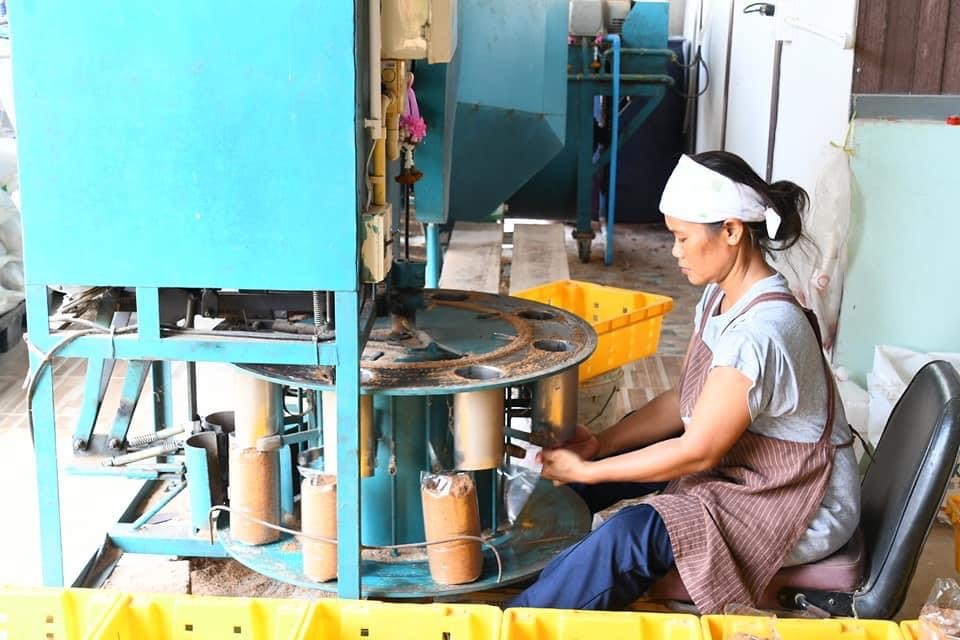
Methodology: The intervention followed a participatory, multi-stage approach. First, the project fostered awareness and shared understanding through study visits, researcher–farmer knowledge exchange, and systematic knowledge management. These activities culminated in the development of a high-efficiency mushroom block production manual covering four critical stages: (1) mushroom block formulation, (2) sterilization processes, (3) spawn inoculation, and (4) incubation and fruiting management. Second, structured training and on-site learning were conducted, combining theoretical instruction with hands-on mushroom block production and direct technology transfer. Farmers were encouraged to adapt high-efficiency production techniques to their local contexts rather than applying a rigid, standardized model. Third, production procedures were improved through individualized coaching and repeated practice. Farmers in selected subdistricts applied refined sterilization, inoculation, and substrate management methods. Microbiological quality was monitored by measuring yeast and mold contamination, heavy metal residues, and Trichoderma infection rates in mushroom blocks.
Results and Findings: The improved production system yielded significant technical and economic gains. High-efficiency mushroom blocks showed yeast and mold contamination levels of 8.6 × 10³ cfu/g, within acceptable safety thresholds (<10.0 × 10³ cfu/g), with no detectable lead or cadmium residues. The Trichoderma contamination rate declined dramatically from 5.8% to 0.1%, representing a 98.5% reduction. Across seven subdistricts, farmers collectively produced 1,248,000 mushroom blocks per year. Improvements in spawn inoculation practices reduced spawn usage per farm and lowered overall production costs by 21.4%. Average mushroom yield increased from 224.8 grams per block to 327.1–342.3 grams per block, corresponding to a 45.5–50.4% increase and an overall productivity gain of approximately 47.5%. These gains translated directly into improved incomes. Farmers earned an additional 45,504–164,592 THB per year (1,516.80 - 5,486.4 USD/Year) from reduced losses and higher yields. Cost savings from reduced spawn usage amounted to 6,000–18,000 THB per year per farm (200 - 600 USD/Year/Farm). Income from increased production rose by 45.3–52.3%, equivalent to 106,995–123,375 THB annually (3,566.50 - 4,112.50 USD/Year). Total net income gains ranged from 158,499 to 305,967 THB per year (5,283.30 - 10,198.90 USD/Year).
Outcome, Impacts and Sustainability: The new mushroom fruiting management system cut the amount of working capital needed by up to four times. For example, farmers producing 10,000 blocks could stagger purchases in four cycles of 2,500 blocks, reducing initial capital requirements from 80,000 THB to 20,000 THB (2,666.67 - 666.67 USD) while maintaining continuous monthly income from staggered harvests. Socially, mushroom producers in Uttaradit established a cooperative network to exchange knowledge and jointly procure production materials, reducing input costs and strengthening collective capacity. Increased production also generated local employment, including seasonal jobs for students during school holidays. The innovation focused on making the best use of agricultural waste products that are available in the area, like rice straw, sawdust, rice husk, and other by-products. This approach reduced production costs, improved mushroom quality, and mitigated environmental problems associated with agricultural waste burning.
Article Details

This work is licensed under a Creative Commons Attribution-NonCommercial-NoDerivatives 4.0 International License.
Area Based Development Research Journal values copyright protection and licensing to safeguard author rights and facilitate the appropriate dissemination of research. Our policies ensure openness, accessibility, and attribution. Authors retain copyright ownership, and articles are published under a Creative Commons Attribution License (CC BY), allowing sharing, adaptation, and proper attribution. Authors have the freedom to publish under the CC BY license, granting broad reuse and distribution permissions. The journal supports posting articles on third-party repositories, adhering to institutional and funding restrictions. Author guidelines detail copyright and licensing requirements, empowering authors with knowledge about their rights and responsibilities. These policies cultivate an environment of collaboration, openness, and responsible sharing, benefiting authors and the research community while honoring intellectual property rights.
References
Aydoğdu, M. (2024). Efficacy of disinfectants and heat treatments against green mould in casing soil and button mushroom (Agaricus bisporus) yield. Phytoparasitica, 52, 51. DOI: https://doi.org/10.1007/s12600-024-01168-0.
Boonchouytan, W., Chatthong, J., & Pongpiriyadecha, N. (2023). Development of mixing and pressing processes of split-gill mushroom spawn blocks. Proceedings of Engineering and Technology Innovation, 24, 63-72.
Chan, X. Y., Saeidi, N., Javadian, A., Hebel, D. E., & Gupta, M. (2021). Mechanical properties of dense mycelium-bound composites under accelerated tropical weathering conditions. Scientific Reports, 11, 22112. DOI: https://doi.org/10.1038/s41598-021-01598-4.
Chieochan, O., Saokaew, A., & Boonchieng, E. (2017). IoT for smart farm: A case study of the Lingzhi mushroom farm at Maejo University. In: Proceedings of the 14th International Joint Conference on Computer Science and Software Engineering (JCSSE), 12-14 July 2017, Nakhon Si Thammarat, Thailand.
Cikarge, G. P., & Arifin, F. (2018). Oyster mushrooms humidity control based on fuzzy logic by using Arduino ATMega238 microcontroller. Journal of Physics: Conference Series, 1140, 012002. DOI: https://doi.org/10.1088/1742-6596/1140/1/012002.
Grimm, D., Sonntag, E., & Rahmann, G. (2024). Evaluation of different pasteurization and sterilization methods for oyster mushroom substrates. Journal of Microbiology Biotechnology and Food Sciences, 13(5), e10428. DOI: https://doi.org/10.55251/jmbfs.10428.
Hunheng, N. (2016). Study of physical factors affecting relative humidity and temperature inside the breeding room gray oyster mushrooms which are made from cement ponds following the model of cold storage clay pots. (Research report). Chonburi: Burapha University. (in Thai).
Jeznabadi, E. K., Jafarpour, M., & Eghbalsaied, S. (2016). King oyster mushroom production using various sources of agricultural wastes in Iran. International Journal of Recycling of Organic Waste in Agriculture, 5, 17-24.
Kamonkunanon, S., Chutchaidej, E., Wittanalai, S., Rangsisuttaporn, K., Mueangtoom, K., & Thanompongchart, P. (2025). Innovation in the controlled production of oyster mushrooms in community greenhouses of mushroom producers, Uttaradit Province, Thailand. Area Based Development Research Journal, 17(1), 1-17. (in Thai).
Kamonkunanon, S., Jaruwatcharaset, C., Khumfu, P., Ketviriyakit, C., Songneam, N., & Supawantanakul, D. (2024). Comparison of gray oyster mushroom production in a smart farm and traditional farm. Wittayasara: Integration Apply Engineering and Industrial Technology, 17(1), 29-41. (in Thai).
Kamonkunanon, S., & Khumfu, P. (2024). Production of spawned spawn traceable for precision agriculture. (Research report). Uttaradit: Uttaradit Rajabhat University. (in Thai).
Kamonkunanon, S., & Thammawongsa, N. (2019). Development of a closed system mushroom cultivation house using technology to increase the cultivation model of Thai farmers. (Research report). Uttaradit: Uttaradit Rajabhat University. (in Thai).
Kamonkunanon, S., & Thanompongchart, P. (2020). The evaporation sprayer in a closed system farm for agriculture. (Research report). Uttaradit: Uttaradit Rajabhat University. (in Thai).
Kamonkunanon, S., Songneam, N., Supawantanakul, D., & Siringam, T. (2022). A study of factor of production for cool group of mushrooms in smart farm using Internet of Things technology. In: Proceedings of 8th Loei Rajabhat University Conference 2022, 25 March 2022, Loei, Thailand. (in Thai).
Mata, G., Savoie, J., Delpech, P., & Olivier, J. M. (1998). Reductions in the incidence of Trichoderma spp. using substrate supplementation with peat and an alternative spawn during cultivation of Lentinula edodes on pasteurised wheat straw. Agronomie, 18(8-9), 515-520. DOI: https://doi.org/10.1051/agro:19980802.
Ministry of Agriculture and Cooperatives. (2012). Good agricultural practices for bag-cultivated mushrooms. Bangkok: National Bureau of Agricultural and Food Standards. (in Thai).
Ministry of Agriculture and Cooperatives. (2020). Good practices for mushroom spawn production. Bangkok: National Bureau of Agricultural and Food Standards. (in Thai).
National Science and Technology Development Agency. (2021). Collection of data on production and marketing of economic mushrooms and wild edible mushrooms in Thailand. Retrieved October 21, 2021, from: https://waa.inter.nstda.or.th/stks/pub/2021/20210817-economic-mushroom-market.pdf. (in Thai).
Office of Agricultural Research and Development Region 1. (2022). Low carbon mushroom production. Retrieved October 21, 2025, from: https://www.doa.go.th/rdpd/wp-content/uploads/2024/11/%E0%B8%AA%E0%B8%A7%E0%B8%9E.1-%E0%B9%80%E0%B8%AB%E0%B9%87%E0%B8%94-LOW-CARBON.pdf. (in Thai).
Pardo-Giménez, A., González, J. E. P., Dias, E. S., Rinker, D. L., Caitano, C. E. C., & Zied, D. C. (2020). Optimization of cultivation techniques improves the agronomic behavior of Agaricus subrufescens. Scientific Reports, 10, 8154 . DOI: https://doi.org/10.1038/s41598-020-65081-2.
Phithakrotchanakoon, C., Mayteeworakoon, S., Siriarchawatana, P., Kitikhun, S., Harnpicharnchai, P., Wansom, S., Eurwilaichitr, L., & Ingsriswang, S. (2022). Beneficial bacterial-Auricularia cornea interactions fostering growth enhancement identified from microbiota present in spent mushroom substrate. Frontiers in Microbiology, 13, 1006446. DOI: https://doi.org/10.3389/fmicb.2022.1006446.
Pongpan, D. (2004). Mushroom production. Chiang Mai: Vegetable Plant Branch, Department of Horticulture, Faculty of Agricultural Production Maejo University. (in Thai).
Prikupets, L. B. (2018). Technological lighting for agro-industrial installations in Russia. Light & Engineering, 26(1), 7-17.
Royse, D. J. (1985). Effect of spawn run time and substrate nutrition on yield and size of the shiitake mushroom. Mycologia, 77(5), 756-762.
Saengpakornkit, T. (2009). Oyster mushrooms. Bangkok: Kaset Siam Bookstore. (in Thai).
Sanchez, C. (2010). Cultivation of Pleurotus ostreatus and other edible mushrooms. Applied Microbiology and Biotechnology, 85(5), 1321-1337.
Singjaroen, B., & Sakaew, S. (2016). Temperature and humidity control system in mushroom farm. In: The 1st Rajamangala University of Technology Suvarnabhumi National Conference, 22 June 2016, Phra Nakhon Si Ayutthaya, Thailand. (in Thai).
Subedi, A., Luitel, A., Baskota, M., & Acharya, T. D. (2020). IoT based monitoring system for white button mushroom farming. Proceedings, 42(1), 46. DOI: https://doi.org/10.3390/ecsa-6-06545.
Youngkerd, N., & Sangdee, P. (2015). Mushroom production for sale. Bangkok: MIS Publishing. (in Thai).
Zhou, G., & Parawira, W. (2022). The effect of different substrates found in Zimbabwe on the growth and yield of oyster mushroom Pleurotus ostreatus. Southern Africa Journal of Education, Science and Technology, 5(2), 73-86.
