
Participatory Management of Cashew Nut Production for Strengthening the Grassroots Economy in Uttaradit Province, Thailand
Article Sidebar
Main Article Content
Abstract
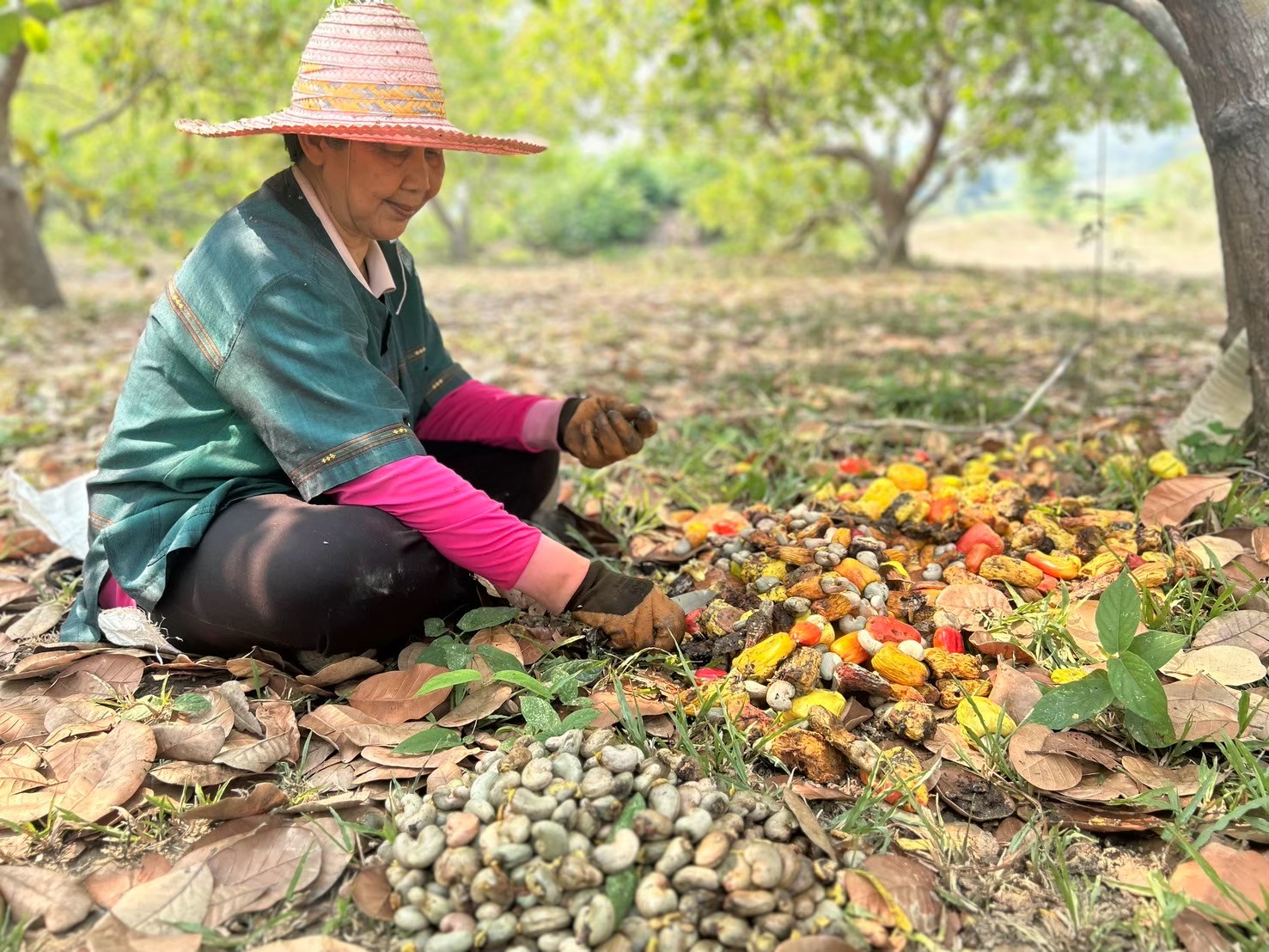
Background: Uttaradit Province is Thailand’s second-largest cashew nut–producing area and plays a strategically important role in supplying raw cashew nuts to domestic processors. However, cashew production in key growing areas—particularly Tha Pla District and Nam Pat District—has long been constrained by low productivity, small nut size that fails to meet market requirements, and price instability. These challenges are largely attributable to the absence of nationally recognized quality standards for raw cashew nuts, which has resulted in bulk-grade trading practices that weaken farmers’ bargaining power. In addition, limited coordination among producers, shelling groups, processors, and buyers has reduced supply chain efficiency, while farmers have had insufficient access to systematic knowledge on quality-based production, post-harvest handling, and market-oriented management. In this context, participatory supply chain management has emerged as a promising strategy for improving agricultural quality, stabilizing prices, and strengthening the grassroots economy.
Objectives: This research aimed to enhance the quality, value, and economic returns of raw cashew nut production in Uttaradit Province through a participatory, supply chain–based approach. The specific objectives were to: (1) develop community-based learning mechanisms to improve cashew production and management practices; (2) establish practical and market-relevant quality inspection criteria for raw cashew nuts to support fair trade and value-based pricing; and (3) formulate development guidelines and policy recommendations to upgrade raw cashew nuts toward high-value agricultural and geographical indication (GI) products.
Methodology: The study adopted a participatory action research (PAR) framework, engaging stakeholders across the cashew supply chain, including farmers, household-scale shellers, community enterprise shelling groups, private-sector entrepreneurs, and government agencies. The research comprised three integrated components.
First, model cashew management communities were established under a “Cashew School” concept in Tha Pla and Nam Pat districts. Learning activities were delivered through modular packages combining lectures, hands-on practice, field visits, and experiential learning. Participants were trained not only in improved cultivation and post-harvest management but also in peer-to-peer knowledge transfer, enabling them to function as community innovators. Learning processes emphasized systems thinking and decision-making along the supply chain.
Second, quality inspection criteria for raw cashew nuts were developed through national quality assessments and pilot purchasing trials. Key indicators included moisture content (7–10%), nut size (180–200 and 201–220 nuts per kilogram), absence of contaminants, and a minimum kernel weight of 270 grams per kilogram of raw nuts. These criteria were tested collaboratively with private buyers and shelling enterprises to ensure practical applicability and market acceptance.
Third, development guidelines and policy recommendations were formulated through stakeholder consultations, focus group discussions, and feedback sessions. These addressed production management, internal quality control systems, market coordination, and institutional support mechanisms required for upgrading raw cashew nuts toward high-value and GI-certified products.
Results and Findings: The research resulted in the establishment of model cashew management communities in both districts, supported by 32 trained community innovators who served as local knowledge disseminators. The participatory learning process fostered a shared vision among stakeholders and promoted consistent adoption of improved practices and appropriate technologies.
Quantitatively, participating farmers achieved substantial productivity gains, with yields increasing by 114%–429% (equivalent to one- to fourfold increases). Average production costs declined by approximately 8% per rai due to more efficient input use and improved management, resulting in income increases of 127%–442%. These outcomes demonstrate the economic viability of participatory, quality-oriented cashew production.
At the supply chain level, systematic information exchange among upstream, midstream, and downstream actors increased awareness of quality standards as a mechanism for agricultural upgrading. Research findings were subsequently used by the National Bureau of Agricultural Commodity and Food Standards as supporting evidence in drafting a national standard for raw cashew nuts. Although most quality data were derived from Uttaradit Province, this limitation prompted broader stakeholder consultations prior to formal standard adoption by the Ministry of Agriculture and Cooperatives.
The study also influenced provincial development initiatives. The Uttaradit Provincial Office of Agriculture and Cooperatives integrated the findings into its Fiscal Year 2025 project on enhancing safe agricultural production and value addition through technology and innovation. Activities included post-harvest quality management training, development of educational board games on quality-based purchasing, demand–supply matching using the Business Model Canvas, and digital marketing capacity building for community enterprises. Planned extensions for Fiscal Year 2026 focus on professional grafting techniques, internal quality control systems for GI readiness, and exposure visits to mechanized shelling facilities. Elements of the research were further aligned with the provincial “Safe Food Uttaradit” strategy, linking cashew production to GAP certification, aflatoxin monitoring, and farm-to-table initiatives under the Provincial Development Plan (2023–2027).
Outcomes, Impacts, and Sustainability: At the local level, the structured participatory process strengthened farmer capacity, fostered collective learning, and enhanced confidence in transitioning from volume-based to quality-based production. At the provincial level, the initiative laid the groundwork for registering “Uttaradit Cashew Nuts” as a GI product, supported by draft operational manuals integrating GAP and industrial standards. At the national level, progress toward a raw cashew nut standard offers opportunities to stabilize supply chains, support domestic processing industries, and reduce Thailand’s trade deficit in cashew products.
Overall, this study demonstrates that participatory supply chain management can effectively transform raw cashew nut production from a low-value, price-volatile activity into a quality-driven, value-added agricultural system. By integrating community learning, quality standards, and policy alignment, the Uttaradit cashew initiative provides a scalable model for strengthening the grassroots economy and upgrading agricultural products in other cashew-growing regions of Thailand.
Article Details

This work is licensed under a Creative Commons Attribution-NonCommercial-NoDerivatives 4.0 International License.
Area Based Development Research Journal values copyright protection and licensing to safeguard author rights and facilitate the appropriate dissemination of research. Our policies ensure openness, accessibility, and attribution. Authors retain copyright ownership, and articles are published under a Creative Commons Attribution License (CC BY), allowing sharing, adaptation, and proper attribution. Authors have the freedom to publish under the CC BY license, granting broad reuse and distribution permissions. The journal supports posting articles on third-party repositories, adhering to institutional and funding restrictions. Author guidelines detail copyright and licensing requirements, empowering authors with knowledge about their rights and responsibilities. These policies cultivate an environment of collaboration, openness, and responsible sharing, benefiting authors and the research community while honoring intellectual property rights.
References
African Cashew Alliance. (2023). Quality measurement of cashew nut (KOR). Retrieved February 25, 2024, from: https://www.africancashewalliance.com/sites/default/files/6_focas_2019_werme_kor_calculation_en.pdf.
Aksorntap, A., Baedcharoen, I., Jatuprayoon, C., & Chuatrakul, W. (2021). Lesson learned for the strategy development of enhancing the gold color longan flesh processing community enterprise management in Ban Thi Subdistrict, Ban Thi, Lamphun Province. Suthiparithat Journal, 35(3), 44–60. (in Thai).
Customs Department. (2024). Value of imported goods, 8-digit tariff list, year 2022. Retrieved February 20, 2024, from: https://catalog.customs.go.th/dataset/ctm_06_07/resource/dc39eec7-d6da-4aa7-bad4-ce3ba6207cd2. (in Thai).
Department of Agricultural Extension. (2024). Agricultural production information service system, Department of Agricultural Extension, Ministry of Agriculture and Cooperatives. Retrieved August 2, 2024, from: https://production.doae.go.th/service/site/index. (in Thai).
Dieng, F., Ngom, D., Dia, D., Sy, M. R., Ndiaye, S., & Dieye, M. (2020). Evaluation of quality raw cashew (Anacardium occidentale L.) nuts from major cashew producing regions of Senegal. American Journal of Agriculture and Forestry, 8(5), 190-197.
FAO. (2025). Crops and livestock products. Retrieved January 29, 2025, from: https://www.fao.org/faostat/en/#data/QCL.
Grant, M., Gilgen, A. K., & Buchmann, N. (2019). The Rich Picture Model: A simple tool for reflective teaching and learning about sustainable food systems. Sustainability, 11, 4815.
Khachatryan, L., Asatryan, H., Poghosyan, S., Azatyan, L., Kocharyan, T., Matinyan, A. & Manucharyan, M. (2025). The agriculture specialization through the lens of PESTLE analysis. Open Agriculture, 10(1), 20250451.
Madureira, T., Nunes, F., Mata, F., & Vaz-Velho, M. (2024). A SWOT analysis of organizations in the Agri-Food Chain Sector from the northern region of Portugal using the PESTEL and MEETHS frameworks. Agriculture,14(9), 1554.
Marnewick, C., Romero-Torres, A., & Delisle, J. (2024). Rich pictures as a research method in project management – A way to engage practitioners. Project Leadership and Society, 5, 100127.
Meteeworachat, K., & Metheevarachatra, A. (2023). Guidelines for developing the operations of community enterprises of Soi Thong Subdistrict, Takhli District, Nakhon Sawan Province. Journal of Thammawat, 4(2), 29–41. (in Thai).
Neef, A., & Neubert, D. (2011). Stakeholder participation in agricultural research projects: A conceptual framework for reflection and decision-making. Agriculture and Human Values, 28, 179–194.
On-Ubon, S. (2024). The Social innovation for product development to commercial markets based on circular economy in Nong Pla Lai Sub-District Community Enterprise, Nong Prue District, Kanchanaburi Province. Phikun Journal, 22(2), 39–59. (in Thai).
Sangmanee, P. (2019). Development of software application delivery through smart phones: A plant nutrition management tool for geographical indication and identity plants of Uttaradit. (Research report). Uttaradit: Uttaradit Rajabhat University. (in Thai).
Sangmanee, P. (2020). Effects of pruning and plant nutrition management on growth, development and yield of cashew nut. Journal of Agriculture, 36(3), 313-319. (in Thai).
Sripila, K., Sunthornhao, P., & Onprom, S. (2019). Stakeholder analysis for management guideline development of Sri Nakhon Khuean Khan Park, Phra Pradaeng District, Samut Prakan Province. Thai Journal of Forestry, 38(1), 133–144. (in Thai).
Thai Industrial Standards Institute. (1998). Industrial product standards for cashew nuts (TIS 1535-2541). Bangkok: Industrial Product Standards Office, Ministry of Industry. (in Thai).
Thai Industrial Standards Institute. (2020). Industrial product standards for cashew nuts (TIS S 93-2563). Bangkok: Industrial Product Standards Office, Ministry of Industry. (in Thai).
Vietnam.vn. (2024). Vietnam’s cashew nut exports maintain the number one position. Retrieved November 8, 2025, from: https://www.vietnam.vn/th/xuat-khau-hat-dieu-cua-viet-nam-giu-vung-vi-tri-so-mot.
Vietnam National Standard. (2018). Raw Cashew Nut – Technical Requirements. Retrieved March 4, 2025, from: https://www.vinacas.com.vn/uploads/download/tieu-chuan-hat-dieu-tho-tieng-anh-tcvn-12380-2018-vietnam-s-rcn-standards-english-2018-1639638581-5iswz.pdf?utm_source.
Warehousing Development and Regulatory Authority. (2025). Raw cashew nuts. WDRA, Government of India. Retrieved March 7, 2025, from: https://wdra.gov.in/web/wdra/raw-cashewnuts.
Zion Market Research. (2024). Cashew nuts market size, share, analysis, trends, growth report 2030. Retrieved May 10, 2025, from: https://www.zionmarketresearch.com/report/cashew-nuts-market.
