
Development of Blue Crab Ice Cream Innovation under the Blue Economy Framework of the Community-Based Tourism Enterprise of Koh Si Chang, Chonburi Province, Thailand
Article Sidebar
Main Article Content
Abstract
Background: Koh Si Chang is a coastal island community whose economy has traditionally depended on small-scale fishing and community-based tourism. Blue crab (Portunus pelagicus) has long been sold as a fresh raw product, a practice constrained by short shelf life, price volatility, and periodic market oversupply during peak fishing seasons. These structural limitations exposed fishers to unstable incomes and encouraged volume-based harvesting, increasing pressure on marine resources. In response, the Community-Based Tourism Enterprise of Koh Si Chang sought to shift from a subsistence-oriented fishing model toward a value-added, innovation-driven approach aligned with the blue economy framework, emphasizing sustainable resource use, waste reduction, and inclusive local economic development.
Objectives: This study aimed to develop and upgrade a blue crab ice cream innovation as a flagship value-added product for the community. Specific objectives were to (1) enhance production efficiency and product quality through appropriate technology and participatory innovation, (2) design a community-owned business and marketing model that ensures fair income distribution across the value chain, and (3) generate integrated economic, social, and environmental benefits consistent with blue economy principles and community-based tourism.
Methodology: The research employed participatory action research combined with design thinking and participatory business and marketing planning. Community enterprise members, small-scale fishers, and local stakeholders collaboratively analyzed challenges across the entire blue crab value chain, from harvesting and processing to marketing and tourism integration.
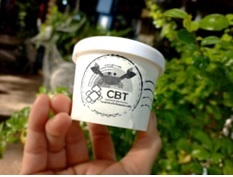
The development process comprised two main stages. First, frequent tourist and local customer segments were surveyed to assess acceptance, perceived value, and market potential of processed blue crab ice cream. Parallel supply chain planning focused on enhancing value addition while ensuring income circulation among fishers, processors, vendors, and tourism-related enterprises. Product upgrading was achieved through innovation and appropriate technology adoption, including industrial-grade food mixers, temperature-controlled boiling systems, batch freezer ice cream machines, and dedicated ice cream freezers. Packaging was redesigned to improve hygiene, portability, and tourist convenience, incorporating ready-to-use spoons and standardized labeling. Iterative customer testing informed adjustments to flavor profile, texture, and portion size.
Second, a comprehensive business and marketing plan was jointly developed to provide a shared strategic vision. This plan articulated production targets, cost structures, pricing strategies, branding through community storytelling, digital marketing channels, and pathways for future product diversification, enabling continuous business analysis and adaptive strategy development.
Results and Findings: Following implementation, the community enterprise increased its production capacity to 2,625 cups of blue crab ice cream per month, representing a 26-fold increase from the previous output of approximately 100 cups per month. Average monthly sales exceeded 2,000 cups, generating total revenue of around 105,000 THB per month and an average net profit of approximately 72,000 THB per month (2,400 USD/Month).
Production upgrading also expanded local employment from 6 to 12 community members, each earning an average of 6,000 THB per month (200 USD/Month). Employment covered the entire production chain, including raw material selection, crab meat extraction, boiling, ice cream mixing, packaging, and distribution. Three pilot sales points were established at key tourist locations on the island, including the ferry pier, the Blue Crab Bank learning center, and a community café, increasing souvenir sales by an average of 21,000 THB per month (700 USD/Month).
The enterprise increased its purchase of blue crabs from local fishers from 10 kg to 50 kg per procurement cycle, reducing post-harvest losses during peak seasons and stabilizing fisher incomes. Residual crab meat and by-products were further valorized into additional products, including blue crab bingsu, blue crab gyoza, seaweed-wrapped crab fried rice, blue crab chiffon cake, blue crab cream soup, and chitosan extracted from crab shells, thereby extending the value chain.
Outcome, Impacts and Sustainability: Socially, more than 12 households participated in capacity-building activities covering standardized food production, basic GMP practices, cost calculation, packaging design, creative marketing, and digital communication. This process transformed community members from production laborers into co-entrepreneurs capable of managing costs, quality, and market strategies independently. Clear role allocation was established within the enterprise across production, procurement, accounting, and public relations.
A community welfare fund was created by allocating approximately 10% of enterprise income to support members during illness or income disruption. The innovation fostered strong local pride, as blue crab ice cream became a nationally distinctive product—the only dessert of its kind in Thailand—positioning Koh Si Chang as a model of creative, innovation-driven blue economy tourism.
Environmentally, the project promoted responsible fishing by shifting incentives from “catch more–low value” to “catch appropriately–high value.” Income generated from value-added products supported the Blue Crab Bank learning center, where gravid crabs are bred and released, contributing to the recovery of coastal crab populations.
A zero-waste approach was implemented across the production process. Crab shells and boiling residues were reused for black soldier fly larvae cultivation as aquatic animal feed or processed into chitosan for ecological cleaning products. These practices reduced organic waste by over 95%, minimized odor pollution, and significantly lowered waste transport from the island, establishing a closed-loop blue resource cycle.
The blue crab ice cream innovation demonstrates integrated sustainability across economic, social, environmental, and cultural dimensions. By embedding innovation within community-based tourism and marine conservation narratives, the enterprise created a distinctive local identity and a replicable model for other coastal communities. The transition from raw material selling to innovation-driven entrepreneurship illustrates how blue economy principles can be operationalized at the community level to generate resilient livelihoods, restore ecosystems, and strengthen local identity over the long term.
Article Details

This work is licensed under a Creative Commons Attribution-NonCommercial-NoDerivatives 4.0 International License.
Area Based Development Research Journal values copyright protection and licensing to safeguard author rights and facilitate the appropriate dissemination of research. Our policies ensure openness, accessibility, and attribution. Authors retain copyright ownership, and articles are published under a Creative Commons Attribution License (CC BY), allowing sharing, adaptation, and proper attribution. Authors have the freedom to publish under the CC BY license, granting broad reuse and distribution permissions. The journal supports posting articles on third-party repositories, adhering to institutional and funding restrictions. Author guidelines detail copyright and licensing requirements, empowering authors with knowledge about their rights and responsibilities. These policies cultivate an environment of collaboration, openness, and responsible sharing, benefiting authors and the research community while honoring intellectual property rights.
References
Amatullo, M., Boyer, B., May, J., & Shea, A. (2022). Design for social innovation: Case studies from around the world. (1st edition). London, England: Routledge.
Auraiwan, D. (2018). Blue economy principle and maritime national interest of Thailand. Journal of Humanities and Social Sciences, Rajapruk University, 4(2), 1–13. (in Thai).
Bason, C. (2014). Design for policy. (1st edition). London, England: Routledge.
Beckman, C. M., Rosen, J., Estrada-Miller, J., & Painter, G. (2023). The social innovation trap: Critical insights into an emerging field. Academy of Management Annals, 17(2), 684-709.
Bennett, N. J., Cisneros-Montemayor, A. M., Blythe, J., Silver, J. J., Singh, G., Andrews, N., ... , & Sumaila, U. R. (2019). Towards a sustainable and equitable blue economy. Nature Sustainability, 2, 991–993.
Bocken, N. M. P., Short, S. W., Rana, P., & Evans, S. (2014). A literature and practice review to develop sustainable business model archetypes. Journal of Cleaner Production, 65, 42–56.
Braun, V., & Clarke, V. (2022). Conceptual and design thinking for thematic analysis. Qualitative Psychology, 9(1), 3-26.
Cajaiba-Santana, G. (2014). Social innovation: Moving the field forward. A conceptual framework. Technological Forecasting and Social Change, 82, 42–51.
Cisneros-Montemayor, A. M., Moreno-Báez, M., Voyer, M., Allison, E. H., Cheung, W. W. L., Hessing-Lewis, M., ..., & Ota, Y. (2019). Social equity and benefits as the nexus of a transformative blue economy: A sectoral review of implications. Marine Policy, 109, 103702.
Crab Bank Learning Center on Si Chang Island. (2024). Report on the release of blue crab juveniles back into the natural ecosystem. Retrieved January 3, 2026, from: https://www.facebook.com/story.php/?story_fbid=967698968715299&id=100064256132144.
European Commission. (2020). The EU blue economy report 2020. Luxembourg: Publications Office of the European Union.
Geissdoerfer, M., Savaget, P., Bocken, N. M. P., & Hultink, E. J. (2018). The circular economy – A new sustainability paradigm? Journal of Cleaner Production, 143, 757–768.
Hjalager, A. M. (2010). A review of innovation research in tourism. Tourism Management, 31(1), 1–12.
Kimbell, L. (2011). Rethinking design thinking: Part I. Design and Culture, 3(3), 285–306.
Liedtka, J. (2018). Why design thinking works. Harvard Business Review, 96(5), 72–79.
Manzini, E. (2015). Design, when everybody designs: An introduction to design for social innovation. USA: MIT Press.
Ministry of Agriculture and Cooperatives. (2022). Action plan for blue swimming crab fishery management, 2023–2027. Retrieved November 5, 2025, from: https://www4.fisheries.go.th/file_area/202303271449531_file.pdf. (in Thai).
Moulaert, F., MacCallum, D., Mehmood, A., & Hamdouch, A. (2013). The international handbook on social innovation. (1st edition). Cheltenham, England: Edward Elgar Publishing.
National Statistical Office of Thailand. (2023). Analytical report on household income and income distribution 2023: Chonburi Province. Retrieved November 5, 2025, from: https://www.nso.go.th/public/e-book/Analytical-Reports/Income-2566/. (in Thai).
Osterwalder, A., Nielsen, C., & Pigneur, Y. (2024). How do you enable business model innovation to thrive in your organisation?. Journal of Business Models, 12(2), 79-91.
Paramee, N. (2021). New-normal behaviors of tourists toward tourism on Koh Sichang under preventive and surveillance measures. (Master's thesis). Burapha University, Faculty of Public Administration. (in Thai).
Pellicer-Sifres, V., Belda-Miquel, S., Cuesta-Fernandez, I., & Boni, A. (2018). Learning, transformative action, and grassroots innovation: Insights from the Spanish energy cooperative Som Energia. Energy Research & Social Science, 42, 100-111.
Porter, M. E., & Kramer, M. R. (2011). Creating shared value: How to reinvent capitalism—and unleash a wave of innovation and growth. Retrieve November 5, 2025, from: https://www.communitylivingbc.ca/wp-content/uploads/2018/05/Creating-Shared-Value.pdf.
Richards, G. (2018). Cultural tourism: A review of recent research and trends. Journal of Hospitality and Tourism Management, 36, 12–21.
Rösch, N., Tiberius, V., & Kraus, S. (2023). Design thinking for innovation: Context factors, process, and outcomes. European Journal of Innovation Management, 26(7), 160-176.
Rungsee, P., & Jaiphet, C. (2023). Blue economy: A concept of marine national interest protection. Journal of Buddhist Innovation and Management, 6(3), 207–220. (in Thai).
Sakcharoen, T., Niyommaneerat, W., & Silalertruksa, T. (2024). Towards low-carbon travel trips through carbon footprint: A case study of marine tourism in Sichang Island, Thailand. Cleaner Engineering and Technology, 23, 100840.
Sawasdee, A. (2018). The distribution of knowledge from relevant researches to support crab bank project in order to enhance blue swimming crab stock in Nakhon Si Thammarat and Surat Thani Provinces. Retrieve January 3, 2025, from: https://inter.fisheries.go.th/eng/en_pic/202103041528541_file.pdf. (in Thai).
United Nations. (2018). Diving into the blue economy. Retrieve November 5, 2025, from: https://www.un.org/en/desa/diving-blue-economy.
Westley, F., Tjörnbo, O., Schultz, L., Olsson, P., Folke, C., Crona, B., & Bodin, Ö. (2013). A theory of transformative agency in linked social–ecological systems. Ecology and Society, 18(3), 27.
