
Enhancing the Potential of Tie-Dye Product Development Processes for Community Entrepreneurs: The Sichon Tie-Dye Group, Nakhon Si Thammarat Province, Thailand
Article Sidebar
Main Article Content
Abstract
Background: The Sichon Tie-Dye Group in Chalong Subdistrict, Sichon District, Nakhon Si Thammarat Province, is an entrepreneurial group that has received vocational development funding from both the government and private sectors. However, the group lacks knowledge and skills in developing new patterns and product designs. Most of their existing products are tie-dyed fabrics using chemical dyes with bright colors. Some products are tie-dyed with natural dyes from mangosteen leaves, resulting in light to medium brown colors. The products’ colors, patterns, and designs are not yet attractive to their target audience and are not significantly different from tie-dyed fabrics from other areas. To enable the Sichon Tie-Dye Group to become self-reliant in product development, a participatory action research process involving group members, researchers, and students was used, integrating design principles with the group’s traditional expertise.
Objectives: This research aims to create a learning process and enhance the self-reliance capacity of the Sichon Tie-Dye Group in product development. The specific objectives of this research were: 1) to develop tie-dye products using natural dyes that can meet a wider range of consumer needs; 2) to enhance the technical capabilities of the Sichon Tie-Dye Group in natural dye tie-dyeing; and 3) to analyze storytelling strategies for the products to increase market opportunities.
Methodology: The research process was designed within the framework of participatory action research, integrated with design thinking concepts. The group members were placed at the center, acting as co-creators with their own expertise and experience. The research consisted of two phases: 1) Development of tie-dye products using natural dyes, which involved surveying data and analyzing the group’s basic capabilities using a four-aspect pre-development readiness assessment; developing design work and conducting additional dyeing experiments to achieve colors and patterns according to the designed concept; creating product prototypes; and developing distribution strategies by designing and creating product labels displaying product information and contact channels. Post-activity evaluation was conducted using four aspects; and 2) Development towards a sustainable tie-dye product group using natural dyes, which involved analyzing storytelling strategies to increase market opportunities, enhancing natural dyeing techniques, and developing products to expand to new target groups and diverse applications.
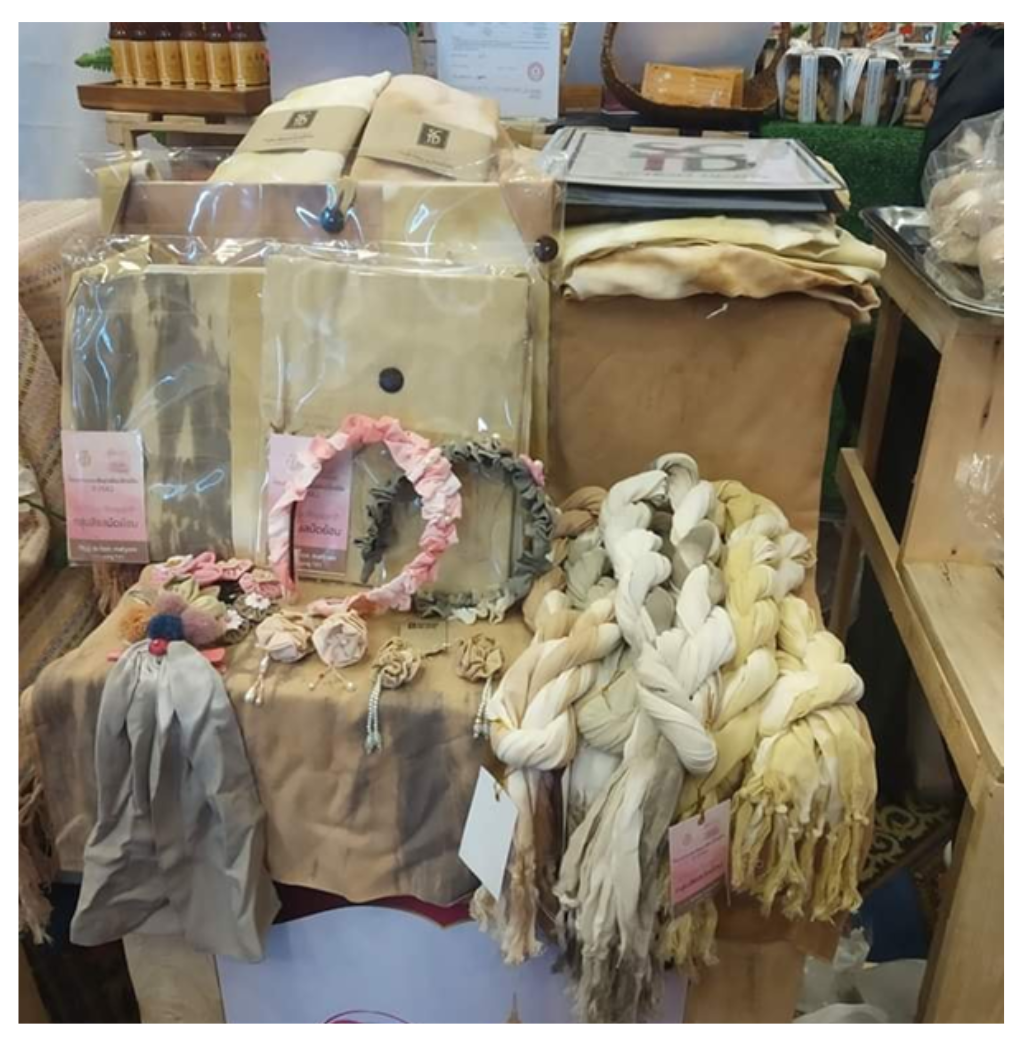
Results and Findings: Phase 1 resulted in five prototype product sets: a two-tone set, a street style set, a beachwear set, a mother-daughter matching set, and a set of accessories made from tie-dyed fabric scraps. The products include clothing, bags, hats, shawls, body accessories, and improved distribution through the design and creation of product labels displaying product information and contact channels. Phase 2 resulted in the creation of the “Sichon Colors” prototype set, comprising women’s casual wear, women’s body accessories, t-shirts, bucket hats, bags, and scarves that can be used by both men and women. The products feature versatile designs that can be mixed and matched for various occasions, with over 30 fabric shades and more than 30 natural tie-dye patterns. Group members were able to transfer knowledge to the community, and a network was created by utilizing local waste materials to add value to the products.
Outcome, Impacts and Sustainability: Economic impact: Value is added to agricultural waste and marigold flowers used for religious ceremonies within the community. This helps reduce production costs and dependence on imported chemical dyes. The group’s income increases from selling products with unique stories and identities. Social impact: Group members gained pride and were empowered through capacity building to become trainers, sharing their knowledge with the community and tourists. A collaborative network was established for managing raw materials and creating value from the local cultural capital. Environmental impact: The transition to a circular economy helps reduce the release of toxins into the ecosystem and promotes the health of producers. The sustainability of this research’s results stems from the Sichon Tie-Dye Group’s ability to create their own natural tie-dye colors and patterns from locally sourced materials, develop their own designs, establish economic networks, transfer knowledge of natural tie-dyeing techniques using local materials, and create added value based on the environmental sustainability of the area.
Article Details

This work is licensed under a Creative Commons Attribution-NonCommercial-NoDerivatives 4.0 International License.
Area Based Development Research Journal values copyright protection and licensing to safeguard author rights and facilitate the appropriate dissemination of research. Our policies ensure openness, accessibility, and attribution. Authors retain copyright ownership, and articles are published under a Creative Commons Attribution License (CC BY), allowing sharing, adaptation, and proper attribution. Authors have the freedom to publish under the CC BY license, granting broad reuse and distribution permissions. The journal supports posting articles on third-party repositories, adhering to institutional and funding restrictions. Author guidelines detail copyright and licensing requirements, empowering authors with knowledge about their rights and responsibilities. These policies cultivate an environment of collaboration, openness, and responsible sharing, benefiting authors and the research community while honoring intellectual property rights.
References
Ampansirirat, A., & Wongchaiya, P. (2017). The participatory action research: Key features and application in community. Journal of Humanities and Social Sciences Mahasarakham University, 36(6), 192–202. (in Thai).
Anusonphat, N., & Kosit, S. (2020). The economic development model for Thai local community 4.0. Journal of Buddhist Anthropology, 5(2), 289–304. (in Thai).
Chaithada, P. (2019). Effects of extraction solvents and pH on the amount and stability of crude color extracted from plants. Wichcha Journal Nakhon Si Thammarat Rajabhat University, 38(1), 65–78. (in Thai).
Fauzi, A. M. J., Sunarti, T. C., & Yulianto, A. (2024). Prospects of the development of the sustainable natural textile dye industry: A systematic literature review. IOP Conference Series: Earth and Environmental Science, 1359(1), 012078. DOI: https://doi.org/10.1088/1755-1315/1359/1/012078.
Fischer, G. (2004). Social creativity: Turning barriers into opportunities for collaborative design. In: Proceedings of the Eighth Conference on Participatory Design: Artful Integration: Interweaving Media, Materials and Practices, PDC 2004, 27-31 July 2004, Toronto, Ontario, Canada.
Harrington, C., Erete, S., & Piper, A. M. (2019). Deconstructing community-based collaborative design: Towards more equitable participatory design engagements. Proceedings of the ACM on Human-Computer Interaction, 3(CSCW), 216. DOI: https://doi.org/10.1145/3359318.
Kant, R. (2012). Textile dyeing industry an environmental hazard. Natural Science, 4(1), 22–26. DOI: https://doi.org/10.4236/ns.2012.41004.
Keativipak, K. (2017). Industrial crafts design framework (Grow-Reborn). Journal of Fine and Applied Arts Khon Kaen University, 9(2), 333–366. (in Thai).
Kritsanaphan, P., & Jitpakdee, R. (2020). Creation and elevation of pot rests: Southerners’ local wisdom to decorative products of Khanap Nak Subdistrict, Nakhon Si Thammarat Province. Area Based Development Research Journal, 12(6), 451–468. (in Thai).
Kurniawan, H., Yulianto, R. S., Mladenov, S. V., & Ardiansyah, M. (2023). Sustainable development through community empowerment based on local wisdom. International Journal of Progressive Sciences and Technologies, 41(2), 164–176. DOI: https:// doi.org/10.52155/ijpsat.v41.2.5719.
Lekhaphan, T., Esamah, A., Junsuk, P., Wattanakul, M., & Junker, T. (2024). Product value addition for Ban Hua Kuan Tie Dye Art Community Enterprise Group, Sathon subdistrict, Songkhla province. Area Based Development Research Journal, 16(1), 75–86. (in Thai).
Memon, J., Rozan, M. Z. A., Ismail, K., Uddin, M., Uddin, M., & Daud, D. (2015). Mentoring an entrepreneur: Guide for a mentor. SAGE Open, 5(1), 1-10. DOI: https://doi.org/10.1177/2158244015569666.
Office of the National Economic and Social Development Council. (2022). The Thirteenth National Economic and Social Development Plan (2023-2027). Retrieved May 9, 2025, from: https://www.nesdc.go.th/en/the-national-economic-and-social-development-plan/the-thirteenth-plan-2023-2027/. (in Thai).
Phriwanrat, K. (2019). Study of tie dye techniques for creating tie dye equipment and fabric patterns. Research and Development Journal Suan Sunandha Rajabhat University, 11(2), 60–70. DOI: https://doi.org/10.53848/irdssru.v11i2.233375. (in Thai).
Pizzicato, B., Pacifico, S., Cayuela, D., Mijas, G., & Riba-Moliner, M. (2023). Advancements in sustainable natural dyes for textile applications: A review. Molecules, 28(16), 5954. DOI: https://doi.org/10.3390/molecules28165954.
Promnakon, K. (2023). Developing and enhancing the potential of product standard of Nam Prik Mae Nogn Ban Sai Community Enterprise Group, Chang Yai Subdistrict, Phra Nakhon Si Ayutthaya Province. Area Based Development Research Journal, 15(2), 117-134. (in Thai).
Sanders, E. B. N., & Stappers, P. J. (2008). Co-creation and the new landscapes of design. CoDesign, 4(1), 5–18. DOI: https://doi.org/10.1080/15710880701875068.
Sathaporn, C., Tonkhundum, P., Tippaya, T., Linma, T., Rodjaroen, S., & Theerachun, S. (2021). Value co-creation process of Tonnamtapi Handmade Community Enterprise by art and design activities with community participation. Area Based Development Research Journal, 13(5), 357–372. (in Thai).
Siva, R. (2010). Plant dyes. In B. P. Singh (Ed.), Industrial Crops and Uses (pp. 349–357). Wallingford, UK: CABI. DOI: https://doi.org/10.1079/9781845936167.0349.
The Queen Sirikit Department of Sericulture. (2017). Si Thammachat Krabuankan Lae Mattrathan Kan Yom Lem 2 [Natural colors dyeing process and standards volume 2]. Bangkok: N.P.J. Engineering Ltd. (in Thai).
Tung, F. W. (2012). Weaving with rush: Exploring craft-design collaborations in revitalizing a local craft. International Journal of Design, 6(3), 71-84.
