
Innovation Development of Local Resources-Based High-Protein Greater Bandicoot Rat Feed for Sustainable Grassroots Economic in Uttaradit Province, Thailand
Article Sidebar
Main Article Content
Abstract
Background: The farming of greater bandicoot rats (Bandicota indica) has emerged as a novel alternative economic livestock that elevates the grassroots economy in Uttaradit province, Thailand. However, farmers face high production costs, with feed accounting for over 70% of the total expenses. Most farmers substitute with commercial swine or poultry feed due to its accessibility, but this comes at a high and continuously rising cost. Meanwhile, although the community has agricultural resources such as field corn available year-round, its direct utilization lacks nutritional balance, particularly protein. This results in poor growth performance, inferior feed conversion ratios, and high cost burdens, thereby disincentivizing commercial expansion. Applying science and technology to upgrade local raw materials into high-quality animal feed is an urgent necessity to ensure occupational stability.
Objectives: This research aimed to (1) develop an innovative high-protein animal feed for greater bandicoot rats by adding value to local resources (corn) through yeast fermentation technology (Saccharomyces cerevisiae) (2) evaluate and compare the growth performance, production costs, and economic returns of post-weaned greater bandicoot rats fed the innovative diet and (3) strengthen the stability of the community-level greater bandicoot rat farming system by establishing a learning process that elevates farmers into community innovators.
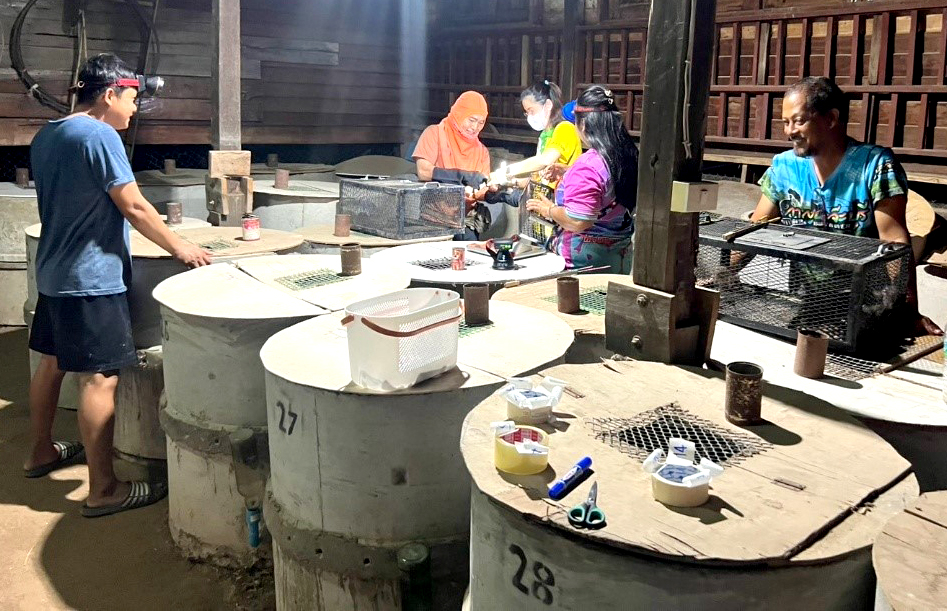
Methodology: The study integrated applied science with participatory community processes via a Learning and Innovation Platform (LIP). Ground corn was fermented with yeast to synthesize single-cell protein, resulting in the innovative Bio-Yeast Corn (BYC). An in vivo trial was conducted using a Randomized Complete Block Design (RCBD) across 6 model network farms (blocks). The experiment consisted of 2 dietary treatments: a control group (commercial swine feed, 18% crude protein) and a treatment group (BYC-mixed diet, 18% crude protein). Each treatment had 3 replicates of 1 cement pit (80 cm diameter) per farm. Post-weaned greater bandicoot rats (mixed sex, approximately 1 month old, average initial weight 237.22 ± 61.56 g) were stocked at 4 animals per pit for a 42-day period. Feed intake and weight gain were recorded to calculate average daily gain (ADG), feed conversion ratio (FCR), and feed cost per weight gain. Statistical analysis was performed alongside an economic return assessment.
Results and Findings: The model farms revealed that greater bandicoot rats fed the 18% protein BYC diet exhibited significantly higher production performance than the control group, achieving a high average daily gain of 7.08 g/day. This improvement is attributed to the fermentation process, which enhanced palatability and nutrient digestibility. Economically, the BYC diet significantly reduced the feed cost per unit of production (per 1 kg weight gain) (P<0.01), decreasing from 117.86 to 60.41 Baht (approximately 3.65 to 1.87 USD), representing a 48.70% cost reduction. This substantial decrease in costs consequently increased the farmers' return on investment (ROI) from 54.11% to 141.76%, reflecting the innovation's concrete efficacy in solving production cost issues
Outcome, Impacts and Sustainability: The economic outcome is a reduction in cost burden and an increase in return on investment, aligning with the bioeconomy model which aims to create added value from local agricultural materials, reduce the risk from fluctuations in animal feed prices in the market, reduce dependence on external factors, and create a database ready for commercial scaling up at the regional and national levels. As for the social impact, the LIP platform has shifted the paradigm of farmers from "buyers of production inputs" to becoming "Community innovators" capable of producing high-quality animal feed for their own use strengthen the network of greater bandicoot rat farmers and serve as models for technology transfer to other communities. Furthermore, they have a positive environmental impact by promoting the efficient recycling and utilization of local resources according to the principles of sustainable environmental management. Using local raw materials reduces transportation distances, a mechanism that supports the reduction of greenhouse gas emissions and mitigates the problem of managing agricultural waste.
Article Details

This work is licensed under a Creative Commons Attribution 4.0 International License.
Area Based Development Research Journal values copyright protection and licensing to safeguard author rights and facilitate the appropriate dissemination of research. Our policies ensure openness, accessibility, and attribution. Authors retain copyright ownership, and articles are published under a Creative Commons Attribution License (CC BY), allowing sharing, adaptation, and proper attribution. Authors have the freedom to publish under the CC BY license, granting broad reuse and distribution permissions. The journal supports posting articles on third-party repositories, adhering to institutional and funding restrictions. Author guidelines detail copyright and licensing requirements, empowering authors with knowledge about their rights and responsibilities. These policies cultivate an environment of collaboration, openness, and responsible sharing, benefiting authors and the research community while honoring intellectual property rights.
References
Area Development Fund Management and Administration Unit (PMU-A). (2023). Annual performance report: Driving LIP for grassroots economic development. Bangkok, Thailand: PMU-A. (in Thai).
AOAC International. (2006). Official methods of analysis of AOAC International (18th edition). Gaithersburg, MD: AOAC International.
Chaucheyras-Durand, F., Walker, N., & Bach, A. (2008). Effects of active dry yeasts on the rumen microbial ecosystem: Past, present and future. Animal Feed Science and Technology, 145(1–4), 5–26. DOI: https://doi.org/10.1016/j.anifeedsci.2007.04.019
Department of Livestock Development. (2017). Handbook of animal feed production. Bangkok, Thailand: Ministry of Agriculture and Cooperatives. (in Thai).
Food and Agriculture Organization. (2021). Biological treatment of agricultural waste for sustainable food systems. Retrieved December 15, 2025, from: https://www.fao.org.
Food and Agriculture Organization of the United Nations. (2019). Good practices for the feed sector: Implementing the Codex Alimentarius code of practice on good animal feeding (4th edition). Rome, Italy: FAO.
Food and Agriculture Organization of the United Nations. (2021). The impact of COVID-19 on livestock sector: Global overview 2020–2021. Rome, Italy: FAO.
Jaruwatcharaset, C., & Mingmuang, K. (2023). Supply chain management of commercial bandicoot rat farms in Uthai Thani Province. Journal of Academic for Public and Private Management, 5(1), 1–12. (in Thai).
Kasemsook, C. (2018). Public participation approach for sustainable community development. Journal of Humanities and Social Sciences, 26(50), 169–186. (in Thai).
Kwanruen, U., & Ketnet, T. (2019). Animal pets and their control. Chiang Rai, Thailand: Comp and Art Printing. (in Thai).
Laorodphan, N., Likittrakulwong, W., Incharoen, I., Yammuen-art, S., & Phromnoi, S. (2021). Use of banana peels fermented with fermentation starter balls and cassava chip on digestibility and blood biochemical contents in meat goats. Journal of Agriculture, 37(3), 265–275. (in Thai).
Manonchai, K. (2020). Raising native bandicoot rats for high income. Technology Chaoban Magazine, 32(723), 61–83. (in Thai).
Mbarga, M. J. A., Davares, A. K. L., Smolyakova, L. A., Ermolaev, A. V., Bassa, Z. C., Marouf, R., & Khelifi, I. (2021). The use of probiotics in animal feeding for safe production and as potential alternatives to antibiotics. Veterinary World, 14(2), 319–328. DOI: https://doi.org/10.14202/vetworld.2021.319-328
McDonald, P., Edwards, R. A., Greenhalgh, J. F. D., Morgan, C. A., Sinclair, L. A., & Wilkinson, R. G. (2011). Animal nutrition (7th edition). Harlow, England: Pearson Education.
National Science and Technology Development Agency. (2022). Guidelines for the operation of the learning and innovation platform (LIP) for spatial development. Pathum Thani, Thailand: National Science and Technology Development Agency. (in Thai).
Office of the National Economic and Social Development Council. (2021). Thai economic and social conditions: Quarter 2, 2021. Bangkok, Thailand: Office of the National Economic and Social Development Council. (in Thai).
Phakachoed, N., Boonmatan, T., Pongjongmit, T., & Norrapoke, T. (2019). Effects of yeast (Saccharomyces cerevisiae) and Lookpang-khaomak on nutritive value of fermented cassava peel. Khon Kaen Agriculture Journal, 47(Suppl. 2), 819–824. (in Thai).
Phromnoi, S., & Laorodphan, N. (2021). Supplementation of yeast (Saccharomyces cerevisiae) and traditional fermentation starter (Loog-Pang) on nutritive value and kinetic of degradation of pineapple peel by in vitro gas production technique. Journal of Mahanakorn Veterinary Medicine, 16(1), 129–138. (in Thai).
Phromnoi, S., Mingchai, C., Manoi, S., Kongloes, N., & Aphaikawee, P. (2021). Effect of yeast (Saccharomyces cerevisiae) fermentation for nutritive value improvement by-products and agricultural waste for feeding beef cattle. Academic Journal Uttaradit Rajabhat University, 16(1), 55–66. (in Thai).
Rattanadulyawijit, S. (2018). Public participation in the formulation of the local development plan of Pa Ngae Subdistrict Municipality, Pa Daet District, Chiang Rai Province. (Master’s thesis). School of Political and Social Sciences, University of Phayao. (in Thai).
Sangthong, K., Noosen, P., & Ngampongsai, W. (2022). Effects of dietary protein levels in concentrate on growth performance and nutrient utilization of Thai indigenous male goat. Khon Kaen Agriculture Journal, 50(2), 448-459. (in Thai). DOI: https://doi.org/10.14456/kaj.2022.39
Srisaard, A. (2018). Field rats, sago beetles, and snakehead fish in cement ponds. Samut Sakhon, Thailand: Naka Intermedia. (in Thai).
Srisaikham, S. (2017). The use of fermented cassava pulp with yeast in beef cattle diets on rumen fermentation process and production performance. (Research report). Chon Buri, Thailand: Burapha University. (in Thai).
Thai Feed Mill Association. (2021). Standards and best practices for feed ingredients. Bangkok, Thailand: Thai Feed Mill Association. (in Thai).
Thip-uten, S., Jitjak, T., Saensri, P., Kaewsena, T., Muangkhot, W., Thip-uten, T., ... , & Subepang, S. (2025). Effect of different diets on growth performance and carcass characteristics of Nu Phuk (Bandicota indica) raised under a circle cement pond. International Journal of Agricultural Technology, 21(4), 1535–1544. DOI: https://doi.org/10.63369/ijat.2025.21.4.1535-1544
Weinberg, Z. G., Muck, R. E., Weimer, P. J., Chen, Y., & Gamburg, M. (2004). Lactic acid bacteria used in inoculants for silage as probiotics for ruminants. Applied Biochemical and Biotechnology, 118(1–3), 1–9. DOI: https://doi.org/10.1385/abab:118:1-3:001
Wisethhom, S. (2025). Raising greater bandicoot rat for export, generating hundreds of thousands of baht, a new dimension in local food. Retrieved December 15, 2025, from: https://www.technologychaoban.com/bullet-news-today/article_242264 (in Thai).
