
Business Model for Creative Products Based on Cultural Capital: A Case Study of the Wiang Bua Community Enterprise, Phayao Province, Thailand
Article Sidebar
Main Article Content
Abstract
Background: The Wiang Bua Community Enterprise, located in Mae Ka Subdistrict, Phayao Province, Thailand, is a culturally rich community with over 700 years of traditional pottery craftsmanship, reflecting strong cultural capital and local wisdom. However, the community faces structural challenges, including fragmented knowledge management, limited business capabilities, and restricted access to contemporary markets. As a result, cultural capital has not been effectively transformed into economic value. This situation reflects a gap between cultural potential and practical economic development, highlighting the need for an integrated approach that combines cultural capital, participatory processes, and business model innovation to support sustainable community development.
Objectives: This study aimed to develop a creative product business model based on cultural capital and local wisdom in the Wiang Bua community. The specific objectives were: (1) to examine the potential of cultural capital and local wisdom for creative product development; (2) to develop a business model that aligns with the cultural context of the community; and (3) to evaluate the application of the business model in enhancing economic value and sustainable community development.
Methodology: This research employed Participatory Action Research (PAR) in combination with Developmental Research. A total of 39 purposively selected informants—including community members, artisans, housewives, community leaders, and youth—were involved in the study. Data were collected through in-depth interviews, focus group discussions, and participatory observation. Data credibility was ensured through triangulation and member checking. The research process consisted of four stages: (1) assessment of cultural capital and local wisdom; (2) participatory process and development of creative products; (3) development of a business model using the Business Model Canvas (BMC); and (4) evaluation using the Social Return on Investment (SROI) framework.
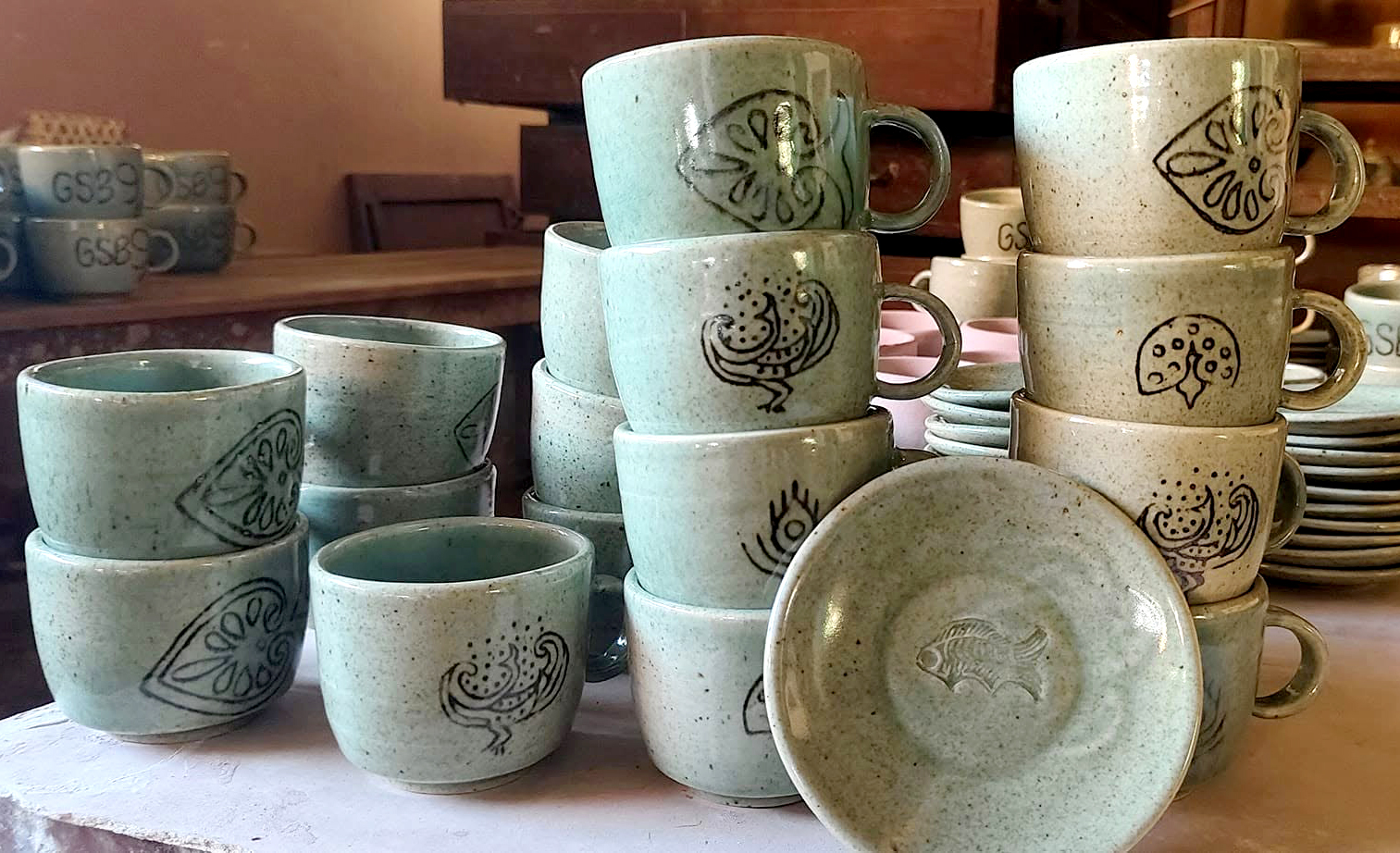
Results and Findings: The findings revealed that the community successfully developed five types of creative product prototypes: (1) Wiang Bua Ceramic Lamp; (2) Wiang Bua Clay Coffee Cup; (3) From Clay Fragments to Heart: Ceramic Beads Jewelry; (4) Handcrafted Floral Offerings and Decorative Items; and (5) Wiang Bua Banana Chips. Following the implementation of the business model, the number of income-generating households increased from 13 to 19, while the average monthly income increased from 3,000 to 4,500 Baht (approximately 93 to 140 USD). In addition, three new occupational groups were established, and a community-based creative economy learning center was initiated. The SROI analysis indicated that the project generated a total social value of 220,000 Baht (approximately 6840 USD) from an investment of 100,000 Baht (approximately 3110 USD), resulting in an SROI ratio of 2.2. The analysis was conducted through stakeholder identification, outcome mapping, financial proxy estimation, and adjustments for deadweight and attribution.
Outcome, Impacts and Sustainability: The study demonstrates multidimensional impacts across economic, social, cultural, and sustainability dimensions. Economically, the community achieved continuous income generation and reduced dependency on external funding. Socially, participatory processes strengthened community cohesion, promoted intergenerational learning, and enhanced entrepreneurial capacity. Culturally, the project contributed to the revitalization of traditional pottery knowledge and local cultural practices, reinforcing community identity. In terms of sustainability, the developed business model can be adapted to other communities with similar contexts, while the establishment of a community learning center ensures continuous knowledge transfer. This study provides empirical evidence that integrating cultural capital with participatory processes and business innovation can effectively drive sustainable development, aligning with Sustainable Development Goals (SDG 8 and SDG 11).
Article Details

This work is licensed under a Creative Commons Attribution 4.0 International License.
Area Based Development Research Journal values copyright protection and licensing to safeguard author rights and facilitate the appropriate dissemination of research. Our policies ensure openness, accessibility, and attribution. Authors retain copyright ownership, and articles are published under a Creative Commons Attribution License (CC BY), allowing sharing, adaptation, and proper attribution. Authors have the freedom to publish under the CC BY license, granting broad reuse and distribution permissions. The journal supports posting articles on third-party repositories, adhering to institutional and funding restrictions. Author guidelines detail copyright and licensing requirements, empowering authors with knowledge about their rights and responsibilities. These policies cultivate an environment of collaboration, openness, and responsible sharing, benefiting authors and the research community while honoring intellectual property rights.
References
A-chinoboonwat, P., Prommas, T., Wisansuwannakorn, T., Nakabhop, C., & Chagothong, P. (2024). The products with cultural identity to the creative economy at Sa-Thale Subdistrict, Phayuha Khiri District, Nakhon Sawan Province. Journal of Humanities and Social Sciences Nakhon Pathom Rajabhat University, 14(2), 43–54. (in Thai).
Chundasutathanakul, S., & Chirapanda, S. (2021). Thailand 4.0: A new value-based economy and its implication on wellness business. Business and Management Review, 12(1), 137–140. DOI: https://doi.org/10.24052/BMR/V12NU01/ART-13
Irjayanti, M., & Lord, L. (2024). Operating a business with local wisdom: A grounded research of women in the creative industry. Cogent Business & Management, 11(1), 2392047. DOI: https://doi.org/10.1080/23311975.2024.2392047
Kelkar, N. P., & Spinelli, G. (2016). Building social capital through creative placemaking. Strategic Design Research Journal, 9(2), 54-66.
Lareau, A., & Weininger, E. (2003). Cultural capital in educational research: A critical assessment. Theory and Society, 32, 567-606. DOI: https://doi.org/10.1007/1-4020-2589-0_6
Malisiova, S., & Kostopoulou, S. (2024). Synergies of cultural–creative industries and development in peripheral areas: Networking, social capital, and place. Heritage, 7(8), 4500-4519. DOI: https://doi.org/10.3390/heritage7080212
Namwong, P., Panyarien, S., & Chatsungnern, A. (2024). Participatory action research to develop cultural capital through the creative economy to the cultural community tourism connection in the ancient city of Nakhon Lampang. Journal of Man and Society, 10(2), 45–70. (in Thai).
Osterwalder, A., & Pigneur, Y. (2010). Business model generation: A handbook for visionaries, game changers, and challengers. Hoboken, NJ: John Wiley & Sons.
Ottaviani, D., Demiröz, M., Szemzö, H., & de Luca, C. (2023). Adapting methods and tools for participatory heritage-based tourism planning to embrace the four pillars of sustainability. Sustainability, 15(6), 4741.
Parmotmuang, M. (2025). Development of culturally inspired textile products to promote careers and enhance the income of the elderly group, in the Ban Nong Khruea Bun Plaid weaving community enterprise, Phachi District, Phra-Nakhon Si Ayutthaya Province. Parichart Journal, 38(4), 1162-1180. (in Thai). DOI: https://doi.org/10.55164/pactj.v38i4.280216
Phumchit, S. (2018). Cultural capital and sustainable community development. Bangkok: Chulalongkorn University Press. (in Thai).
Petrova, L., Graça, S., & Klamer, A. (2022). Evaluating qualities of cultural production: A value-based approach. Media Practice and Education, 23(2), 112–125. DOI: https://doi.org/10.1080/25741136.2022.2056793
Rifqiansyah, R., & Wijaya, H. (2025). Entrepreneurship based on culture and local wisdom: Building sustainable business from tradition. Journal of Indonesian Scholars for Social Research, 5(1), 14–23. DOI: https://doi.org/10.59065/jissr.v5i1.169
Ritmhong, M., Harasarn, A., & Wingwon, B. (2025). Applying local wisdom of Dum Yai pottery to online commerce: Marketing strategies for upgrading community enterprises in Muang Sam Sip District, Ubon Ratchathani Province. URU Journal of Integrated Sciences for Development, 15(2), URU–J.ISD 288454. (in Thai).
Riyakan P., & Chaitawittanun N. (2025). The development of an elderly health system based on community capital in the urban area of Phitsanulok Province. Journal of Local Management and Development Pibulsongkram Rajabhat University, 5(1), 140-154. (in Thai).
Shura, R., Siders, R. A., & Dannefer, D. (2011). Culture change in long-term care: Participatory action research and the role of the resident. Gerontologist, 51(2), 212–225. DOI: https://doi.org/10.1093/geront/gnq099
Somjai, J., & Kasornbua, T. (2026). Success factors in community management: The case of Ban Khlong Fan Pla, Prachinburi Province. Research and Development Journal, Loei Rajabhat University, 21(75), 126–138. (in Thai). DOI: https://doi.org/10.14456/lruj.2026.10
Sornnoey, K., & Kaewsritong, J. (2025). A design thinking process of developing souvenir products from cultural capital of the Tai Yuan ethnic group in Phitsanulok Province. Arts and Culture Journal of the Lower Moon River, 14(1), 195–207. (in Thai). DOI: https://doi.org/10.14456/acj.2025.15
Suwanthada, P., & Sikka, S. (2018). Community product design and development applying the cultural capital and wisdom in the upper northeastern region. Art and Architecture Journal Naresuan University, 9(2), 137–155. (in Thai).
Tanggulungan, G., Sukoharsono, E., Djamhuri, A., & Purwanti, L. (2023). Cultural heritage accounting for participatory governance: A participatory action research in Pata'padang Village. Journal of Public Administration Studies, 8(2), 18–24. DOI: https://doi.org/10.21776/ub.jpas.2023.008.02.3
UNESCO. (2009). Creative economy report 2008: The challenge of assessing the creative economy towards informed policymaking. United Nations. Retrieved December 20, 2025, from: https://unctad.org/system/files/official-document/ditc20082cer_en.pdf.
Utto, G., & Utto, W. (2025). Business model for fresh and Indigenous food roadside stall-type market to promote utilizing community cultural ground of the Khemmarat walking street, Ubon Ratchathani, Thailand. Food Research, 9(1), 226-235. DOI: https://doi.org/10.26656/fr.2017.9(1).243
Yang, C. M., Thu-Hua, L., & Ya-Yi, Z. (2019). A study on design thinking based creative product design process in a design project. International Journal of Systematic Innovation, 5(3), 62-71. DOI: https://doi.org/10.6977/IJoSI.201903_5(3).0005
