
Cashew Nut Value Chain Development: A Case Study of Tha Mueang Subdistrict, Ubon Ratchathani Province, Thailand
Article Sidebar
Main Article Content
Abstract
Background: Ubon Ratchathani Province, Thailand continues to face structural poverty, especially among smallholder farming households whose incomes remain unstable and largely dependent on primary agricultural production. In Tha Mueang Subdistrict, Don Mot Daeng District, more than 25,000 cashew trees are cultivated, producing over 112 tons of raw cashew nuts each year. Despite this strong production base, most farmers still sell their harvest as raw materials through middlemen. Farmers also have limited opportunities to organize collectively and often lack knowledge in farm management, soil improvement, and product value addition. As a result, average productivity remains only about 103 kilograms per rai (approximately 644 kilograms per hectare), which is significantly lower than the provincial average. This short and weak value chain has become a major constraint preventing poor households from increasing their income. For this reason, this research focused on strengthening the cashew value chain through a community-based participatory process in order to improve household income and support stronger local economic development.
Objectives: This study aimed to examine how the cashew value chain in Tha Mueang Subdistrict, Don Mot Daeng District, Ubon Ratchathani Province could be strengthened to improve access to livelihoods and increase income among cashew-growing farmers and poor households. The study explored the existing structure of the value chain and the key constraints affecting income generation through a participatory analysis process with farmers and community enterprise members. At the same time, the research supported improvements in production practices and product value addition through collective learning and cooperation within the community enterprise. The goal was to develop a more inclusive value chain that benefits poor households and strengthens the local grassroots economy.
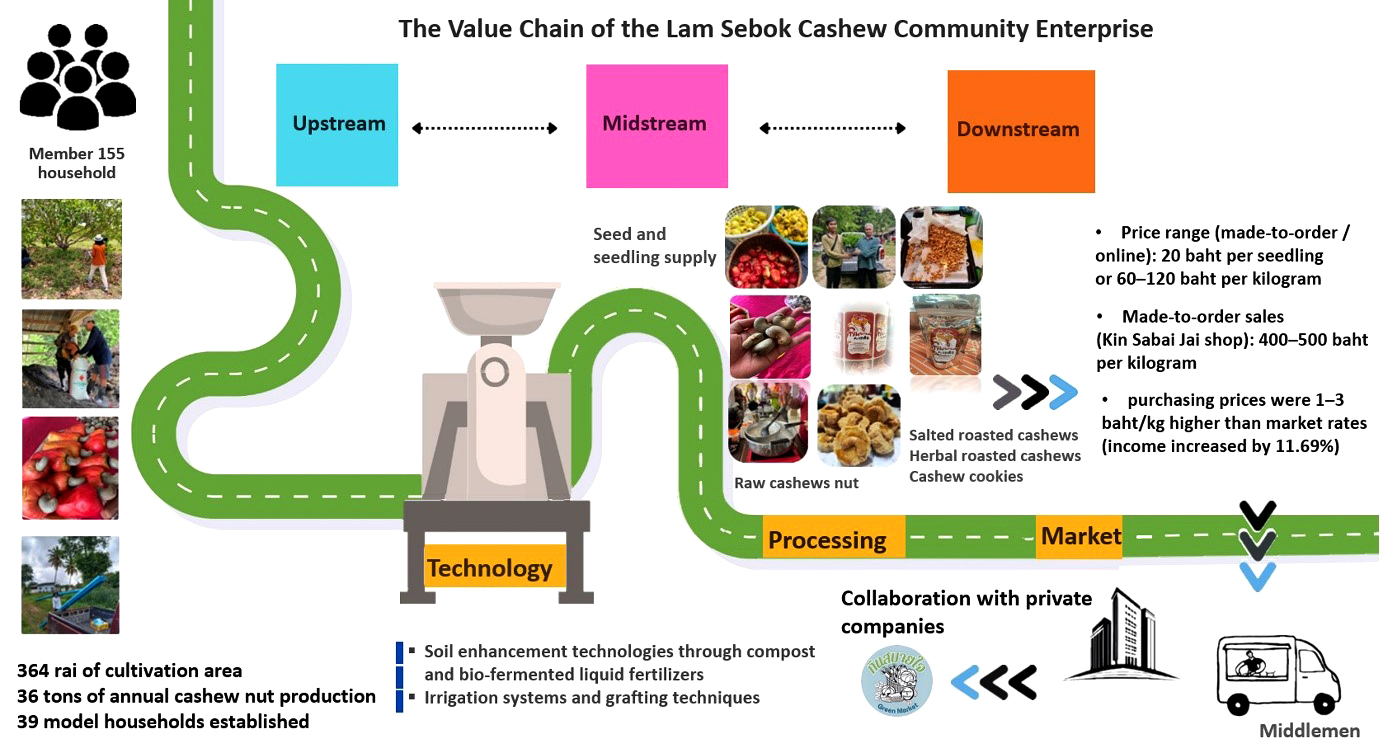
Methodology: This research applied a Participatory Action Research (PAR) approach, with members of the Lam Sebok Muang Mueang Cashew Community Enterprise playing a central role in identifying problems, designing solutions, and implementing activities. Government agencies and academic institutions provided technical support throughout the process. The work was carried out through three main processes. First, the project strengthened community enterprise members through participatory discussions that linked production challenges with income-related problems. Members jointly analyzed the cashew value chain and worked together to identify solutions. Knowledge-sharing workshops and training sessions were organized with experts from the Faculty of Agriculture, Ubon Ratchathani University. These activities included soil analysis, compost production, systematic orchard management, and irrigation system installation. Peer learning among members also helped reduce production costs and improve productivity per rai. For the next process, the project supported cashew processing activities through the development of the SREBOK brand. Raw cashew nuts were upgraded into processed products such as herb-roasted cashew nuts, salted roasted cashews, and cashew cookies. Packaging was designed, market testing was conducted, and a business plan for cashew cookies was developed to strengthen entrepreneurial skills among members. Finally, the project expanded collaboration networks with government agencies and educational institutions to support the long-term development of a more complete and sustainable value chain.
Results and Findings: The study found that strengthening the cashew value chain through a participatory community process created improvements across all stages of the value chain—from upstream production to midstream organization and downstream marketing. At the upstream level, community enterprise members improved orchard management through soil analysis, appropriate fertilizer application, varietal improvement, and irrigation system development. As a result, 39 model learning plots were established as shared learning spaces. At the midstream level, the formation of a community enterprise enabled members to set a purchasing price for cashew nuts that was 3 Baht (approximately 0.1 USD) per kilogram higher than the price offered by middlemen, increasing farmers’ bargaining power. At the downstream level, new processed products were successfully developed under the SREBOK brand, including herbal roasted cashews, salted roasted cashews, and cashew cookies. Packaging improvements and market testing helped the community increase product value and expand marketing channels in practical ways. Following the 2024 harvest season, income among 74 poor member households increased from 6,432 to 7,183 Baht (approximately 200 to 223 USD) per month, representing an increase of 11.69%. Other members also benefited from improved technical knowledge, higher selling prices, and stronger bargaining power when dealing with traders.
Outcomes, Impact, and Sustainability: The development of the cashew value chain in Tha Mueang Subdistrict produced important outcomes at the household, group, and community levels. These included improved production capacity among farmers, stronger community enterprise management, increased income shares for poor households within the value chain, and stronger cooperation among local development partners. The collective learning process strengthened both social capital and human capital within the community, enabling members to become more self-reliant and better prepared to expand future economic activities. At the policy level, the Tha Mueang Subdistrict Administrative Organization integrated support for the Lam Sebok Mueang Muang Cashew Community Enterprise into its five-year local development plan. The enterprise will receive annual financial support of 100,000 Baht (approximately 3110 USD) from fiscal years 2025 to 2027, helping ensure the continuity and sustainability of the initiative.
Article Details

This work is licensed under a Creative Commons Attribution 4.0 International License.
Area Based Development Research Journal values copyright protection and licensing to safeguard author rights and facilitate the appropriate dissemination of research. Our policies ensure openness, accessibility, and attribution. Authors retain copyright ownership, and articles are published under a Creative Commons Attribution License (CC BY), allowing sharing, adaptation, and proper attribution. Authors have the freedom to publish under the CC BY license, granting broad reuse and distribution permissions. The journal supports posting articles on third-party repositories, adhering to institutional and funding restrictions. Author guidelines detail copyright and licensing requirements, empowering authors with knowledge about their rights and responsibilities. These policies cultivate an environment of collaboration, openness, and responsible sharing, benefiting authors and the research community while honoring intellectual property rights.
References
Aue-aungkul, A., Srichookiat, S., Khemakhunasai, P., Sampantamit, T., Kaewsuksaeng, S., & Jitnirat, N. (2023). Tube sedge-based poverty alleviation model of Thale Noi Community, Phatthalung Province. Area Based Development Research Journal, 15(3), 251–265. (in Thai).
Boonrasamee, B., Songrak, A., Patcharaprakiti, N., Hasuk, A., Srichai, P., Chutjueajin, S., & Chammari, U. (2024). Pro-poor value chain analysis for appropriate technology: PAT. Songkhla: Rajamangala University of Technology Srivijaya. (in Thai).
Chaisinson, S. (2024). Strategic management for community enterprise development under the Sustainable Development Goals (SDGs). Journal of the Association of Researchers, 29(1), 98–116. (in Thai).
Channui, C., & Lapthananon, P. (2019). Community enterprise success on the basis of viability and sufficiency. Academic and Research Journal of Liberal Arts (Online), 14(1), 67–78. (in Thai).
Department of Agricultural Extension. (2025). Agricultural production information system: Crop production status report classified by crop and pest types. Retrieved April 22, 2025, from: https://production.doae.go.th/. (in Thai).
Kaiyasit, W. (2019). Success factors for small and micro community enterprises in Namkian Subdistrict, Phu Phiang District, Nan Province. (Master’s thesis). Chiang Mai University, Faculty of Political Science and Public Administration. (in Thai).
Kamonlimsakun, S., Kitatron, D., Preechanan, C., & Lertyingyot, S. (2022). Lessons learned from the value chain of the rice production system under a large agricultural plot scheme in Non-Krasang, Krabueng Yai Subdistrict, Phimai District, Nakhon Ratchasima Province. DRIRDI Research for Community Service Journal, 8(1), 93–107. (in Thai).
Office of the National Economic and Social Development Council. (2024). Poverty & Inequality report 2024. Retrieved May 7, 2025, from: https://www.nesdc.go.th/download/รายงานการวิเคราะห์สถาน/. (in Thai).
Pianroj, N., Chodchuang, S., & Srikhwan, K. (2019). Guidelines for value-added marketing development of Samui coconut, Samui Island, Surat Thani Province. Srinakharinwirot Business Journal, 10(1), 1–16. (in Thai).
Practical Poverty Provincial Connext. (2024). Poverty data at the household level Ubon Ratchathani Province. Retrieved June 25, 2025, from: http://www.ppaos.com. (in Thai).
Prasantree, N., Udom, C., & Butcheewan, P. (2024). The development guidelines for the operation of local community enterprises: A study of community enterprise groups in Koh Kret Municipality, Nonthaburi Province. Journal of Multidisciplinary in Humanities and Social Sciences, 7(1), 25–42. (in Thai).
Sampantamit, T., Aueaungkul, A., Srichookiat, S., Jansoon, N., Kiriratinikom, A., Keawpibal, N., & Kaewsuksaeng, S. (2025). Srinaka model: Development of community enterprises for an inclusive economy in Ban Na Subdistrict, Srinakarin District, Phatthalung Province, Thailand. Area Based Development Research Journal, 17(3), 195–211. (in Thai).
Seville, D., Buxton, A., & Vorley, B. (2011). Under what conditions are value chains effective for pro-poor development: Summary paper. London: International Institute for Environment and Development. Retrieved June 24, 2025, from: https://www.iied.org/g03136.
Soil Resources Survey and Research Division. (2026). Soil series group map, scale 1:25,000, Tha Mueang Subdistrict, Don Mot Daeng District, Ubon Ratchathani Province, Department of Land Development. Retrieved January 12, 2026, from: http://ossoss101.ldd.go.th/web_thaisoilinf/northeast/Ubon/ub_map/ub_manman62/3424/342403_home. (in Thai).
Tupmongkol, P., Sanew, S., Marnarath, P., & Ratchathawan, K. (2025). Enhancing household income through handwoven plastic- strip bags: A case study in Don Mot Daeng Subdistrict, Ubon Ratchathani Province, Thailand. Area Based Development Research Journal, 17(3), 231-241. (in Thai).
