
Knowledge Management of Khmer Handicraft Wisdom in Thai Communities: Ban Yang Village, Surin Province, Thailand
Article Sidebar
Main Article Content
Abstract
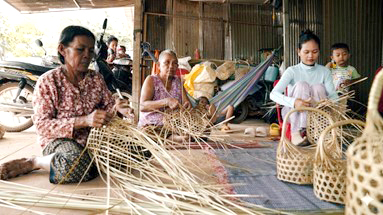
Background: The indigenous craft wisdom of the Thai-Khmer community in Ban Yang, Surin Province, Thailand is deeply embedded in life-cycle rituals, ancestral beliefs, and everyday cultural practices. This knowledge represents an important component of the community’s cultural heritage and identity, reflecting accumulated experiences and skills transmitted across generations. However, the community currently faces structural challenges that weaken the continuity of this knowledge, including low household income, agricultural dependency, labor outmigration, and a declining number of young successors. As a result, indigenous knowledge had increasingly become fragmented, tacit, and unevenly transmitted across generations, despite its continued cultural significance. Much of this knowledge remains undocumented and is mainly transmitted through oral traditions and practical engagement within community rituals and daily activities. In response, the community recognized the need to collectively organize, document and transmit its craft wisdom through a community-led knowledge management process, aiming to strengthen intergenerational learning and enable the sustainable use of indigenous knowledge in both educational and community contexts.
Objectives: This research aimed to develop a participatory knowledge management process for documenting and transmitting Thai-Khmer handicraft wisdom in Surin Province. The specific objectives of this research were: (1) to study the historical background, community context, and lifestyle of the Thai-Khmer community in Surin Province; (2) to examine indigenous handicraft wisdom related to life-cycle rituals practiced within the Thai-Khmer community; and (3) to develop knowledge management guidelines for producing a handbook entitled “Thai-Khmer Handicraft Wisdom in Surin Province: Community Dimensions, Development, and Sustainability” to support learning in the Social Studies, Religion, and Culture subject area.
Methodology: This research employed a qualitative ethnographic approach combined with participatory knowledge management processes. The study was conducted in communities within the Surin cultural landscape where traditional handicraft practices related to ritual activities are still maintained and practiced by local artisans. Data were collected through multiple qualitative methods, including in-depth interviews, participant observation, field documentation, and group discussions. A total of twenty-five local artisans and knowledge holders were purposively selected as key informants based on their expertise and long-term experience in producing ritual-related handicrafts. These artisans represented different craft traditions, including weaving, bamboo craft, ritual decoration, and ceremonial object production. The knowledge management process followed the SECI model (Socialization, Externalization, Combination, Internalization) consisting of four stages: socialization, externalization, combination, and internalization. Initially, tacit knowledge from artisans was collected through interviews and observation of craft production processes. This knowledge was then documented, organized, and categorized according to different ritual contexts and life-cycle ceremonies. Based on the collected information, a practical handicraft handbook was developed. The handbook presents explanations of materials, tools, production processes, and cultural meanings associated with each craft item. Training workshops were organized for youth participants, including demonstrations and hands-on practice. Pre- and post-training assessments were conducted to evaluate the effectiveness of the handbook and the learning activities.
Results and Findings: The findings indicate that local handicrafts play a crucial role in supporting ritual practices and maintaining cultural continuity within the Surin cultural landscape. Various types of handicraft items were identified as integral components of ritual activities, including woven containers for ceremonial offerings, bamboo ritual structures, decorative craft objects, ceremonial trays, and symbolic items used in life-cycle ceremonies. The knowledge collection process successfully documented important information regarding raw materials, production techniques, cultural meanings, and ritual contexts associated with each handicraft item. The study also revealed that most handicraft knowledge is experiential and traditionally transmitted through observation and practice rather than through formal educational systems. The classification of handicrafts according to life-cycle rituals helped clarify the cultural functions of different craft items within community ceremonies. For example, certain woven objects are specifically associated with wedding ceremonies, while particular decorative craft elements are used in ordination rituals and funeral rites. The developed handbook organized this knowledge into a clear and accessible format, including visual illustrations and step-by-step production explanations. Training workshops using the handbook enabled youth participants to better understand both the cultural significance and practical techniques of local handicrafts. Evaluation results indicated that participants demonstrated increased knowledge and improved basic craft skills after participating in the training activities.
Outcome, Impact and Sustainability: This research resulted in the documentation of local handicraft knowledge related to ritual practices in the Surin cultural landscape and the development of a practical handbook for knowledge transmission. These outputs contribute to the preservation of local cultural heritage by transforming tacit knowledge into a structured learning resource. The project also strengthened collaboration between local artisans and youth participants, encouraging intergenerational knowledge exchange within the community. The handbook can be applied in community learning programs, local schools, and cultural development initiatives. In the long term, the documentation and transmission of handicraft knowledge can support cultural preservation, community identity, creative cultural industries, and cultural tourism. Continued cooperation among communities, educational institutions, and cultural organizations will be essential for ensuring the sustainability of these initiatives.
Article Details

This work is licensed under a Creative Commons Attribution 4.0 International License.
Area Based Development Research Journal values copyright protection and licensing to safeguard author rights and facilitate the appropriate dissemination of research. Our policies ensure openness, accessibility, and attribution. Authors retain copyright ownership, and articles are published under a Creative Commons Attribution License (CC BY), allowing sharing, adaptation, and proper attribution. Authors have the freedom to publish under the CC BY license, granting broad reuse and distribution permissions. The journal supports posting articles on third-party repositories, adhering to institutional and funding restrictions. Author guidelines detail copyright and licensing requirements, empowering authors with knowledge about their rights and responsibilities. These policies cultivate an environment of collaboration, openness, and responsible sharing, benefiting authors and the research community while honoring intellectual property rights.
References
Atthakorn, K. (2013). For an understanding the meaning and value: Marie Corelli's a romance of two worlds. RMUTSB Academic Journal, 1(1), 1–9. (in Thai).
Boosaparerk, N., & Putphun, P. (2022). Guidelines for management of community capital consistent with the 20-year national strategy at Bueng Cham-O Subdistrict, Nong Suea District, Pathum Thani Province. Panyapiwat Journal, 14(1), 158–171. (in Thai).
Butprom, A., & Sanedee, P. (2024). Factors of Thai tourists affecting workcation’s travel in Khlong San District, Bangkok. Journal of Humanities and Social Sciences Prince of Songkla University, 20(2), 130–147. (in Thai).
Chaisaengpratheep, N. (2014). The formats and operation process of agro-tourism. Veridian E-Journal, Silpakorn University (Humanities, Social Sciences and Arts), 7(3), 310–321. (in Thai).
Chaiyakhet, W., Thongpoon, K., Thongsanoer, N., Somwatee, S., & Pasasuk, W. (2021). The evaluation of Wang Ang community potential to develop farmer tourism, Nakhon Si Thammarat Province. Suratthani Rajabhat Journal, 8(2), 42–72. (in Thai).
Choibamroong, T. (2014). Agricultural resources research of sustainable agro-tourism: A case study of Surat Thani, Thailand. NIDA Development Journal, 54(3), 202–220. (in Thai).
Chupanya, T., & Kingtakran, N. (2023). The development of creative cultural tourism activity in Suan Dusit and relevant area. Tamnak Journal Sunandha Rajabhat University, 1(2), 24–37. (in Thai).
Cornish, F., Breton, N., Moreno-Tabarez, U., Delgado, J., Rua, M., de-Graft Aikins, A., & Hodgetts, D. (2023). Participatory action research. Nature Reviews Methods Primers, 3(1), 34. DOI: https://doi.org/10.1038/s43586-023-00214-1
Creative Economy Agency. (2022). Creative industries development report: Fashion 2022. Retrieved January 2, 2025, from: https://cea.or.th/storage/app/media/Creative-Industries-Development-Report-Fashion-2022.pdf. (in Thai).
Creative Economy Agency. (2023). Creative economy report 2023. Retrieved January 12, 2025, from: https://www.cea.or.th/th/statistics-and-research/Thailand-Creative-Economy-Report-2023. (in Thai).
Department of Community Development. (2024). Basic Minimum Needs (BMN) household indicators report for Ban Yang Subdistrict, Sikhoraphum District, Surin Province. Retrieved March 15, 2025, from: https://rdic.cdd.go.th/wp-content/uploads/sites/154/2017/10/BMN-Measurement-Manual.pdf. (in Thai).
Department of Foreign Trade. (2025). The Ministry of Commerce summarizes rice export figures for 2024. Retrieved March 15, 2025, from: https://www.dft.go.th/th-th/DFT-Service/Rice-Export-Statistics. (in Thai).
Duangjaidee, W. (2024). Conceptual framework for developing a community capital-based school-level curriculum framework for implementation in school curriculum development. Journal of Information and Learning, 35(3), 143–153. (in Thai).
Fetterman, D. (1998). Ethnography (2nd edition). Thousand Oaks, USA: Sage Publications.
Geertz, C. (1973). The interpretation of cultures. New York: Basic Books.
Harris, M., & Johnson, O. (2000). Cultural anthropology (5th edition). Boston, USA: Allyn and Bacon.
Intakhan, P., Pratuangboriboon, N., Khamsan, W., Limpaiboon, J., Bunvut, S., Suwannaraj, S., & Srivichai, K. (2023). Creative cultural tourism for health by communities, Koh Kha District, Lampang Province. Area Based Development Research Journal, 15(1), 56–71. (in Thai).
International Information and Networking Center for Intangible Cultural Heritage in the Asia-Pacific Region. (2022). Intangible cultural heritage and sustainable development (P. Ekrojanakul, Trans.). Retrieved March 10, 2025, from: https://ich.unesco.org/doc/src/34299-TH.pdf. (in Thai).
Jarenpanit, T., Sangyoka, S., & Chimjan, O. (2021). Enhancing the potential of creative community-based tourism of Nakhon Chum Subdistrict, Phitsanulok Province. Area Based Development Research Journal, 13(5), 373–388. (in Thai).
Jueajun, C., Panjaroen, N., Rubchan, P., & Kliaokaeo, P. (2023). Surin Rajabhat University strategy for local development and heritage continuation of Ban Chang Pi Pottery handicraft. Journal of Academic Surindra Rajabhat, 1(1), 57–72. (in Thai). DOI: https://doi.org/10.14456/jasrru.2023.5
Khamkerd, T., Chaiyo, P., Sangiemsilp, P., Therawat, J., Rueangrit, U., & Chuayphen, P. (2020). Development of community agricultural tourism by multilateral organization in Wang-Yang Community, Suphan Buri Province. Area Based Development Research Journal, 12(6), 432–450. (in Thai).
Koment, J., Panyadee, C., & Chaoprayoon, P. (2017). Ethnographic research: The anthropological investigation that is more than the study of ethnic groups. Mekong-Salween Civilization Studies Journal, 8(2), 193–219. (in Thai).
Ministry of Culture. (2023). Five-year operational plan (2023–2027) of the Ministry of Culture. Retrieved March 10, 2025, from: https://emenscr.nesdc.go.th/planlevel3/view_five_year.html?id=6421d3634fc7035c328ff98d. (in Thai).
Nonaka, I., Takeuchi, H., & Umemoto, K. (1996). A theory of organizational knowledge creation. International Journal of Technology Management, 11(7–8), 833–845.
Payakkaprakhon, M. (2015). Local weavers and social change in Surin Province. Journal of Communication Arts Innovation, 3(2), 16–24. (in Thai).
Sirikul, K. (2025). Impacts of migration and cultural integration in Thai society. Thai Social Science Journal, 2(3), 25–35. (in Thai).
Siriphaprapagon, Y., Intayung, S., & Klangrit, S. (2023). Knowledge in divination of Thai-Khmer ethnic group in Surin Province. Arts and Culture Journal of the Lower Moon River, 12(1), 53–67. (in Thai).
Srimanta, N., & Navapan, N. (2019). Embedded spiritual ideology in community spaces and vernacular houses of Thai-Khmer in lower Northeastern Thailand. Asian Creative Architecture, Art and Design, 28(1), 35–49. (in Thai).
Surin Provincial Statistical Office. (2023). Surin provincial statistical report 2023. Retrieved March 10, 2025, from: https://surin.nso.go.th/images/ebook/Report_surin66.pdf. (in Thai).
Suriyankietkaew, S., Krittayaruangroj, K., Thinthan, S., & Lumlongrut, S. (2025). Community capitals framework for sustainable development: A qualitative study of creative tourism in Ban Chiang world heritage site. Sustainability, 17(8), 3311. DOI: https://doi.org/10.3390/su17083311
Tanhakorn, T., & Pasunon, P. (2018). Participatory action research for creative entrepreneurship development. Asia Social Issues, 11(2), 45–76. (in Thai).
Thorat, R. C., Yantong, T., Kamhom, N., & Niyomthong, K. (2024). “PhuTai Renu Nakorn”: Ethnic Identity and Integration of Social Studies Teaching religion and culture Uthen Phatthana School Tha Uthen District Nakhon Phanom Province. Journal of Graduate School Chaiyaphum Review, 1(1), 48–65 (in Thai).
Ubertazzi, B. (2022). Sustainable development and intangible cultural heritage. In: Intangible cultural heritage, sustainable development and intellectual property. (pp. 67–118). Cham, Switzerland: Springer.
UNESCO. (2014a). Vineyard landscape of Piedmont: Langhe-Roero and Monferrato. Paris, France: UNESCO World Heritage Centre.
UNESCO. (2014b). Trang: A landscape complex (World Heritage List). Paris, France: UNESCO World Heritage Centre.
UNESCO. (2021). Reimagining our futures together: A new social contract for education. Paris, France: UNESCO.
UNESCO. (2023). The need to accelerate worldwide progress: UNESCO 2023 report on public access to information. Paris, France: UNESCO.
Van Maanen, J. (1996). Ethnography. In: A. Kuper & J. Kuper (Eds.), The social science encyclopedia. (2nd edition, pp. 263–265). London, UK: Routledge.
Whitehead, T. L. (2015). Basic classical ethnographic research methods. College Park, USA: Department of Anthropology, University of Maryland.
