
Technology Transfer of Artificial Insemination in Khaolak Black Bone Chicken to Enhance Community Income in Nam Phut Subdistrict, Trang Province, Thailand
Article Sidebar
Main Article Content
Abstract
Background: Khaolak black bone chicken is a locally developed strain derived from crossbreeding and selection among four black chicken lines: Mongolian, Indonesian, Yunnan, and Phu Phan. The farmer group raising Khaolak black bone chicken in Nam Phut Subdistrict, Mueang District, Trang Province, Thailand is able to produce high quality black boned chickens and utilize them as health-oriented food products to meet the demand of consumers and tourists. However, the group still faces limitations in breeding and multiplication, particularly the high infertile egg rate of 31.56±6.27%, which reflects constraints in mating efficiency. This problem is mainly associated with an insufficient number of high-quality breeder males and the advanced age of existing males, averaging approximately two years. These factors affect breeder flock management efficiency and limit the production of black boned chicks to meet market demand. The total production cost of Khaolak black bone chicken was 168.49 THB/kg per production cycle, with a return on investment (ROI) of 18.70%.
Objectives: This study aimed to transfer artificial insemination technology for Khaolak black bone chicken to farmer groups in order to improve breeding efficiency, increase the fertile egg rate, enhance the production of high-quality black boned chicks, reduce production costs, and sustainably increase community income.
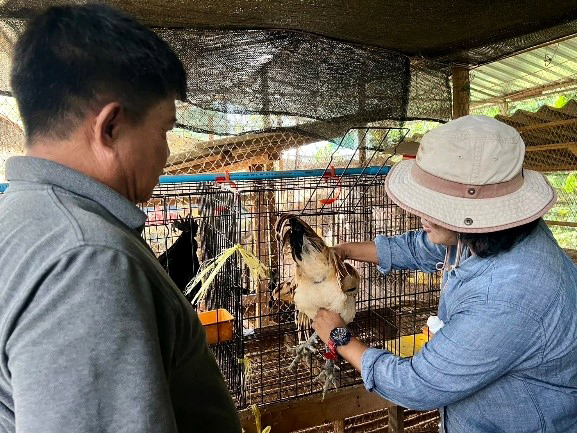
Methodology: The project was implemented through a participatory approach involving Khaolak black bone chicken farmers, educational institutions, and local network partners. The activities included: 1) organizing community forums to synthesize the problems and needs of farmer groups; 2) collecting baseline data and conducting pre technology transfer evaluation; and 3) organizing practical training workshops on artificial insemination technology for genetic improvement of Khaolak black bone chicken. The training process consisted of: 1) assessing farmers’prior knowledge; 2) transferring new knowledge and technology; and 3) conducting post-activity evaluation to improve the efficiency of Khaolak black bone chicken multiplication, together with an economic return assessment.
Results and Findings: The farmer group was able to apply the acquired knowledge to manage Khaolak black bone chicken breeding more effectively. The fertile egg rate increased to 86.62±2.46%, while the infertile egg rate decreased to 9.09±1.96%. These results helped address the problem of black boned chick production. Farmers were able to plan the production of high-quality chicks and marketable black bone chickens in accordance with market demand. In addition, the total production cost decreased by 22.39 THB/kg (0.66 USD/kg) per production cycle, while the return on investment (ROI) increased to 36.89%, representing an increase of 18.19 percentage points.
Outcomes, Impacts, and Sustainability: The farmers were able to produce sufficient quantities of high quality black bone chickens to meet market demand, reduce production costs, increase income, and improve advance marketing planning. As a result, pre orders from consumers, restaurants in Trang Province, and nearby areas increased. Socially, the project promoted farmer group strengthening and knowledge exchange through learning stations on rearing, breeding, multiplication, and artificial insemination of Khaolak black bone chicken. Knowledge transfer courses, rearing manuals, and technology demonstrations were also developed and can be further extended to other farmers and other native chicken breeds. Environmentally, the rearing and utilization of Khaolak black bone chicken, as a native chicken breed, contribute to the conservation of local animal genetic resources and community biodiversity. Therefore, this initiative provides a practical approach to upgrading Khaolak black bone chicken production, increasing community income, and supporting the sustainable improvement of farmers’ quality of life in Trang Province.
Article Details

This work is licensed under a Creative Commons Attribution 4.0 International License.
Area Based Development Research Journal values copyright protection and licensing to safeguard author rights and facilitate the appropriate dissemination of research. Our policies ensure openness, accessibility, and attribution. Authors retain copyright ownership, and articles are published under a Creative Commons Attribution License (CC BY), allowing sharing, adaptation, and proper attribution. Authors have the freedom to publish under the CC BY license, granting broad reuse and distribution permissions. The journal supports posting articles on third-party repositories, adhering to institutional and funding restrictions. Author guidelines detail copyright and licensing requirements, empowering authors with knowledge about their rights and responsibilities. These policies cultivate an environment of collaboration, openness, and responsible sharing, benefiting authors and the research community while honoring intellectual property rights.
References
Ampaporn, K., Duangjinda, M., & Vongpralab, T. (2017). Approach: The using of semen for detection of 24BP-PRL gene in Pradu Hang Dam. Khon Kaen Agriculture Journal, 45(Suppl. 1), 69-73. (in Thai).
Ansari, M., (2024). Recent strategies to mitigate reproductive aging in male broiler breeders: A review. Animal Reproduction Science, 268, 107570. DOI: https://doi.org/10.1016/j.anireprosci.2024.107570
Ashizawa, K., Suzuki, Y., & Okachi, K. (1989). Flagella movement in demem branated preparation of ejaculate fowl permatozoa. Journal of Reproduction and Fertility, 86(1), 263-270. DOI: https://doi.org/10.1530/jrf.0.0860263
Baxter, M., Joseph, N., Osborne, V. R., & Bédécarrats, G. Y. (2014). Red light is necessary to activate the reproductive axis in chickens independently of the retina of the eye. Poultry Science, 93(5), 1289–1297. DOI: https://doi.org/10.3382/ps.2013-03799
Breque, C., Surai, P., & Brillard, J. P. (2003). Roles of antioxidants on prolonged storage of avian spermatozoa in vivo and in vitro. Molecular Reproduction and Development, 66(3), 314–323. DOI: https://doi.org/10.1002/mrd.10347
Charoensin, S., Laopaiboon, B., Boonkum, W., Phetcharaburanin, J., Villareal, M. O., Isoda, H., & Duangjinda, M. (2021). Thai native chicken as a potential functional meat source rich in anserine, anserine/carnosine, and antioxidant substances. Animals, 11(3), 902. DOI: https://doi.org/10.3390/ani11030902
Chen Z., Zhang J. R., Zhou Y. W., Liang C., & Jiang Y. Y. (2015). Effect of heat stress on the pituitary and testicular development of Wenchang chicks. Archives Animal Breeding, 58(2), 373–378. DOI: https://doi.org/10.5194/aab-58-373-2015
Chumchon Tong Tiew. (2024). Ban Khao Lak community, Trang Province. Retrieved December 20, 2025, from: https://chumchontongtiew.com/chumchontongtiew-preview-462791791792. (in Thai).
Chuaychu-noo, N., Maliwan, P., Ekkhara, A., & Chaipetch, S. (2025). Study of reproductive efficiency in Southern Thai native chickens. Journal of Agricultural Research and Extension, 42(1), 94-106. (in Thai). DOI: https://doi.org/10.14456/jare-mju.2025.9
Cobb. (2009). Cobb breeder management guide. Retrieved January 5, 2026, from: http://www.cobbvantress.com/contactus/brochures/Breeder_guide_2008.pdf.
Cox, N. A., Stern, N. J., Wilson, J. L., Musgrove, M. T., Buhr, R. J., & Hiett, K. L. (2002). Isolation of Campylobacter spp. from semen samples of commercial broiler breeder roosters. Avian Diseases, 46(3), 717–720. DOI:
https://doi.org/10.1637/0005-2086(2002)046[0717:IOCSFS]2.0.CO;2
Crawford, R. D. (1990) Origin and history of poultry species. In: Poultry Breeding and Genetics. Amsterdam: Elsevier.
Das, S. K. (2002). Effects of feeding on semen production in native cock in Bangladesh. Journal of Biological Sciences, 2(12), 810-811. DOI: https://doi.org/10.3923/jbs.2002.810.811
Dorshorst, B., Okimoto, R., & Ashwell, C. (2010). Genomic regions associated with dermal hyperpigmentation, polydactyly and other morphological traits in the Silkie chicken. Journal of Heredity, 101(3), 339–350. DOI: https://doi.org/10.1093/jhered/esp120
El-Sheikh, T. M., Essa, N. M., Elsagheer, M. A. (2016). Effect of cages type and mating management on fertility and hatchability of Japanese quail. Scientific Papers-Animal Science Series, 67, 54–59.
Elsagheer, M. A., Mohamed, O. A., Khattab, I. M., & Wadea, M. K. (2024). Impact of different mating ratios of broiler breeder on reproductive performance during post moult phase. Animal Biotechnology, 35(1), 2398707. DOI: https://doi.org/10.1080/10495398.2024.2398707
Etches, R. J. (1996). Reproduction in poultry. Wallingford: CAB International.
Ferenczi, S., Juhasz, B., Vegi, B., Drobnyak, A., Horvath, K., Kuti, D., ..., & Kovács, K. J. (2025). Gut-testis axis in roosters: Lactiplantibacillus plantarum supplementation improves reproductive performance. Poultry Science, 104(7), 105141. DOI: https://doi.org/10.1016/j.psj.2025.105141
Froman, D. P., & Feltmann, A. J. (2005). Fowl (Gallus domesticus) sperm motility depends upon mitochondrial calcium cycling driven by extracellular sodium. Biology of Reproduction, 72(1), 97-101. DOI: https://doi.org/10.1095/biolreprod.104.033209
Galal, A. (2007). Predicting semen attributes of naked neck and normally feathered male chickens from live performance traits. International Journal of Poultry Science, 6(1), 36–42. DOI: https://doi.org/10.3923/ijps.2007.36.42
Gee, G. F. (1995). Artificial insemination and cryopreservation of semen from nondomestic birds. In: Proceeding of the 1st international symposium on the artificial insemination of poultry (pp. 262–279), 19-22 June 1994, University of Maryland, College Park, Maryland, USA.
Geng, A. L., Zhang, Y., Zhang, J., Wang, H. H., Chu, Q., Yan, Z. X., & Liu, H. G. (2022). Effects of light regime on circadian rhythmic behavior and reproductive parameters in native laying hens. Poultry Science, 101(5), 101808. DOI: https://doi.org/10.1016/j.psj.2022.101808
Geng, S. S., Li, H. Z., Wu, X. K., Dang, J. M., Tong, H., Zhao, C. Y., Liu, Y., & Cai, Y. Q. (2010). Effect of Wujijing oral liquid on menstrual disturbance of women. Journal of Ethnopharmacology, 128(3), 649-653. DOI: https://doi.org/10.1016/j.jep.2009.12.041
Haghighi, M., Irani, M., Jafari, M., Firouzi, S., & Habibi, H. (2016). Effect of sex ratio on the production and hatchability of broiler breeder flock. Journal of World’s Poultry Research, 6(1), 14-17.
Hammerstedt, R. H., & Graham, J. K. (1992). Cryopreservation of poultry sperm: The enigma of glycerol. Cryobiology, 29(1), 26-38. DOI: https://doi.org/10.1016/0011-2240(92)90004-L
Harsha, M., Swathi, B., Neeradi, R., Kannaki, T. R., Venkata Rama Rao, S., Shanmugam, M., Pranay Kumar, K., & Vidyasagar Reddy, A. (2021). Effects of heat stress on semen quality of Gramapriya male line roosters. Pharma Innovation Journal, 10(7), 1413–1417.
Hassan, M. R., Sultana, S., Choe H. S., & Ryu K. S. (2014). A comparison of monochromatic and mixed LED light color on performance, bone mineral density, meat and blood properties, and immunity of broiler chicks. Journal of Poultry Science, 51(2), 195-201. DOI: https://doi.org/10.2141/jpsa.0130049
Karaca, A. G., Parker, H. M., & McDaniel, C. D. (2002). Elevated body temperature directly contributes to heat stress infertility of broiler breeder males. Poultry Science, 81(12), 1892–1897. DOI: https://doi.org/10.1093/ps/81.12.1892
Kheawkanha, T., Chankitisakul, V., Pimprasert, M., Boonkum, W., & Vongpralub, T. (2024). Fertility and insemination characteristics of sperm storage tubules in old Thai-native hens. Animals, 14(5), 694. DOI: https://doi.org/10.3390/ani14050694
Klinprathap, K., Kasekarn, W., Sattayakawee, S., Phothi, T., & Khongsombat, O. (2025). Effects of black bone chicken on learning and memory in oxonic-induced hyperuricemia male rats. Functional Food Science, 5(3), 97-112. DOI: https://doi.org/10.31989/ffs.v5i3.1571
Laffaldano, N., Manchisi, A., & Rosato, M. P. (2008). The preservability of turkey semen quality during liquid storage in relation to strain and age of males. Animal Reproduction Science, 109(1-4), 266-273. DOI: https://doi.org/10.1016/j.anireprosci.2007.11.024
Leska, A. Kiezun, J., Kaminska, B., & Dusza, L. (2012). Seasonal changes in the expression of the androgen receptor in the testes of the domestic goose (Anser anser f. domestica). General and Comparative Endocrinology, 179(1) 63-70. DOI: https://doi.org/10.1016/j.ygcen.2012.07.026
Liang, W., He, Y., Zhu, T., Zhang, B., Liu, S., Guo, H., ..., & Sun, G. (2024). Dietary restriction promote sperm remodeling in aged roosters based on transcriptome analysis. BMC Genomics, 25(1), 680. DOI: https://doi.org/10.1186/s12864-024-10544-3
Lengkidworraphiphat, P., Wongpoomchai, R., Taya, S., & Jaturasitha, S. (2020). Effect of genotypes on macronutrients and antioxidant capacity of chicken breast meat. Asian-Australasian Journal of Animal Sciences, 33(11), 1817–1823. DOI: https://doi.org/10.5713/ajas.19.0736
Li, Y., Liu, N., & Wang, J. (2023). Effect of dietary lutein on semen quality, reproductive hormones, and oxidative injury products of aged roosters. European Poultry Science, 87, 1-10. DOI: https://doi.org/10.1399/eps.2023.390
Lukanov, H., & Genchev, A. (2013). Fibromelanosis in domestic chickens. Journal of Science and Agricultural Technology, 5(3), 239-246.
Máchal, L., Kopec, T., Rečková, Z., Filipčík, R., Večeřa, M., Pešan, V., & Tůmová, E. (2025). Analysis of ejaculate parameters and sperm morphology in roosters of initial laying strains. Czech Journal of Animal Science, 70(2), 72–81. DOI: https://doi.org/10.17221/203/2024-CJAS
Mussa, N. J., Boonkum, W., & Chankitisakul, V. (2023). Semen quality traits of two Thai native chickens producing a high and a low of semen volumes. Veterinary Sciences, 10(2), 73. DOI: https://doi.org/10.3390/vetsci10020073
Nam Phut Subdistrict Administrative Organization. (2022). General information and basic data of Nam Phut Subdistrict, Mueang Trang District, Trang Province. Retrieved October 21, 2022, from: https://www.numpud.go.th/index.php. (in Thai).
Noirault, J., Brillard, J. P., & Bakst, M. R. (2006). Effect of various photoperiods on testicular weight, weekly sperm output and plasma levels of LH and testosterone over the reproductive season in male turkeys. Theriogenology, 66(4), 851–859. DOI: https://doi.org/10.1016/j.theriogenology.2005.11.025
Obidi, J. A., Onyeanusi, B. I., Ayo, J. O., Rekwot, P. I., & Abdullahi, S. J. (2008). Effect of timing of artificial Insemination on fertility and hatchability of Shikabrown breeder hens. International Journal of Poultry Science, 7(12), 1224–1226. https://doi.org/10.3923/ijps.2008.1224.1226
Olanrewaju, H. A., Thaxton, J. P., Dozier III, W. A., Purswell, J., Roush, W. B. & Branton, S. L. (2006). A Review of lighting programs for broiler production. International Journal of Poultry Science, 5(4) 301-308. DOI: https://doi.org/10.3923/ijps.2006.301.308
Pan, H., Song, S., Ma, Q., Wei, H., Ren, D., & Lu, J. (2016). Preparation, identification and antioxidant properties of black-bone silky fowl (Gallus gallus domesticus Brisson) iron(II)-oligopeptide chelate. Food Technology and Biotechnology, 54(2), 164–171. DOI: https://doi.org/10.17113/ftb.54.02.16.4166
Peters, S. O., Shoyebo, O. D., Ilori, B. M., Ozoje, M. O., Ikeobi, C. O. N., & Adebambo, O. A. (2008). Semen quality traits of seven strain of chickens raised in the humid tropics. International Journal of Poultry Science, 7(10), 949-953. DOI: https://doi.org/10.3923/ijps.2008.949.953
Potue, P., Chiangsaen, P., Maneesai, P., Khamseekaew, J., Pakdeechote, P., Chankitisakul, V., ..., & Duangjinda, M. (2022). Effects of Thai native chicken breast meat consumption on serum uric acid level, biochemical parameters, and antioxidant activities in rats. Scientific Reports, 12(1), 14056. DOI: https://doi.org/10.1038/s41598-022-18484-2
Prabakar, G., Gopi, M., Kolluri, G., Rokade, J. J., Pavulraj, S., Pearlin, B. V., ..., & Mohan, J. (2022). Seasonal variations on semen quality attributes in turkey and egg type chicken male breeders. International Journal of Biometeorology, 66, 1547–1560. DOI: https://doi.org/10.1007/s00484-022-02299-x
Rakha, B. A., Ansari, M. S., Akhter, S., & Blesbois, E. (2017). Effect of season and age on Indian red jungle fowl (Gallus gallus murghi) semen characteristics: A 4-year retrospective study. Theriogenology, 99, 105-110. DOI: https://doi.org/10.1016/j.theriogenology.2017.05.016
Reviers, M. de, & Brillard, J. P. (1975). Le développement testiculaire du coq IV. Étude quantitative des cellules germinales du coq placé sous des photopériodes croissantes à des âges différents. Annales de Biologie Animale, Biochimie, Biophysique, 15(4), 633–641.
Salas-Huetos, A., James, E. R., Aston, K. I., Jenkins, T. G., & Carrell, D. T. (2019). Diet and sperm quality: Nutrients, foods and dietary patterns. Reproductive Biology, 19(3), 219–224. DOI: https://doi.org/10.1016/j.repbio.2019.07.005
Santiago-Moreno, J., Castaño, C., Toledano-Díaz, A., Coloma, M. A., López-Sebastián, A., Prieto Pablos, M. T., & Campo, J. L. (2012). Influence of season on the freezability of freerRange poultry semen. Reproduction in Domestic Animals, 47(4), 578-583. DOI: https://doi.org/10.1111/j.1439-0531.2011.01921.x
Sarabia Fragoso, J., Pizarro Diaz, M., Abad Moreno, J. C., Casanovas Infesta, P., Rodriguez-Bertos, A., & Barger, K. (2013). Relationships between fertility and some parameters in male broiler breeders (body and testicular weight, histology and immunohistochemistry of testes, spermatogenesis and hormonal levels). Reproduction in Domestic Animals, 48(2), 345-352. DOI: https://doi.org/10.1111/j.1439-0531.2012.02161.x
Siudzinska, A., & Lukaszewicz, E. (2008). The effect of breed on freezability of semen of fancy fowl. Animal Science Papers and Reports, 26(4), 331-340.
Sonseeda, P. (2013). Characteristics of annual semen and quality of frozen semen in Thai native chickens. (Doctor of Philosophy's thesis). Faculty of Agriculture, Khon Kaen University. (in Thai).
Sturkie, P. D. (1976). Avian physiology. (3rd edition). New York: Springer-Verlag.
Tabatabaei, S., Chaji, M., & Mohammadab, T. (2010). Correlation between age of rooster and semen quality in Iranian indigenous broiler breeder chickens. Journal of Animal and Veterinary Advances, 9(1), 195-198. DOI: https://doi.org/10.3923/javaa.2010.195.198
Thananurak, P., Maliwan, P., Chaipetch, S., & Chuaychu-noo, N. (2022). Reproductive performance of Khaolak black bone chicken, Trang Province. Prawarun Agricultural Journal, 19(2), 59 – 65. (in Thai). DOI: https://doi.org/10.14456/paj.2022.19
Vongpralub, T., Utha, A., Pongpeng, J., Sonseeda, P., & Yindee, W. (2011). A comparison of simple vapour method and programmable freezer on motility and fertility of frozen Thai native chicken semen. In: Proceedings of the 3rd International Conference on Sustainable Animal Agriculture for Developing Countries (SAADC 2011) (pp. 649–652), 26-29 July 2011, Suranaree University of Technology, Nakhon Ratchasima, Thailand.
Wang, M. S., Thakur, M., Peng, M. S., Jiang, Y., Frantz, L. A. F., Li, M., …, & Zhang, Y. P. (2020). 863 genomes reveal the origin and domestication of chicken. Cell Research, 30(8), 693–701. DOI: https://doi.org/10.1038/s41422-020-0349-y
Xiong Y., Yin Q., Li J., & He S. (2020). Oxidative stress and endoplasmic reticulum stress are involved in the protective effect of alpha lipoic acid against heat damage in chicken testes. Animals, 10(3), 384. DOI: https://doi.org/10.3390/ani10030384
Yan, Y. Q., Liu, M., Xu, Z. J., Xu, Z. J., Huang, Y. X., Li, X. M.,..., & Sun, L. H. (2024). Optimum doses and forms of selenium maintaining reproductive health via regulating homeostasis of gut microbiota and testicular redox, inflammation, cell proliferation, and apoptosis in roosters. Journal of Nutrition, 154(2), 369–380. DOI: https://doi.org/10.1016/j.tjnut.2023.12.021
Yang, X., Tang, C., Ma, B., Zhao, Q., Jia, Y., Meng, Q., Qin, Y., & Zhang, J. (2024). Identification of characteristic bioactive compounds in silkie chickens, their effects on meat quality, and their gene regulatory network. Foods, 13(6), 969. DOI: https://doi.org/10.3390/foods13060969
Zhang, Z., Li, G., Wei, Y., Feng, Z., Fang, L., Li, M., ..., & Gan, J. (2022). In vitro immunomodulatory and antioxidant effects of oligopeptides and four characteristic peptides in black-bone silky fowl (Gallus gallus domesticus Brisson). Journal of Food Biochemistry, 46, e14469. DOI: https://doi.org/10.1111/jfbc.14469
