
Development of Bannangsta Saba Banana Chips with Mangosteen Filling of the Ban Na La Agricultural Product Processing Community Enterprise, Yala Province, Thailand
Article Sidebar
Main Article Content
Abstract
Background: Yala province is a major mangosteen-producing area in the southern border region of Thailand. The Ban Na La Agricultural Product Processing Community Enterprise, located in Tachi Subdistrict, Yaha district, Yala province, generates approximately 37% of fresh mangosteen fruit that does not meet grading standards each year, resulting in significant post-harvest losses. To reduce such losses, the community enterprise processes these low-grade mangosteens into mangosteen paste. However, the enterprise has encountered challenges with production processes, product quality, and packaging, resulting in sales at less than 50% of its total production capacity. Therefore, developing a new value-added processed product that effectively responds to market demand became necessary.
Objectives: This research aimed to 1) investigate the business management, operational problems, and product development needs of the Ban Na La Agricultural Product Processing Community Enterprise; and 2) develop processed mangosteen products based on the Understand- Access-Develop principle of the King’s Philosophy.
Methodology: This research employed a research and development approach integrating qualitative and quantitative methods based on the Understand-Access-Develop principle of the King’s Philosophy. In the Understand phase, qualitative data were collected from 16 key informants through focus group discussions and in-depth interviews, including community enterprise members, community enterprise and local product development officers, regular customers, and experts in community product development. In the Access phase, qualitative data were collected from the same group of key informants, and quantitative data were obtained from 450 consumers who had purchased mangosteen paste products at least once during the previous year. In the Develop phase, sensory evaluation regarding color, aroma, taste, texture, and overall liking was conducted with 30 untrained panelists, and product satisfaction was assessed with 100 consumers who participated in product tasting. Qualitative data were analyzed using content analysis, while quantitative data were analyzed using descriptive statistics, including frequency, percentage, mean, and standard deviation. Sensory evaluation data were analyzed using a randomized complete block design (RCBD) and compared using the least significant difference (LSD) test. The development process consisted of nine stages: 1) investigating the product development needs of the community enterprise and stakeholders, 2) examining consumer needs for processed mangosteen products, 3) developing Saba banana chips with mangosteen filling based on the Understand-Access-Develop principle, 4) developing suitable packaging, 5) improving product standards and quality, 6) designing product labels, 7) providing practical training on the production of Saba banana chips filled with mangosteen paste and business management, 8) commercializing the product and monitoring its performance, and 9) refining the product.
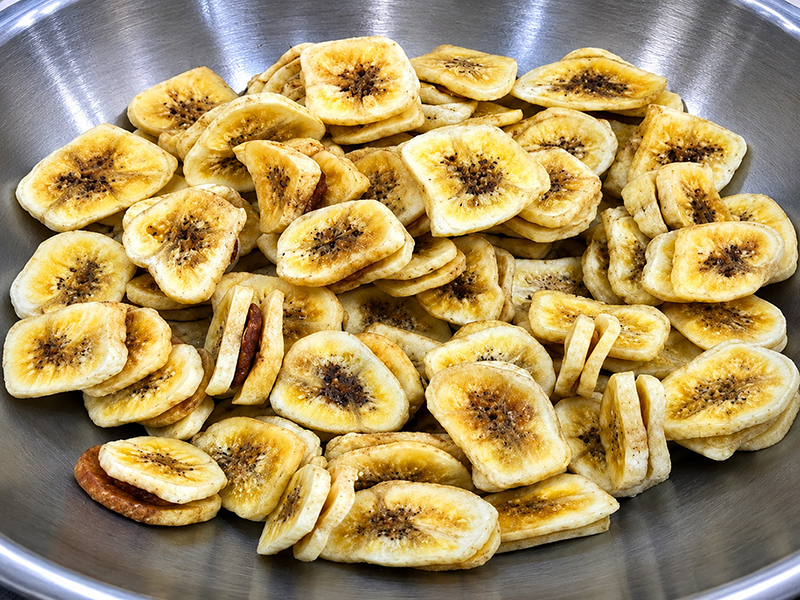
Results and Findings: The Saba banana chips with mangosteen filling were developed by combining mangosteen paste with Bannangsta Saba bananas, a geographical indication (GI) product of Yala province. Improvements in packaging, product labeling, quality standards, and training in food science and business management enhanced consumer acceptance. The product obtained a food registration number from the Thai Food and Drug Administration and became commercially available. Initially, the product was sold in jar packaging, generating a profit margin of 26.37% of revenue. After changing to zip-lock packaging, the sales volume increased by 1.63 times while maintaining a similar profit level.
Outcome, Impact and Sustainability: The community enterprise has continuously produced and marketed the product, generating approximately 300 USD per month. To ensure year-round production, mangosteen flesh is preserved through freezing during the harvesting season for use as raw material. The enterprise plans to apply for the Thai community product standard and the One Tambon One Product (OTOP) product selection program, as well as to expand distribution channels through online platforms. The enterprise members have transformed from traditional producers into competitive community-based entrepreneurs. The utilization of local raw materials has reduced post-harvest losses and waste within the supply chain, increased income distribution to local farmers, and provided a practical model for sustainable product development in similar community contexts.
Article Details

This work is licensed under a Creative Commons Attribution 4.0 International License.
Area Based Development Research Journal values copyright protection and licensing to safeguard author rights and facilitate the appropriate dissemination of research. Our policies ensure openness, accessibility, and attribution. Authors retain copyright ownership, and articles are published under a Creative Commons Attribution License (CC BY), allowing sharing, adaptation, and proper attribution. Authors have the freedom to publish under the CC BY license, granting broad reuse and distribution permissions. The journal supports posting articles on third-party repositories, adhering to institutional and funding restrictions. Author guidelines detail copyright and licensing requirements, empowering authors with knowledge about their rights and responsibilities. These policies cultivate an environment of collaboration, openness, and responsible sharing, benefiting authors and the research community while honoring intellectual property rights.
References
Agricultural Marketing Resource Center. (2022). Value-added-agriculture. Retrieved April 15, 2025, from: https://www.agmrc.org/value-added-agriculture.
Brealey, R. A., Myers, S. C., & Allen, F. (2022). Principles of corporate finance. (14th edition). New York, NY: McGraw-Hill.
Department of Industrial Promotion. (2021). Report on promoting value-added local food products using technology. Bangkok: Ministry of Industry. (in Thai).
Department of Internal Trade. (2024). Mangosteen: Weekly report for the fourth week of June 2024 (June 24–28, 2024). Retrieved December 20, 2025, from: https://regional.moc.go.th/th/file/get/file/2024070149de4ce4f3e2b0095ea4efb1769e9adc161355.pdf.
Dessler, G. (2020). Human resource management. (16th edition). London, UK: Pearson.
Fauziana, D. R., Marimin., Suwarsinah, H. K., & Prasetio, E. A. (2023). What factors impact the adoption of postharvest lossreduction technologies in mangosteen supply chain?. Journal of Open Innovation: Technology, Market, and Complexity, 9(3), 100102. DOI: https://doi.org/10.1016/j.joitmc.2023.100102
Food and Agriculture Organization. (2019). The state of food and agriculture 2019: Moving forward on food loss and waste reduction. Retrieved April 15, 2025, from: https://www.fao.org/3/ca6030en/ca6030en.pdf.
Heizer, J., Render, B., & Munson, C. (2023). Operations management. (14th edition). Upper Saddle River, NJ: Pearson Education.
Jarimopas, B., Pushpariksha, P., & Singh, S. P. (2009). Postharvest damage of mangosteen and quality grading using mechanical and optical properties as indicators. International Journal of Food Properties, 12(2), 414–426. DOI: https://doi.org/10.1080/10942910701837262
Jarusen, J., & Cheunkamon, E. (2024). Measurement model for community enterprise management strategies. Heliyon, 10(19), e38744. DOI: https://doi.org/10.1016/j.heliyon.2024.e38744
Katkaew, P., Paksa, T., & Kosayodom, P. (2024). Developing the potential of community enterprises to build community strength: A case study of a coffee producing community enterprise in Chumphon Province. Arts of Management Journal, 8(3), 98–110. (in Thai).
Kitipadung, J., & Jaiborisudhi, W. (2023). Community enterprise in processed agricultural products after the COVID-19: Problems and adaptation for the development of grassroots economy. WSEAS Transactions on Business and Economics, 20, 573–585. DOI: https://doi.org/10.37394/23207.2023.20.53
Kotler, P., & Keller, K. L. (2016). Marketing management. (15th edition). Upper Saddle River, NJ: Pearson Education.
Kulkanyuenyong, P., Pittayawatthanachai, Y., & Sutthi, J. (2024). Building new product innovation for small and medium entrepreneurs. Journal of Social Communication Innovation, 12(1), 165–174. (in Thai).
Lasserre, P., & Monteiro, F. (2022). Global strategic management. (5th edition). London, England: Bloomsbury Publishing.
Lawless, H. T., & Heymann, H. (2010). Sensory evaluation of food: Principles and practices. (2nd edition). New York, NY: Springer.
Maneenin, P., & Kamphaengdee, S. (2025). Factor analysis of community enterprises producing processed agricultural products in the three southern border provinces. Thai Interdisciplinary and Sustainability Review, 14(1), 1. (in Thai). DOI: https://doi.org/10.14456/tisr.2025.1
Office of Agricultural Economics. (2025). OAE Region 8 reveals study on value-added utilization of mangosteen waste under BCG model to increase farmers’ income. Retrieved December 20, 2025, from: https://oae.go.th/uploads/files/2025/06/19/a79bc86385e7bf39.pdf. (in Thai).
Office of Small and Medium Enterprises Promotion. (2019). Guidelines for marketing promotion and branding for processed food products. Bangkok: Office of Small and Medium Enterprises Promotion. (in Thai).
Office of the National Economic and Social Development Council. (2021). Framework of the 13th National Economic and Social Development Plan. Bangkok: Office of the National Economic and Social Development Council. (in Thai).
Office of the Royal Development Projects Board. (2020). Working principles of His Majesty King Bhumibol Adulyadej the Great (3rd edition). Bangkok: Thana Arun Printing. (in Thai).
Office of the Secretariat of the House of Representatives. (2017). Report of the committee on driving and continuing the King's philosophy for national reform. Bangkok: Parliamentary Printing Office. (in Thai).
Office of the Southern Border Provinces Strategic Administration. (2023). Southern border provinces development plan B.E. 2566–2570. (Revised version 2023). Yala: Office of the Southern Border Provinces Strategic Administration. (in Thai).
Phankhong, T., & Bunsong, P. (2025). Consumer behavior and factors influencing the purchase decision of bamboo shootprocessed product among consumers in Songkhla Province. Prawarun Agricultural Journal, 22(1), 27–39. (in Thai). DOI: https://doi.org/10.14456/paj.2025.4
Prasunin, J. (2019). Retrospective footprint the King of Thailand: Learning for the King Bhumibol’s philosophy. Journal of Humanities and Social Sciences (HUSOKKU), 36(3), 1–38. (in Thai).
Rungjindarat, N., Jaiyai, T., Sinthupachee, A., & Phansaita, N. (2023). Analyzing food and beverages through sensory evaluation for acceptance testing: Concepts, experimental planning, and selection of appropriate statistics. Dusit Thani College Journal, 17(3), 190–204. (in Thai).
Sathientharadol, P., Duangjai, C., Chaibao, J., & Homchompoo, S. (2024). Developing crispy jelly products from ginger and pumpkins and fostering an innovation community in Ban So Community, Phayao Province, Thailand. Area Based Development Research Journal, 16(3), 224–238. (in Thai). DOI: https://doi.org/10.48048/abcj.2024.224
Siridan, P., & Plaisanoor, T. (2026). Development of blue crab ice cream innovation under the blue economy framework of the community-based tourism enterprise of Koh Si Chang, Chonburi Province, Thailand. Area Based Development Research Journal, 18(1), 256905. (in Thai). DOI: https://doi.org/10.48048/abcj.2026.256905
Somboonpol, U., Ruengphakdee, P., Chiyachantana, C., Thirachoksawat, K., & Sanitprachakorn, S. (2025). The structural relationships between product development, value creation, and customer satisfaction influencing the purchase decision of processed durian products by Thai entrepreneurs toward business success in Bangkok and metropolitan areas. Western University Research Journal of Humanities and Social Science, 11(1), 237–252. (in Thai).
Soonjanda, N. (2022). Development of community enterprises to success a case study of Ban Phu Bon Natural Products Community Enterprise, Kaeng Krachan Subdistrict, Kaeng Krachan District, Phetchaburi Province. Academic Journal of Phetchaburi Rajabhat University, 12(3), 117–126. (in Thai).
Srathongkham, T., Taiwan, A., & Thoongsuwan, A. (2022). Product development model of community enterprise group meeting the needs of customer in the future. Western University Research Journal of Humanities and Social Science, 8(1), 239–250. (in Thai).
Stockholm Environment Institute. (2021). Food loss and waste in Southeast Asia: A review of key issues and challenges. Retrieved April 15, 2025, from: https://www.sei.org/publications/food-loss-waste-southeast-asia/.
Thai Industrial Standards Institute. (2015). TCPS 35/2015 Preserved vegetables and fruits. Bangkok: Thai Industrial Standards Institute. (in Thai).
Thummachote, R. (2024). Thai community economic management strategy under the King’s Philosophy. Political Science Critique, 11(22), 47–78. (in Thai).
Traiphopsakul, S. (2022). Marketing principles for entrepreneurship. Bangkok: Chulalongkorn University Press. (in Thai).
Ueasangkomsate, P. (2020). Small and medium food business management. Bangkok: Chulalongkorn University Press. (in Thai).
Wiriyacharee, P. (2018). Sensory evaluation. (2nd edition). Chiang Mai: Research Administration Center, Chiang Mai University. (in Thai).
Yala Provincial Agriculture Office. (2025). Basic information of Yala Province 2025: Situation of mangosteen cultivation. Yala: Yala Provincial Agriculture Office. (in Thai).
