
Capacity-Building of Mankaeo Borabue Farmers in GAP-Standard Production for Geographical Indication Value Addition in Maha Sarakham Province, Thailand
Article Sidebar
Main Article Content
Abstract
Background: Farmers cultivating Borabue yam bean in Borabue and Kudrang districts, Maha Sarakham Province, Thailand comprise 263 households across 261 Hectare. Fresh yam bean is predominantly sold to middlemen at an average farm-gate price of 8.5 THB (approximately 0.26 USD) per kilogram, generating limited returns. Despite Borabue yam bean having been registered as a Geographical Indication (GI) product since 2022, none of the farmers had exercised the right to use the GI mark, and their produce had not been certified under Good Agricultural Practices (GAP). Although two large community enterprises existed in the area, concrete mechanisms for upgrading production standards, exercising GI rights, and developing higher-value markets had not yet been established. These conditions indicated a gap between the formal registration of a GI product and its actual utilization by producers.
Objectives: This research aimed to develop a participatory process to enhance farmers’ capacity to produce Borabue yam bean in compliance with GAP standards and to create added value through the legitimate use of Maha Sarakham’s GI mark. The specific objectives were to: (1) analyze production constraints and existing marketing channels; (2) establish guidelines for promoting GAP compliance and obtaining GI usage rights while expanding market opportunities; (3) implement production, value-addition, packaging, and marketing development activities; and (4) evaluate changes in farmers’ knowledge, production practices, attitudes, economic returns, and capacity for sustained development.
Methodology: Sixty farmers voluntarily participated in the study in collaboration with a multi-stakeholder network comprising five government agencies, three academic staff, and two private-sector partners. The research employed a Participatory Action Research (PAR) approach integrated with an Agricultural Innovation System (AIS) framework. The development process consisted of four stages: (1) joint analysis and prioritization of production and marketing problems; (2) behavioral changes in production practices to align with GAP standards; (3) group submission for GAP certification and GI mark usage rights; and (4) creation of new marketing channels and development of prototype packaging. Knowledge, attitudes, and production practices were assessed before and after training and activities using evaluation forms and paired t-tests. Production costs, revenues, and profits were collected through individual and group interviews and analyzed using descriptive statistics.
Results and Findings: Farmers demonstrated substantial improvements in production practices in three key areas: systematic chemical management; contamination-free harvesting and transportation; and record keeping for traceability. GAP implementation also encouraged safer chemical storage and disposal practices, reducing potential risks to farmers, consumers, soil, water, and the production environment. Ultimately, all 60 participating farmers cultivating 21 Hectare obtained GAP certification and legal rights to use the Borabue yam bean GI mark, becoming the first farmer group in Maha Sarakham Province to achieve both.
A key finding was that farmer acceptance was driven not simply by training, but by three interconnected “turning points.” First, self-assessment against GAP criteria enabled farmers to recognize that many of their existing practices already complied with the standards, reducing their perception that certification was unattainable. Second, direct communication with Siam Makro Public Company Limited representatives demonstrated the potential price and market advantages of GAP-GI produce. Third, the experience of the first 20 certified farmers provided tangible evidence that encouraged a further 34 farmers to participate.
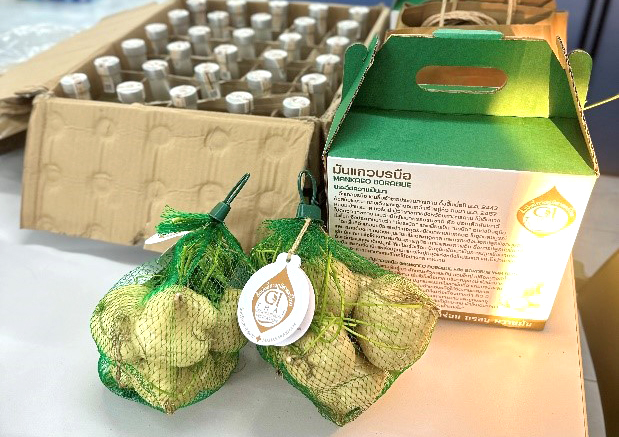
Marketing channels expanded to institutional markets, direct consumer sales, online platforms such as Facebook and TikTok, and modern retail markets. Two prototype packaging designs were developed. One farmer also transformed online selling from simple product promotion into storytelling that communicated the identity and local pride associated with Borabue yam bean as a GI product, demonstrating the use of cultural capital in contemporary marketing. Economic returns increased substantially, demonstrating the economic potential of GAP-GI upgrading. Nevertheless, the results represent market conditions during the study period and should be interpreted in light of seasonal price and demand fluctuations.
Outcomes, Impact, and Sustainability: The changes were sustained through mutually reinforcing mechanisms at local, provincial, and national levels. At the local level, GAP certification must be renewed every three years, while GI usage rights must be renewed every two years, creating external institutional incentives for continued compliance. Internally, the two community enterprises function as aggregators, internal quality controllers, and knowledge-sharing mechanisms. They are expected to transfer knowledge to an additional 203 households over the next 2–3 years through farmer-to-farmer learning, self-assessment against GAP criteria, and plot-level mentoring by certified farmers.
Institutionally, the ability of farmers to pursue GAP certification and GI usage rights in parallel resulted from coordinated action between the Maha Sarakham Agricultural Research and Development Center and the Provincial Commerce Office under provincial policy supporting Borabue yam bean GI development. This adjustment of procedures represents an institutional innovation within the AIS framework, demonstrating how inter-agency coordination can shorten conventional certification processes and accelerate agricultural innovation. At the provincial level, the four-stage development process provides a model for advancing other GI and locally distinctive agricultural products in Maha Sarakham. At the national level, the case offers lessons for other Thai GI products that have been registered but remain underutilized.
Article Details

This work is licensed under a Creative Commons Attribution 4.0 International License.
Area Based Development Research Journal values copyright protection and licensing to safeguard author rights and facilitate the appropriate dissemination of research. Our policies ensure openness, accessibility, and attribution. Authors retain copyright ownership, and articles are published under a Creative Commons Attribution License (CC BY), allowing sharing, adaptation, and proper attribution. Authors have the freedom to publish under the CC BY license, granting broad reuse and distribution permissions. The journal supports posting articles on third-party repositories, adhering to institutional and funding restrictions. Author guidelines detail copyright and licensing requirements, empowering authors with knowledge about their rights and responsibilities. These policies cultivate an environment of collaboration, openness, and responsible sharing, benefiting authors and the research community while honoring intellectual property rights.
References
Amekawa, Y. (2013). Can a public GAP approach ensure safety and fairness?: A comparative study of Q-GAP in Thailand. Journal of Peasant Studies, 40(1), 189–217. DOI: https://doi.org/10.1080/03066150.2012.746958
Amekawa, Y., Bumrungsri, S., Wayo, K., Gebre, G. G., & Hongsibsong, S. (2022). Pesticide use under public good agricultural practices standard: A comparative study in Thailand. Agriculture, 12(5), 606. DOI: https://doi.org/10.3390/agriculture12050606
Department of Agriculture. (n.d.). Good agricultural practices (GAP) for plants. Chanthaburi Agricultural Research and Development The office of Agricultural and Development Region 6 Department of Agriculture, Ministry of Agriculture and Cooperatives. Retrieved May 11, 2026, from: https://www.doa.go.th/ac/chanthaburi/?page_id=182. (in Thai).
Department of Agricultural Extension. (n.d.). Center farmer registration database. Retrieved July 22, 2024, from: https://farmer.doae.go.th/. (in Thai).
Department of Agricultural Extension. (2015). Yam bean. Retrieved October 1, 2025, from: https://esc.doae.go.th/wp-content/uploads/2015/02/mun-kaew.pdf. (in Thai).
Department of Intellectual Property. (n.d.). How to register a geographical indication. Retrieved September 8, 2025, from: https://www.ipthailand.go.th/images/781/GI_final1.pdf. (in Thai).
Department of Intellectual Property. (2019). Book G| Thailand. Bangkok: Onpa Co., Ltd Publishing. (in Thai).
Department of Intellectual Property. (2022). Public announcement of the registration of the geographical indication Mankaeo Borabue (Mankaeo Borabue), Volume 63, Announcement No. 188. Retrieved May 11, 2026, from: https://www.ipthailand.go.th/images/3534/2565/GI/GIAN188.pdf. (in Thai).
Food and Agriculture Organization of the United Nations. (2003). Development of a framework for good agricultural practices (COAG/2003/6). Committee on Agriculture, Seventeenth Session. Retrieved June 8, 2026, from: https://www.fao.org/4/y8704e/y8704e.htm.
Global Forum for Rural Advisory Services. (2012). Agricultural innovation systems (Good Practice Note No. 13). Retrieved June 8, 2026, from: https://www.g-fras.org/en/good-practice-notes/agricultural-innovation-systems.html?showall=1.
Government Public Relations Department. (2023). From Thai local wisdom to GI products: What is it and how beneficial is it?. Retrieved May 11, 2026, from: https://thailand.go.th/issue-focus-detail/006_043. (in Thai).
Hiebing, R. G., Cooper, S. W., & Wehrenberg, S. J. (2012). The successful marketing plan: How to create dynamic, results oriented marketing. (4th edition). New York: McGraw Hill Professional.
Institute of Public Policy, Prince of Songkla University. (n.d.). Guidelines for value addition and income distribution to communities through geographical indications (GI). Retrieved May 11, 2026, from: https://ppi.psu.ac.th/project/968. (in Thai).
Jaimun, R. (2022). Value addition of dried fruit products by packaging design. Journal of Fine Arts, 13(2), 169–195. (in Thai).
Kamthonkiat, D. (2025). Management of GI-certified agricultural products and their contribution to household income in rural Thailand. Asian Journal of Agriculture and Rural Development, 15(2), 121-133. DOI: https://doi.org/10.55493/5005.v15i2.5367
Kanjanawong, D., & Yenpiam, K. (2022). Safety rice production model forward to GAP standard in Suphan Buri province. Journal of Social Science and Buddhistic Anthropology, 7(8), 67-81. (in Thai).
Kanokhong, K., Rattanawan, N., & Jeerat, P. (2019). Adoption of crop growing methods under the standards of Good Agricultural Practice (GAP) of farmers, Mon Ngo Royal Project Development Center Mae Tang District, Chiang Mai. Journal of Agricultural Research and Extension, 36(1), 75–84. (in Thai).
Kemmis, S. & McTaggart, R. (2007). Participatory action research: Communicative action and the public sphere. In: N. Denzin & Y. Lincoln (Eds.), Strategies of Qualitative Inquiry (pp. 271-330), California: Sage, Thousand Oaks.
Klerkx, L., van Mierlo, B., & Leeuwis, C. (2012). Evolution of systems approaches to agricultural innovation: Concepts, analysis and interventions. In: I. Darnhofer, D. Gibbon, & B. Dedieu (Eds.), Farming systems research into the 21st century: The new dynamic (pp. 457–483). Netherlands: Springer, Dordrecht. DOI: https://doi.org/10.1007/978-94-007-4503-2_20
Kotler, P., & Keller, K. L. (2016). Marketing management. (15th edition). Boston: Pearson Education.
Kularsar, J. (2018). Participatory action research for developing the classroom research competencies of teachers in Non-Formal and Informal Education Center at Huai Mek, Kalasin. (Master’s thesis). Mahasarakham University, Faculty of Education. (in Thai).
Kwanmuang, P. (2017). Jicama (yam bean): The properties for functional beverages production. Journal of Industrial Education, 16(3), 1-6. (in Thai).
Lamprinopoulou, C., Renwick, A., Klerkx, L., Hermans, F., & Roep, D. (2014). Application of an integrated systemic framework for analysing agricultural innovation systems and informing innovation policies: Comparing the Dutch and Scottish agrifood sectors. Agricultural Systems, 129, 40–54. DOI: https://doi.org/10.1016/j.agsy.2014.05.001
Laosutsan, P., Shivakoti, G. P., & Soni, P. (2019). Factors influencing the adoption of good agricultural practices and export decision of Thailand's vegetable farmers. International Journal of the Commons, 13(2), 867–880. DOI: https://doi.org/10.5334/ijc.895
Maha Sarakham Provincial Office. (2024). Mahasarakham Provincial Development Plan (2023-2027) 2024 Revision. Strategy and Information for Provincial Development Group. Retrieved October 1, 2025, from: https://mahasarakham.go.th/new/files/com_ebook_strategy/2022-12_077fe8c31740130.pdf. (in Thai).
National Bureau of Agricultural Commodity and Food Standards. (2021). Good agricultural practices for food crops (Thai Agricultural Standard TAS 9001-2021). Ministry of Agriculture and Cooperatives. Retrieved June 8, 2026, from: https://www.doa.go.th/oard6/wp-content/uploads/2021/12/20211105094741_960669.pdf. (in Thai).
Organisation for Economic Co-operation and Development. (2013). Agricultural innovation systems: A framework for analysing the role of the government. Retrieved June 8, 2026, from: https://doi.org/10.1787/9789264200593-en.
Ozanne, J. L., & Saatcioglu, B. (2008). Participatory action research. Journal of Consumer Research, 35(3), 423–439. DOI: https://doi.org/10.1086/586911
Parmotmuang, M., Sukontachart, T., & Ananwettayanon, C. (2023). The development of contemporary packaging for order to increasing of remaining agricultural community a case study of community enterprise applications Amphoe Doem Bang Nang Buat Suphanburi. Journal of Fine Arts Research and Applied Arts, 10(1), 182–199. (in Thai).
Perreault, W. D., Cannon, J. P., & McCarthy, E. J. (2017). Essentials of marketing: A marketing strategy planning approach. (15th edition). New York: McGraw-Hill.
Phadungkwan, S. (2024). The elements of Geographical Indication (GI) product creation towards customer’s purchase decision in Bangkok and Metropolitan areas. (Master’s thesis). Bangkok University, Graduate School. (in Thai).
Pongvinyoo, P., Yamao, M., & Hosono, K. (2014). Factors affecting the implementation of good agricultural practices (GAP) among coffee farmers in Chumphon Province, Thailand. American Journal of Rural Development, 2(2), 34–39. DOI: https://doi.org/10.12691/ajrd-2-2-3
Sae-lee, P., & Pochan, J. (2021). Supply chain management in melon production: A case study of melon hydro green farm. Industrial Technology and Engineering Pibulsongkram Rajabhat University, 3(2), 182–197. (in Thai).
Spielman, D. J., & Birner, R. (2008). How innovative is your agriculture?: Using innovation indicators and polices to strengthen capacities and performance (Agriculture and rural development discussion paper No.41). World Bank. Retrieved May 11, 2026, from: https://documents.worldbank.org/en/publication/documents-reports/documentdetail/696461468316131075.
Spielman, D. J., Ekboir, J., & Davis, K. (2009). The art and science of innovation systems inquiry: Applications to sub-Saharan African agriculture. Technology in Society, 31(4), 399–405. DOI: https://doi.org/10.1016/j.techsoc.2009.10.004
Sukkon, K. & Ketphet, C. (2021). Branding and packaging design for processed cashew nuts with cultural capital of Ranong Province. Journal of Design Echo, 2(2), 33-45. (in Thai).
Supapunt, P., & Awirothananon, T. (2018). Knowledge, practices, and marketing channels of vegetables with Good Agricultural Practice Standard in Chiang Mai. Journal of Agricultural Research and Extension, 35(2), 64–76. (in Thai).
Sutthinarakorn, W. (2013). Action research: Freedom and creativity-based research. Bangkok: Siamparitut.
Thaotrakool, N. (2019). Branding and packaging design for community business group in Mae Sariang District, Mae Hong Son Province. Journal of Accountancy and Management, 11(2), 100-117. (in Thai).
Thepchauy, P., & Noknoi, J. (2025). Guidelines for developing a good agricultural practice melon farm business model: A case study of be fruits farm, Songkhla province. Journal of Social Science and Cultural, 9(11), 303–316. (in Thai).
Thikul, S., & Suwanmaneepong, S. (2020). Marketing strategies and business model for organic melon farm: A case of Farm Suk Plook Organic, Rong Kham District, Kalasin Province. In: Proceedings of the 58th Kasetsart University Annual Conference (pp. 494–501). Bangkok: National Research Council of Thailand. (in Thai).
Trade Policy and Strategy Office. (2024). A study report on guidelines for promoting Geographical Indications (GI) products. Ministry of Commerce. Retrieved May 11, 2026, from: https://www.tpso.go.th/document/2405-0000000009. (in Thai).
Wongpratheep, N., Phohirun, W., Noitup, P., & Sirisan, P. (2022). Development of pineapple value chain system of Ban Tham Phrik, Phitsanulok Province. Area Based Development Research Journal, 14(1), 14-26. (in Thai).
World Bank. (2007). Enhancing agricultural innovation: How to go beyond the strengthening of research systems. Retrieved May 11, 2026, from: https://documents1.worldbank.org/curated/en/864351468325269468/pdf/379000Enhancin101OFFICIAL-0USE0ONLY1.pdf.
World Bank. (2012). Agricultural innovation systems: An investment sourcebook. Retrieved May 11, 2026, from: https://documents1.worldbank.org/curated/en/140741468336047588/pdf/672070PUB0EPI0067844B09780821386842.pdf.
