
Nypa Fruticans Waste for Construction of an Eco-Friendly Pavilion: A Learning Resource and Identity Enhancement of Green Community in Wangwon Sub-District, Trang Province
Article Sidebar
Main Article Content
Abstract
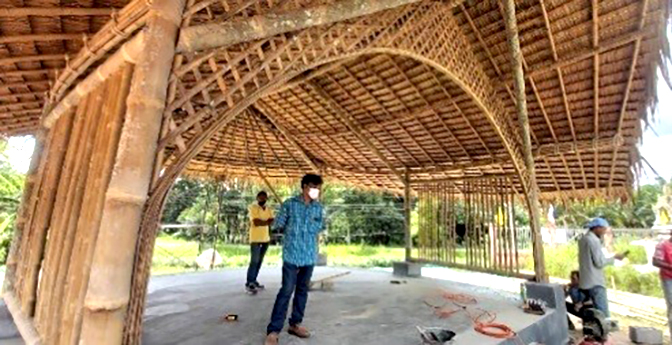
The community of Wang Won sub-district, Kantang district in Trang province is an area fertile with Nypa fruticans which are community economic plants. There is a large amount of Nypa fruticans waste material caused by the peeling of Nypa fruticans leaves approximately 30,000-50,000 pieces per day, which are causing the environmental problems and a problem of scenery in the community. This research has utilized waste materials to add value and build an environment in the community. By using participatory work processes, consisting of 1) Resource exploration 2) Review of physical and mechanical properties of Nypa fruticans waste blocks before application and product development 3) Tool development 4) Design of an eco-friendly pavilion, and 5) Development and construction of an eco-friendly pavilion, 6) The expansion of the eco-friendly pavilion. As a result, the eco-friendly pavilion has turned the area into a learning center in the community as it provides space for exhibitions, knowledge transfer training, and creating an identity for the community. It also promotes knowledge transfer to nearby villages and develops local innovators to transfer knowledge. The budget for waste management in the community has been reduced. Previously, the cost of waste management was 20,000 baht per month, reduced to 8,000 baht per month, accounting for 60% of the original cost reduction. Finally, the constructed pavilion solves the environmental problem and is considered a tool to sustain the local wisdom of "Nypa fruticans" plantation and application of the community.
Article Details

This work is licensed under a Creative Commons Attribution-NonCommercial-NoDerivatives 4.0 International License.
Area Based Development Research Journal values copyright protection and licensing to safeguard author rights and facilitate the appropriate dissemination of research. Our policies ensure openness, accessibility, and attribution. Authors retain copyright ownership, and articles are published under a Creative Commons Attribution License (CC BY), allowing sharing, adaptation, and proper attribution. Authors have the freedom to publish under the CC BY license, granting broad reuse and distribution permissions. The journal supports posting articles on third-party repositories, adhering to institutional and funding restrictions. Author guidelines detail copyright and licensing requirements, empowering authors with knowledge about their rights and responsibilities. These policies cultivate an environment of collaboration, openness, and responsible sharing, benefiting authors and the research community while honoring intellectual property rights.
References
Brophy, V., & Lewis, J. O. (2012). A green vitruvius: Principles and practice of sustainable architectural design. UK: Routledge.
Cooper, W. W., Seiford, L. M., & Zhu, J. (Eds.). (2011). Handbook on data envelopment analysis. Germany: Springer.
Jaitae, S. (2021). Agricultural residues utilization among farmers in Keelek sub-district municipality, Mae Rim district, Chiang Mai. Journal of Agricultural Research and Extension, 38(2), 79-88. (in Thai).
Kamyingyong, P. (2016). Maximizing the value of material scraps and turning into eco products case study: Home decoration products from wood scraps. (Master’ s thesis). Bangkok University, Faculty of Business Administration. (in Thai).
Kersey, J., McCue, M., & Skidmore, E. (2020). Domains and dimensions of community participation following traumatic brain injury. Brain Injury, 34(6), 708-712.
Krishnan, V., & Ulrich, K. T. (2001). Product development decisions: A review of the literature. Management Science, 47(1), 1-21.
Peng, J., Strijker, D., & Wu, Q. (2020). Place identity: How far have we come in exploring its meanings?. Frontiers in Psychology, 11, 294.
Pikkemaat, B., Peters, M., & Bichler, B. F. (2019). Innovation research in tourism: Research streams and actions for the future. Journal of Hospitality and Tourism Management, 41, 184-196.
Ragheb, A., El-Shimy, H., & Ragheb, G. (2016). Green architecture: A concept of sustainability. Procedia-Social and Behavioral Sciences, 216, 778-787.
Sangkakool, T. (2018). The survey of residual waste from nipa palms in Palian communities in order to create product prototype. Academic Journal of Architecture, 67, 131-146. (in Thai).
Tansakul, P., & Chuaykarn, N. (2021). Development of creative products from nipa palm forest resources to promote tourism of Khanab Nak community, Nakhon Si Thammarat province. Area Based Development Research Journal, 13(1), 44-60. (in Thai).
