
Power of Color: Applying Biophilic Principles to Visual Art
Article Sidebar
Main Article Content
บทคัดย่อ
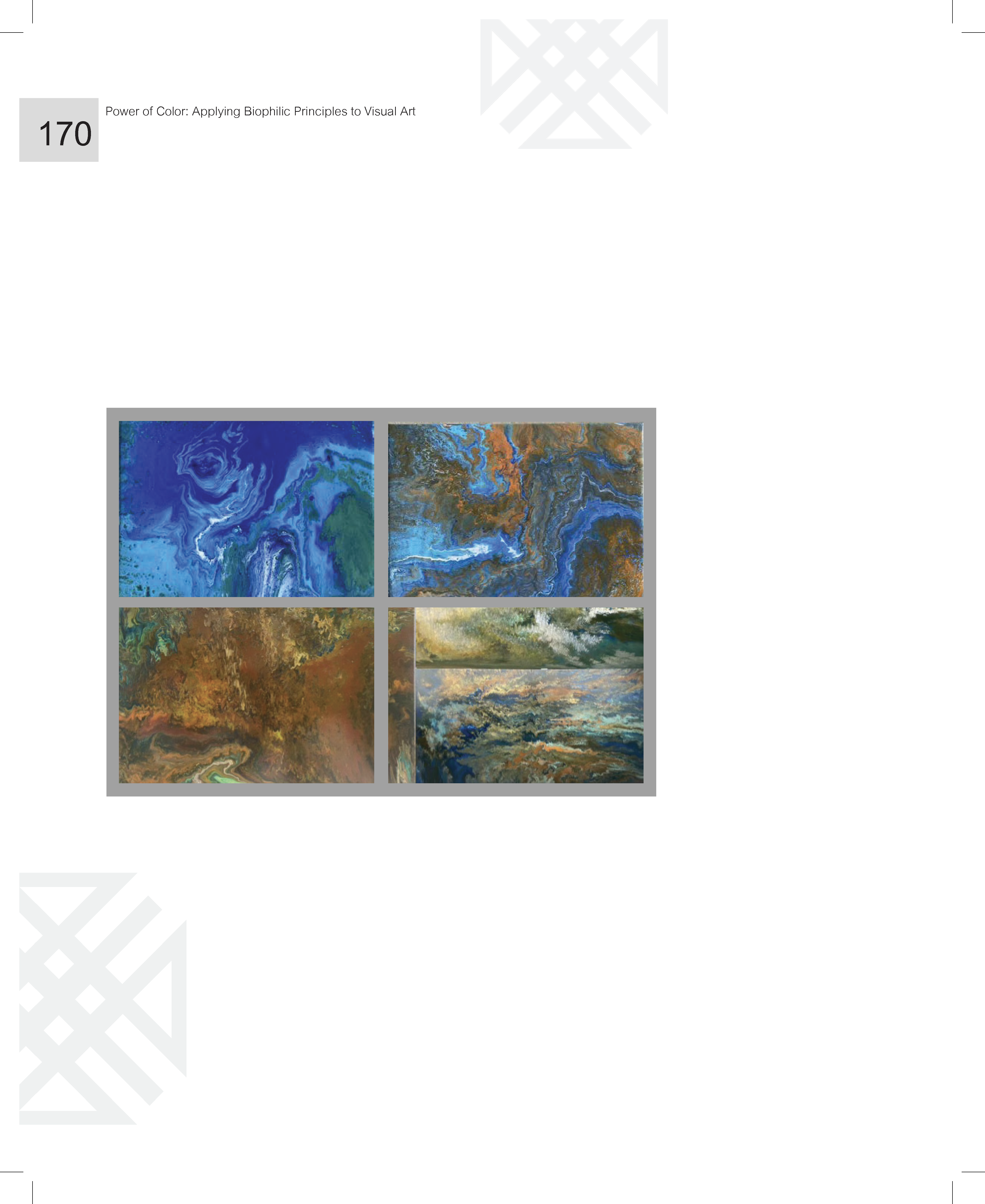
This study explores color theory and its manifestations in visual art, uniquely anchored in the dynamic interplay of biophilic principles and cultural contexts, specifically within the terrains of Xinjiang and Gansu. Emphasizing the profound role of biophilia, the research accentuates the emotive potential of color in visual art, enriched by a spectrum of stylistic diversities, avant-garde techniques, and meticulous material choices. With a theoretical foundation in biophilic design, the study examines the intricate balance between nature and culture, manipulating color and diluent proportions to evoke the quintessence of local environments and traditions. Moreover, this paper illuminates the democratization of visual art, championing its therapeutic capacities. It ardently advocates for an interdisciplinary fusion - marrying sociology, visual art, and philosophy - to both amplify and refine the future trajectories of color-centered visual art. In doing so, it positions biophilia as an indispensable lens for understanding and innovating within the broader scope of visual art and cultural interpretation.
Article Details

อนุญาตภายใต้เงื่อนไข Creative Commons Attribution-NonCommercial-NoDerivatives 4.0 International License.
ต้นฉบับที่ได้รับการตีพิมพ์ในวารสารศิลปกรรมบูรพา (Burapha Arts Journal) คณะศิลปกรรมศาสตร์ มหาวิทยาลัยบูรพา ถือเป็นกรรมสิทธิ์ของมหาวิทยาลัยบูรพา ห้ามนำข้อความทั้งหมดหรือบางส่วนไปพิมพ์ซ้ำเว้นเสียแต่ว่าจะได้รับอนุญาตจากมหาวิทยาลัยฯ เป็นลายลักษณ์อักษร
เอกสารอ้างอิง
Albers, J. (1963). The Interaction of Color. New Haven, NY: Yale University Press.
Annerstedt, Matilda and Peter Währborg. (2011). “Nature-Assisted Therapy: Systematic Review of Controlled and Observational Studies.” Scandinavian Journal of Public Health 39 (4): 371-388
Barbiero, Giuseppe, and Rita Berto. (2021). “Biophilia as Evolutionary Adaptation: An Onto-and Phylogenetic Framework for Biophilic Design.” Frontiers in Psychology 12 (1): 700709.
Beatley, Timothy. (2011). Biophilic Cities: Integrating Nature into Urban Design and Planning. Washington, D.C.: Island Press.
Best, J. (Ed.). (2017). Colour Design: Theories and Applications. Duxford: Woodhead Publishing.
Browning, William, and Catherine Ryan. (2020). Nature Inside: A Biophilic Design Guide. London, UK: RIBA Publishing.
de Noblet J. (1993). Industrial Design: Reflection of a Century. Paris: Flammarion.
Delamare, F. and B. Guineau. (1999). Colour: Making and Using Dyes and Pigments. London: Thames & Hudson.
Dow, A.W. (1913). Composition: A Series of Exercises in Art Structure. New York, NY: Doubleday, Page and Company.
Fortner, Brand and Theodore E. Meyer. (1997). “Hue, Saturation, Intensity.” In Number by Colors: A Guide to Using Color to Understand Technical Data (63-84), edited by Brand Fortner and Theodore E. Meyer. New York, NY: Springer.
Fromm, Erich. (1963). “The Prophetic Concept of Peace.” In The Dogma of Christ and Other Essays on Religion Psychology and Culture (183-191), edited by Erich Fromm. Greenwich, England: Fawcett Premier.
Gage, J. (1995). Colour and Culture. London: Thames & Hudson.
Gage, J. (2000). Colour and Meaning: Art, Science and Symbolism. London: Thames & Hudson.
Gerritsen, Anne. (2012). “Porcelain and the Material Culture of the Mongol-Yuan Court.” Journal of Early Modern History 16 (3): 241-273.
Gribkov, Vitaly S., and Vladimir M. Petrov. (1996). “Color Elements in National Schools of Painting: A Statistical Investigation.” Empirical Studies of the Arts 14 (2): 165-181.
Hartig, Terry, and Peter H. Kahn Jr. (2016). “Living in Cities, Naturally.” Science 352 (6288): 938-940.
Hauffe T. (1998). Design: A Concise History. London: Laurence King.
Hawkins, Harriet. (2013). For Creative Geographies: Geography, Visual Arts and the Making of Worlds. London: Routledge.
Hsiao, Shih‐Wen, and Hung‐Cheng Tsai. (2004). “Use of Gray System Theory in Product‐Color Planning.” Color Research & Application 29 (3): 222-231.
Hua, Peng. (2020). “Value of the Heritage.” In China Danxia (121-133), edited by Hua Peng. New York, NY: Springer.
Ibraheem, Noor A., Mokhtar M. Hasan, Rafiqul Z. Khan, and Pramod K. Mishra. (2012). “Understanding Color Models: A Review.” ARPN Journal of Science and Technology 2 (3): 265-275.
Itten, J. (1973). The Art of Color, Revised Edition. New York, NY: John Wiley.
Jasper, Adam. (2014). “Colour Theory.” Architectural Theory Review 19 (2): 119-123.
Kaixiang, Zhang, and Zheng Xioahong. (2020). “Application of Chinese Five Elements Color View in Chinese Restaurant Space.” Journal of the Color Science Association of Japan 44 (3): 261.
Katcher, Aaron Honori, and Alan M. Beck. (1983). New Perspectives on our Lives with Companion Animals. Philadelphia, PN: University of Pennsylvania Press.
Kellert, Stephen R. (2012). Birthright: People and Nature in the Modern World. New Haven, CT: Yale University Press.
Kellert, Stephen R. (2018). Nature by Design: The Practice of Biophilic Design. New Haven, CT: Yale University Press.
Kellert, Stephen, and Elizabeth Calabrese. (2015). The Practice of Biophilic Design. London: Terrapin Bright.
Lee, Tien-Rein. (2012). “Heaven, Earth and Humans: Color Harmony in Chinese Culture.” Obuda University e-Bulletin 3 (1): 155-164.
Li, Xueyang, and Xiaozhao Cao. (2022). “Analysis of the Art Design of Virtual Three-Dimensional Data Imaging Technology in the Rural Landscape Design of Western Sichuan.” In 2022 3rd International Conference on Smart Electronics and Communication (ICOSEC) (1436-1439). Piscataway, NJ: IEEE.
Madden, Thomas J., Kelly Hewett, and Martin S. Roth. (2000). “Managing Images in Different Cultures: A Cross-National Study of Color Meanings and Preferences.” Journal of International Marketing 8 (4): 90-107.
Marcu, Gabriel G. and Satoshi Abe. (1997). “New HSL and HSV Color Spaces and Applications.” In SPIE Proceedings Vol. 2949: Imaging Sciences and Display Technologies (252-263). https://doi.org/10.1117/12.266331.
McGee, Beth, Nam–Kyu Park, Margaret Portillo, Sheila Bosch, and Mickie Swisher. (2019). “DIY Biophilia: Development of the Biophilic Interior Design Matrix as a Design Tool.” Journal of Interior Design 44 (4): 201-221.
Mollica, Patti. (2013). Color Theory: An Essential Guide to Color: From Basic Principles to Practical Applications, Vol. 53. Mission Viejo, CA: Walter Foster.
Morton, Jill. (1997). A Guide to Color Symbolism, Vol. 28. Harleysville, PA: Colorcom.
Nowak, P. M., and P. Koscielniak. (2019). “What Color is your Method? Adaptation of the RGB Additive Color Model to Analytical Method Evaluation.” Analytical Chemistry, 91(16): 10343-10352.
O’Connor, Z. (2021). “Traditional Colour Theory: A Review.” Color Research and Application, 46 (4): 838-847.
O’Connor, Z. (2023). “Traditional Colour Theory in Design Context: A Focus on Value.” Journal of the International Colour Association 32: 29-43.
Öhman, Arne. (1986). “Face the Beast and Fear the Face: Animal and Social Fears as Prototypes for Evolutionary Analyses of Emotion.” Psychophysiology 23 (2): 123-145.
Parkhurst, Charles, and Robert L. Feller. (1982). “Who Invented the Color Wheel?” Color Research & Application 7 (3): 217-230.
Parsons, F.A. (1921). The Art Appeal in Display Advertising. New York, NY: Harper & Brothers.
Raizman D. (2003). History of Modern Design. London: Laurence King.
Ross, D.W. (1919). The Painter's Palette: A Theory of Tone Relations, an Instrument of Expression. Boston and New York: Houghton Mifflin.
Ryan, Catherine O., William D. Browning, Joseph O. Clancy, Scott L. Andrews, and Namita B. Kallianpurkar. (2014). “Biophilic Design Patterns: Emerging Nature-Based Parameters for Health and Well-Being in the Built Environment.” ArchNet-IJAR: International Journal of Architectural Research 8 (2): 62.
Sachs, Naomi A. (2022). “EO Wilson: A Legacy of “Biophilia”.” HERD: Health Environments Research & Design Journal 15 (4): 283-286.
Sheng, Li, Zhu Ying, Zhao Aili, Zheng Lili, Du Jiahui, and Yang Xiaoli. (2022). “Research on the Cultural and Creative Design of Paper Cutting Based on the Red Culture in Heilongjiang, China.” In 2022 8th International Conference on Humanities and Social Science Research (ICHSSR 2022) (2424-2428). Paris: Atlantis Press.
Söderlund, Jana. (2019). The Emergence of Biophilic Design; Cities and Nature. Switzerland: Springer Nature.
Stern, D. N. (2010). Forms of Vitality: Exploring Dynamic Experience in Psychology, the Arts, Psychotherapy, and Development. Oxford: Oxford University Press.
Turner, Will R., Toshihiko Nakamura, and Marco Dinetti. (2004). “Global Urbanization and the Separation of Humans from Nature.” Bioscience 54 (6): 585-590.
Ulrich, Roger. (1993). “Biophilia, Biophobia, and Natural Landscapes.” In The Biophilia Hypothesis (73-137), edited by Stephen Kellert and Edward Wilson. Washington, D.C.: Island Press.
Ulrich, Roger. (2008). “Biophilic Theory and Research for Healthcare Design.” In Biophilic Design: The Theory, Science, and Practice of Bringing Buildings to Life (87-106), edited by Judith Heerwagen, Martin Mador, and Stephen R. Kellert. New York, NY: Wiley.
Wang, Ran, Minghui Wang, and Renzo Shamey. (2021). “Azurite Blue in the Qing Dynasty.” Color Research & Application 46 (4): 848-855.
Wen, Xiaojing, and Paul White. (2020). “The Role of Landscape Art in Cultural and National Identity: Chinese and European Comparisons.” Sustainability 12 (13): 5472.
Wilson, Edward O. (1986). Biophilia. Cambridge, MA: Harvard University Press.
Wood, Nigel, Michael S. Tite, Chris Doherty, and Brian Gilmore. (2007). “A Technological Examination of Ninth–Tenth Century AD Abbasid Blue‐and‐White Ware from Iraq, and its Comparison with Eighth Century AD Chinese Blue‐and‐White Sancai Ware.” Archaeometry 49 (4): 665-684.
Worldbank. (2019). “Urban Population (% of Total Population.” [Online]. Available at: https://data.worldbank.org/indicator/SP.URB.TOTL.IN.ZS (Accessed 12 October 2023).
Yuan, Yihong, and Xuemei Liu. (2021). “Research on Decorative Design of Porcelain Censers in Song Dynasty.” In 7th International Conference on Arts, Design and Contemporary Education (ICADCE 2021) (495-500). Paris: Atlantis Press.
Yu, Hui-Chih. (2014). “A Cross-Cultural Analysis of Symbolic Meanings of Color.” Chang Gung Journal of Humanities and Social Sciences 7 (1): 49-74.
Zhang, Yanyan. (2023). “The Influence of Chinese Culture on Xinjiang Art Theme.” Art and Performance Letters 4 (3): 39-45.
Zhou, Qian. (2022). “The Difference Between Chinese and Western Color Symbolism and the Reasons.” In Conference Proceedings of Vitebsk State University (507-508). Vitebsk: Vitebsk State University.
Zujie, Yuan. (2007). “Dressing for Power: Rite, Costume, and State Authority in Ming Dynasty China.” Frontiers of History in China 2 (2): 181-212.
