การสื่อสารวิกฤตมลพิษทางอากาศผ่านศิลปะสื่อใหม่: กรณีศึกษานิทรรศการ “Polluted Currents”
Article Sidebar
Main Article Content
บทคัดย่อ
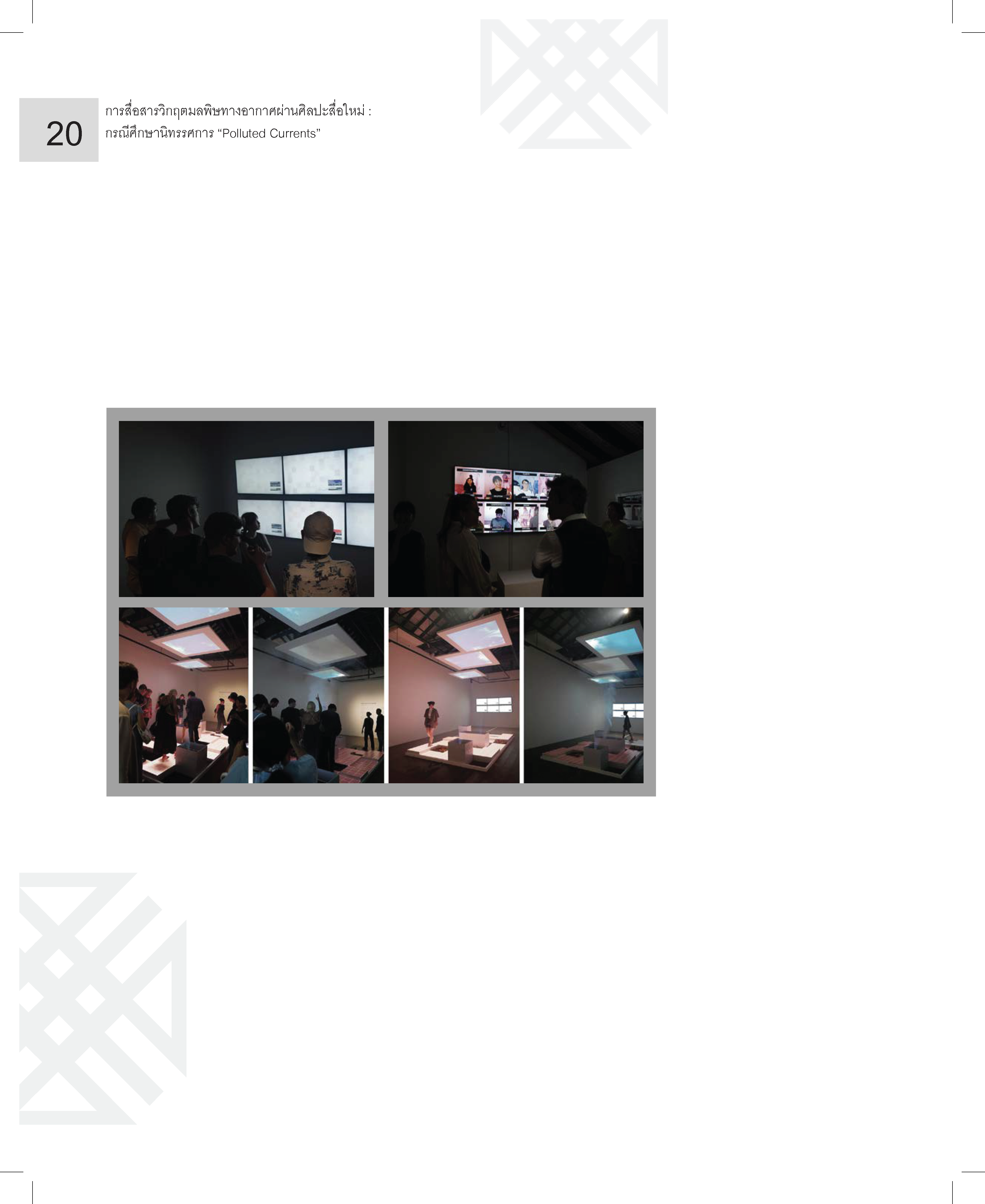
This research examines the use of new media and interactive art to communicate air pollution awareness in the exhibition "Polluted Currents," held at Warin Lab Contemporary from November 29, 2022, to January 25, 2023. The study explores how new media art can effectively address environmental issues, focusing on PM2.5 and PM10 pollution through three interconnected artworks
The exhibition included "Data Flow," a generative art piece visualizing real-time air quality data; "Footstep of Impact," an interactive installation where visitors' movements generated pollution effects on a terrain map; and "Visage Reaction," which used facial detection to confront viewers with their environmental impact. Together, these works provided an immersive and educational experience.
Non-participant observation and Interviews with gallery executives, curators, academics, artists, and collectors highlighted the effectiveness of digital technology and audience interaction in raising awareness. Experts praised the fusion of art, science, and technology for simplifying complex data, though concerns about costs and maintenance were noted. This study underscores the potential of new media art to drive social change through meaningful aesthetic engagement.
Article Details

อนุญาตภายใต้เงื่อนไข Creative Commons Attribution-NonCommercial-NoDerivatives 4.0 International License.
ต้นฉบับที่ได้รับการตีพิมพ์ในวารสารศิลปกรรมบูรพา (Burapha Arts Journal) คณะศิลปกรรมศาสตร์ มหาวิทยาลัยบูรพา ถือเป็นกรรมสิทธิ์ของมหาวิทยาลัยบูรพา ห้ามนำข้อความทั้งหมดหรือบางส่วนไปพิมพ์ซ้ำเว้นเสียแต่ว่าจะได้รับอนุญาตจากมหาวิทยาลัยฯ เป็นลายลักษณ์อักษร
เอกสารอ้างอิง
Candy, L., & Edmonds, E. (2018). Practice-based research in the creative arts: Foundations and futures from the front line. Leonardo, 51(1), 63-69.
Cox, R. (2013). Environmental communication and the public sphere (3rd ed.). SAGE Publications.
Edmonds, E. (2010). The art of interaction. Digital Creativity, 21(4), 257-264.
Galanter, P. (2003). What is generative art? Complexity theory as a context for art theory. Proceedings of the International Conference on Generative Art, 6, 1-21.
Hornby, L. (2017). Appropriating the weather: Olafur Eliasson and climate control. Environmental Humanities, 9(1), 60-83.
Kolb, D. A. (1984). Experiential learning: Experience as the source of learning and development. Prentice Hall.
Lumley, S. (2021). Interactive visualization of climate change: Characteristics, intentions, and metrics for success (Master's thesis, McGill University). McGill University. https://escholarship.mcgill.ca/downloads/qr46r5743
Manovich, L. (2001). The language of new media. MIT Press.
Personal Data Protection Act B.E. 2562. (2019, May 27). Royal Thai Government Gazette. Vol. 136, Section 69 A, pp. 52-95.
Pinsky, M., & Sommer, L. (2020). Pollution Pods: Can art change people's perception of climate change and air pollution? Field Actions Science Reports, Special Issue 21, 90-95. https://journals.openedition.org/factsreports/6161
Pollution Control Department. (2024). Report on Thailand's Pollution Situation 2023. https://www.pcd.go.th/publication/32171/
Tufte, E. R. (1983). The visual display of quantitative information. Graphics Press.
