
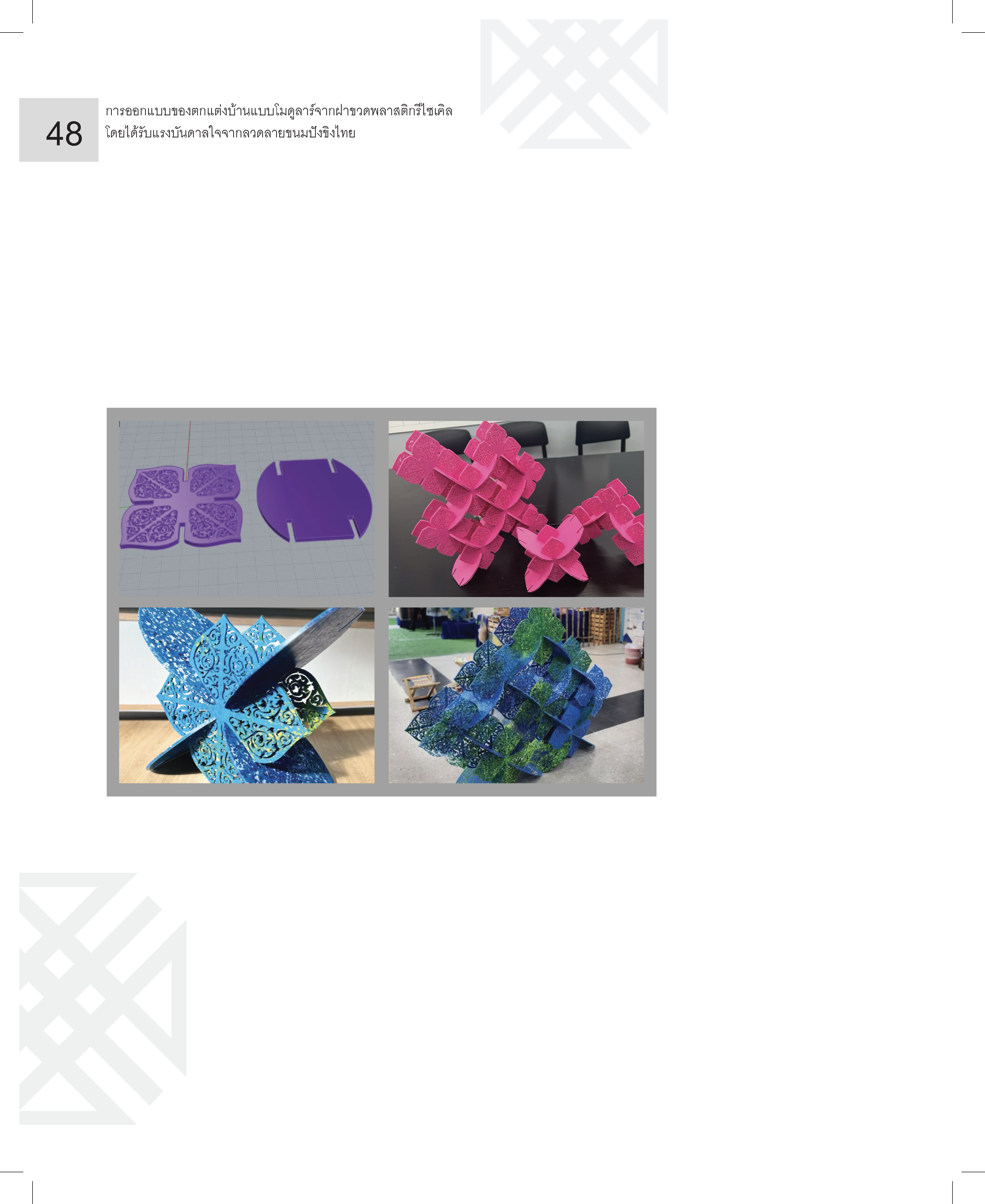
การออกแบบของตกแต่งบ้านแบบโมดูลาร์จากฝาขวด พลาสติกรีไซเคิล โดยได้รับแรงบันดาลใจจากลวดลายขนมปังขิงไทย
Article Sidebar
Main Article Content
บทคัดย่อ
This research investigates the potential of repurposing plastic bottle caps into modular home décor items, inspired by traditional Thai gingerbread fretwork patterns that highlight the beauty of local craftsmanship. Utilizing a Creative Practice-Based Research approach, the study emphasizes design and experimentation. High-Density Polyethylene (HDPE) and Polypropylene (PP) plastic bottle caps are recycled through a melting process to create sheets, which are then used to craft modular fretwork patterns. These patterns are CNC-cut to produce prototypes suitable for shelves, light partitions, or other decorative elements. The prototypes are assessed for their cultural significance and sustainability through a modular design framework, alongside Siu’s Outer–Intermediate–Inner Structure concept.
The evaluation conducted by four experts and six end-users demonstrated that the modular design utilizing recycled plastic bottle caps effectively met the research objectives, particularly regarding material quality, structural integrity, and usability. The design received a score of 4.00 (S.D. = 0.00) for structural strength and an impressive 4.50 (S.D. = 0.50) for assembly flexibility. Its versatility was similarly well-rated, achieving a score of 4.50 (S.D. = 0.50). User feedback highlighted the ease of assembly, which scored 3.83 (S.D. = 0.69), and noted good flexibility for reconfiguration, receiving a score of 4.17 (S.D. = 0.69). Aesthetic appeal earned the highest score of 4.50 (S.D. = 0.50). Suggestions for improvement included enhancing structural strength, adding safety features, and developing a supporting base system, indicating potential areas for future development.
Article Details

อนุญาตภายใต้เงื่อนไข Creative Commons Attribution-NonCommercial-NoDerivatives 4.0 International License.
ต้นฉบับที่ได้รับการตีพิมพ์ในวารสารศิลปกรรมบูรพา (Burapha Arts Journal) คณะศิลปกรรมศาสตร์ มหาวิทยาลัยบูรพา ถือเป็นกรรมสิทธิ์ของมหาวิทยาลัยบูรพา ห้ามนำข้อความทั้งหมดหรือบางส่วนไปพิมพ์ซ้ำเว้นเสียแต่ว่าจะได้รับอนุญาตจากมหาวิทยาลัยฯ เป็นลายลักษณ์อักษร
เอกสารอ้างอิง
Aroonsrimorakot, S. (2020). The Study of Recycle Process of Plastic Bottle and Texturing
Process by Integration with Debris Netting, Rope, Nets and Foam Buoy. Burapha Arts Journal, 22(2), 90–103. retrieved from https://so01.tci-thaijo.org/index.php/ buraphaJ/article/view/241940
Boonstra, M., & van Hest, F. (2017). The findings of the first survey into plastic bottle cap pollution on beaches in the Netherlands. The North Sea Foundation. https://www.bottlebill.org/images/PDF/Dutch%20study%20on%20caps_Doppenrapport_EN_2017_DEF_small.pdf
Burke, H., Wallis, L. A., & Gorman, A. C. (Eds.). (2021). RECYCLE(D): Objects and their afterlives. Wallis Heritage Consulting. https://www.researchgate.net/publication/355484496_RECYCLED_Objects_and_Their_Afterlives
Fletcher, S., March, A., Roberts, K., & Shiran, Y. (2023). Turning off the tap: How the world can end plastic pollution and create a circular economy. United Nations Environment Programme. https://www.researchgate.net/publication/370825570_ Turning_off_the_Tap_How_the_world_can_end_plastic_pollution_and_create_a_circular_economy
Gall, M., Schweighuber, A., Buchberger, W., & Lang, R. W. (2020). Plastic bottle cap recycling—Characterization of recyclate composition and opportunities for design for circularity. Sustainability, 12(24), 10378. https://doi.org/10.3390/su122410378
Geyer, R., Jambeck, J. R., & Law, K. L. (2017). Production, use, and fate of all plastics ever made. Science Advances, 3(7), e1700782. https://doi.org/10.1126/sciadv.1700782
Hopewell, J., Dvorak, R., & Kosior, E. (2009). Plastics recycling: Challenges and opportunities. Philosophical Transactions of the Royal Society B: Biological Sciences, 364(1526), 2115–2126. https://doi.org/10.1098/rstb.2008.0311
Hsu, C.-H., Lin, C.-L., & Lin, R. (2011). A study of framework and process development for cultural product design. In P. L. P. Rau (Ed.), Internationalization, Design and Global Development: Proceedings of the 4th International Conference, IDGD 2011, Held as Part of HCI International 2011, Orlando, FL, USA, July 9–14, 2011 (pp. 55–64). Springer. https://doi.org/10.1007/978-3-642-21660-2_7
Jamroenpuek, P. (2024). The branding innovation of partywear for consciouslites from value added recycle by using modular concept. Journal of Fine and Applied Arts Research, 11(2), 163–177. https://doi.org/10.60101/faraa.2024.265254
Keativipak, K. (2017). Develop product design through the Industrial Crafts Design Framework (Grow - Reborn). Journal of Fine and Applied Arts Khon Kaen University, 9(2), 333–366. retrieved from https://so02.tci-thaijo.org/index.php/fakku/article/view/114568
Kim, K.-B., Do-Seung, C., & Jang, J.-S. (2020). A study of product design using recycled materials. International Journal of Advanced Smart Convergence, 9(1), 70–81. https://doi.org/10.7236/IJASC.2020.9.1.70
Kuamsup, P. (2017). Stick-style fretwork: The beauty of the Rattanakosin period. Bangkok: Office of Archaeology, Fine Arts Department.
Li, S., Li, L., Zhang, T., & Huang, Y. (2022). Modular design realization and application. Journal of Sensors, 2022, Article ID 7192152. https://doi.org/10.1155/2022/7192152
Mazidah, M., Widiyanto, A., Sukesi, K., Suwignyo, H., & Dewi, E. P. (2024). Design optimization through modular and eco-friendly components. Management and Production Engineering Review, 15(1), 45–55. https://doi.org/10.2478/mspe-2024-0029
Phueaknamphol, K., Joneurairatana, E., & Sirivesmas, V. (2024). Composition of gingerbread fretwork: Case studies of Chanthaboon waterfront community. NAJUA: History of Architecture and Thai Architecture, 21(2), 1–22. https://doi.org/10.69598/najuahata. 21.2.274768
Qin, Z., & Ng, S. (2020). Culture as inspiration: A metaphorical framework for designing products with traditional cultural properties (TCPs). Sustainability, 12(17), 7171. https://doi.org/10.3390/su12177171
Srikhongchan, T. (2022). Modular system for outdoor furniture in Larn Hin Korn Wat Panyanant Ram area. Art and Architecture Journal Naresuan University, 13(2), 71–85. https://so01.tci-thaijo.org/index.php/ajnu/article/view/248880/172324
Wang, Z. G. (2022). Shaping traditional Chinese culture in contemporary fashion: ‘Guochao’ as a rising aesthetic and the case study of the designer brand Angel Chen. International Journal of Humanities and Social Sciences, 16(3), 102–110. World Academy of Science, Engineering and Technology. https://publications.waset.org/ 10012449/pdf
Wongtongsanguan, J. (2022). Emotional attachment: Redesign fashion waste for longevity [Doctoral dissertation, Silpakorn University]. Silpakorn University Institutional Repository. http://ithesis-ir.su.ac.th/dspace/handle/123456789/4098
