From “Ban Talad Kwan” to “Mueang Nonthaburi”: Historical Development during the 15th–17th Centuries through Archaeological and Art Historical Evidence
Keywords:
Ban Talad Kwan, Nonthaburi, Khlong Oam NonAbstract
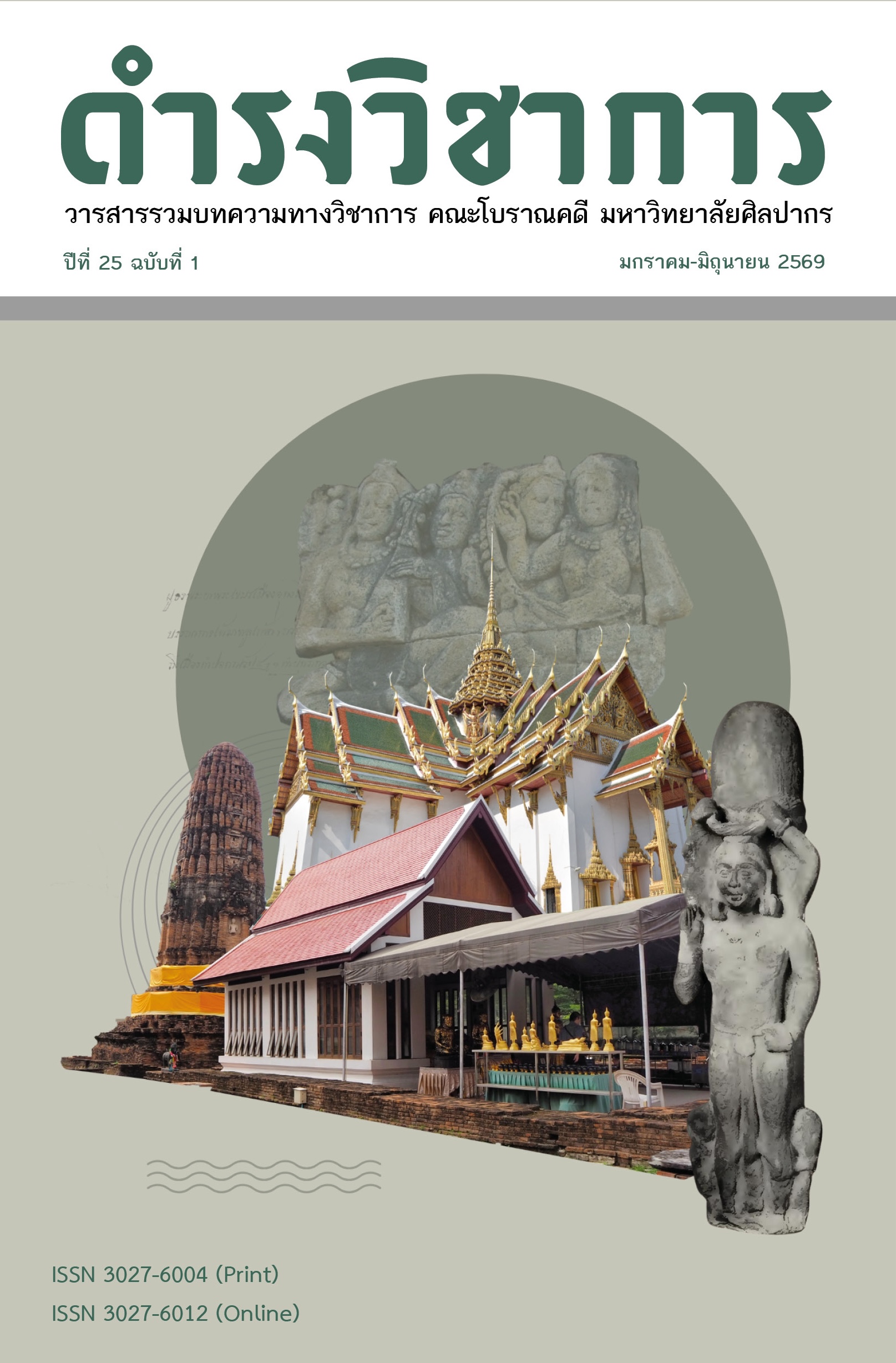
Nonthaburi is an important agricultural and trading hub along the Chao Phraya River, dating back to the Ayutthaya period. The development of the city is reflected in archaeological evidence, historical documents, arts, and other related sources. Nonthaburi began as a collection of agricultural communities along the old Chao Phraya River or Khlong Oam Non in the late 15th century, and the area eventually became known as “Ban Talad Kwan.” It began to form more clearly as a city, particularly after the construction of a large Prang at Wat Prang Luang, located near Khlong Bang Muang, dating back to the second half of the 16th century. Nonthaburi officially became a city in 1549 under the reign of King Maha Chakrapat, serving as an important port and food supply center on the eastern bank of the Chao Phraya River. Sandstone Buddha statues and red sandstone Semas discovered in the area date back to the same period as the establishment of the city. At the same time, the construction of Khlong Lat Bang Kruai, linking the area of Bangkok, contributed to the expansion of the communities and orchards. This is reflected in Crowned Buddha statues and red sandstone Semas, showing the prosperity of this area during the middle Ayutthaya period. Thus, the early development of Nonthaburi from a “village” to a “city” is marked by three key areas: Bang Muang, Ban Talad Kwan (Nonthaburi), and Bang Kruai.
Downloads
Published
Issue
Section
License
Copyright (c) 2026 Damrong Journal of The Faculty of Archaeology Silpakorn University

This work is licensed under a Creative Commons Attribution-NonCommercial-NoDerivatives 4.0 International License.
บทความนี้เป็นผลงานของข้าพเจ้าแต่เพียงผู้เดียว และ/หรือเป็นผลงานของข้าพเจ้าและผู้ร่วมงาน ตามชื่อที่ระบุในบทความจริง และเป็นผลงานที่มิได้ถูกนำเสนอหรือตีพิมพ์ที่ใดมาก่อน



