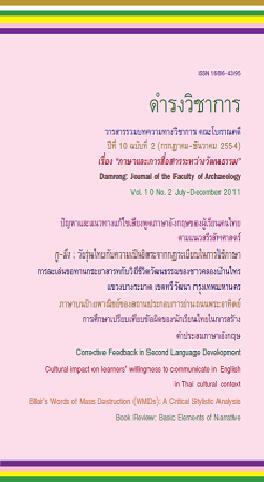
ผลกระทบทางวัฒนธรรมที่มีความเต็มใจของผู้เรียนในการพูดภาษาอังกฤษในบริบทวัฒนธรรมไทย
คำสำคัญ:
-บทคัดย่อ
บทความนี้มีวัตถุประสงค์ในการนำเสนออิทธิพลของวัฒนธรรมไทยที่มีผลต่อการเลือกตัดสินใจใช้ภาษาอังกฤษในชั้นเรียนในประเทศไทย โดยอาศัยกรอบแนวคิดของ แมคอินไทร์ และคณะ (1998) เรื่องความเต็มใจในการพูดในภาษาที่สอง เป็นพื้นฐานของการวิเคราะห์ อย่างไรก็ตามกรอบแนวคิดดังกล่าวถูกสร้างขึ้นจากบริบททางวัฒนธรรมของประเทศแคนาดาซึ่งเป็นประเทศที่มีภาษาทางการสองภาษา ลักษณะดังกล่าวตรงข้ามกับบริบททางวัฒนธรรมในประเทศไทยที่มีภาษาทางการเพียงภาษาเดียว บทความนี้จึงมุ่งเน้นศึกษาเฉพาะปัจจัยที่เกี่ยวข้องกับสถานการณ์การใช้ภาษาในรูปแบบต่างๆที่พบในห้องเรียนภาษาอังกฤษในประเทศไทย รวมถึงศึกษาค่านิยมทางวัฒนธรรมของคนไทยที่มีผลต่อทัศนคติในการสื่อสารด้วยภาษาอังกฤษ ผลการศึกษาสะท้อนให้เห็นถึงอิทธิพลของคู่สนทนาซึ่งเป็นตัวแปรทางวัฒนธรรมที่มีผลต่อการตัดสินใจเลือกพูดภาษาอังกฤษของคนไทย
เอกสารอ้างอิง
Cao, Y. & Philp, J. (2006). Interactional context and willingness to communicate: Acomparison of behavior in whole class, group and dyadic interaction.System, 34(4), 480-493.
Gudykunst, W.B. (1998). Individualistic and collectivistic perspectives oncommunication: An introduction. International Journal of InterculturalRelations, 22(2), 107-134.
Hofstede, G. (2001). Culture’s consequences: Comparing values, behaviors,institutions, and organizations across nations. California: Sage.
Holmes, H., Tangtongtavy, S. & Tomizawa, R. (1995). Working with the Thais. Bangkok: White lotus.
Kang, S.J. (2005). Dynamic emergence of situational willingness to communicate ina second language. System, 33(2), 277-292.
Komin, S. (1985). The world view through Thai value systems. In A. Pongsapich et al.,Traditional and changing Thai world view. Bangkok: Chulalongkorn University Press.
Komin, S. (1990). The psychology of Thai people. Bangkok: Research Institute of Development Administration.
MacIntyre, P.D. (1994). Variables underlying willingness to communicate: A causalanalysis. Communication Research Reports, 11(2), 135-142.
MacIntyre, P.D. (2007). Willingness to communicate in the second language:understanding the decision to speak as a volitional process. ModernLanguage Journal, 91(4), 564-576.
MacIntyre, P.D., Baker, S.C., Clément, R. & Donovan, L.A. (2003). Talking in order tolearn: Willingness to communicate and intensive language programs.Canadian Modern Language Review, 59(4), 589-607.
MacIntyre, P.D., Dörnyei, Z., Clément, R. & Noels, K.A. (1998). Conceptualizingwillingness to communicate in a L2: A situational model of L2 confidence andaffiliation. Modern Language Journal, 82(4), 545-562.
McCroskey, J.C. & Richmond, V.P. (1990). Willingness to communicate: A cognitiveview. In M. Booth-Butterfield (Ed.), Communication, cognition, andanxiety. Thousand Oaks, CA: Sage.
McCroskey. (1997). Willingness to communicate, communication apprehension,and self-perceived communication competence: Conceptualizationsand perspectives. In J.A. Daly & J.C. McCroskey (Eds.), Avoidingcommunication: Shyness, reticence, and communication apprehension. Cresskill, NJ: Hampton Press.
Mulders, N. (1979). Everyday life in Thailand: An interpretation. Bangkok: Duang Kamol.
Mulders, N. (1996). Inside Thai society: Interpretations of everyday life.Amsterdam: Pepin Press.
Pattapong, K. (2010). Willingness to communicate in a second language: A qualitativestudy of issues affecting Thai EFL learners from students’ and teachers’points of view. Unpublished Ph.D. thesis, The University of Sydney, Australia.Peng, J.E. (2007). Willingness to communicate in the Chinese EFLclassroom: A cultural perspective. In L.J. (Ed.), English language teachingin China: New approaches, perspectives, and standards. NY: Continuum.
Senawong, P. (1999). Developing pragmatic competence for cross-cultural communication. In English is an Asian language: The Thai context.Sydney: Macquarie Library.
Sensenig, B. (1975). Socialization and personality in Thailand. In K. Ishwaran (Ed.),Contributions to Asian studies (Vol. The psychological study of Theravadasocieties). E.J. Brill: Leiden.
Triandis, H.C. (1995). Individualism and collectivism. Boulder, CO: Westview Press.
Ushioda, E. (2009). A person-in-context relational view of emergent motivation, selfand identity. In D. Zoltán & U. Ema (Eds.), Motivation, language identity, and the L2 self. Bristol: Multilingual Matters.
Wen, W.P., & Clément, R. (2003). A Chinese conceptualization of willingness to communicate in ESL. Language, Culture and Curriculum, 16(1), 18-38.
Wichiajarote, W. (1973). The theory of affiliative society. Bangkok: PrasanmitrCollege of Education.
ดาวน์โหลด
ฉบับ
ประเภทบทความ
สัญญาอนุญาต
บทความนี้เป็นผลงานของข้าพเจ้าแต่เพียงผู้เดียว และ/หรือเป็นผลงานของข้าพเจ้าและผู้ร่วมงาน ตามชื่อที่ระบุในบทความจริง และเป็นผลงานที่มิได้ถูกนำเสนอหรือตีพิมพ์ที่ใดมาก่อน



