
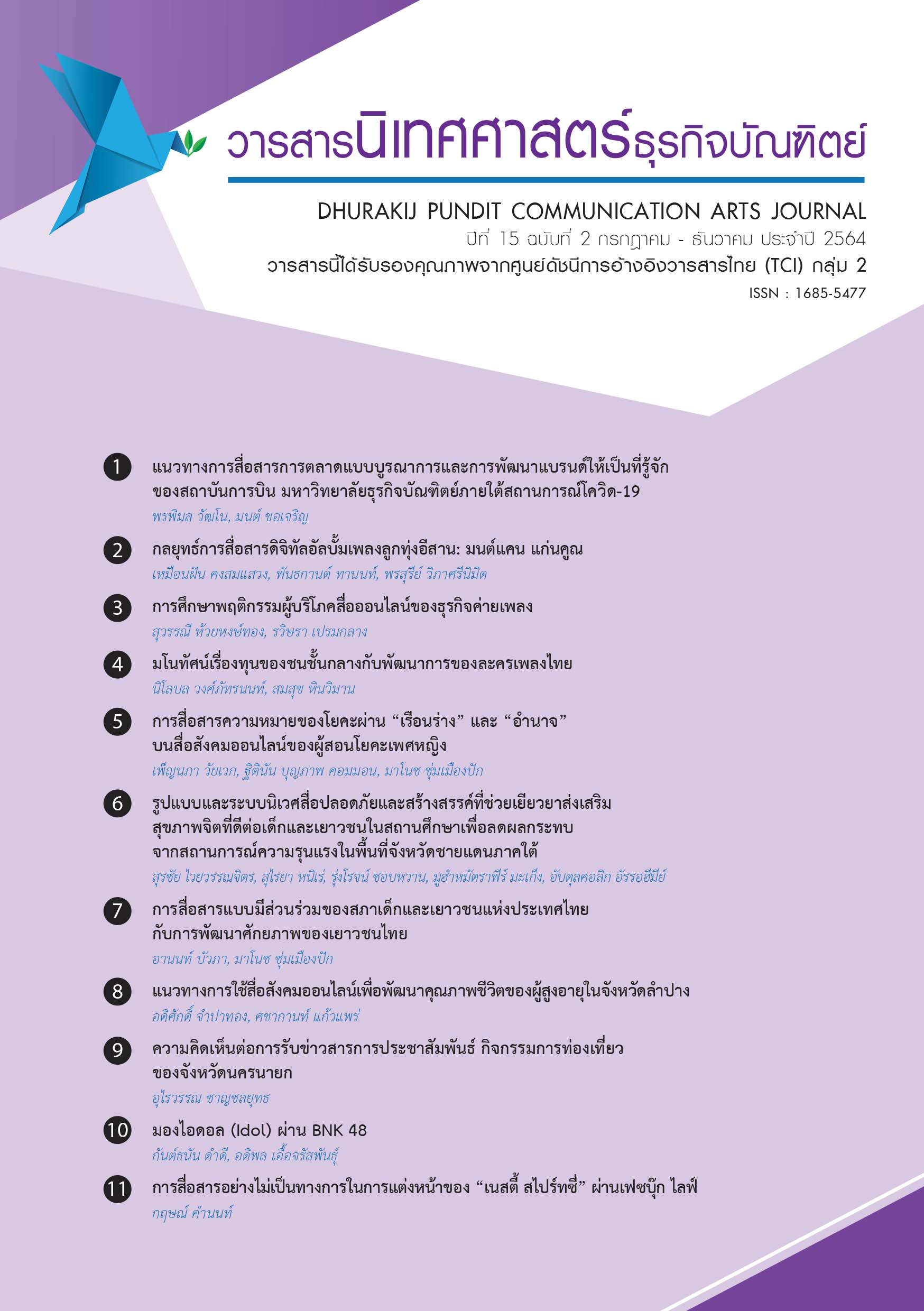
The Analysis Communication of Yoga's Meaning On Social Media of Female Yoga Instructor
Keywords:
Communication of Yoga’s meaning, body, Power, Social Media, Female Yoga InstructorAbstract
The study titled “Communication of Yoga’s Meaning through bodies and power on social media of Female Yoga Instructors” is a qualitative study aimed 1) to investigate Yoga’s meaning communicated through bodies and power of female Yoga instructors 2) to study components of communication of Yoga’s meaning through bodies and power of female Yoga instructors on social media and 3) to study the use of social media to communicate Yoga’s meaning through bodies and power of female Yoga instructors. The methodologies including Content Analysis and In-depth interview were employed to analyze six Yoga female instructors engaging in the communication of Yoga’s meaning on social media platforms namely YouTube videos, Facebook and Instagram. The analysis was directed to each instructor’s 50 pieces of the contents posted, constituting a total of 300 posts.
The first part revealed the meaning of Yoga communicated through bodies and power of female Yoga instructors on social media categorized into five aspects; 1) health 2) disease treatment 3) beauty 4) fashion and 5) business. Female yoga instructors reconstructed meaning of Yoga in compliance with culture and current social context such as Yoga’s meaning in the aspect of beauty, fashion, business, and maintained authentic meanings of Yoga concerning treatment disease. They also deconstructed meaning of Yoga which is tied to men and redefined the meaning of Yoga harmonizing with female bodies.
The second part: female yoga instructors presented meanings of Yoga through components of photos comprising six components1) a person in photos 2) types of photos 3) photo backgrounds 4) clothes/equipment 5) camera angles and lenses, and 6) tradition of photos. Components of videos include 1) setting 2) lighting 3) color 4) performance 5) photography and 6) sound. Yoga female instructors used their bodies as the raw materials and power as a tool to manage and manipulate their bodies. Nonetheless, such power is only confined to the field of Yoga, so they sustain gender identity in this field as a way to maintain their power.
The third part: online social media granted freedom for the female Yoga instructors so that they could conquer this space for communication and use it to convert their bodies to capital and accumulate it in order to expand to other capitals. Social media served as a path for the female Yoga instructors to ascend to power stemming from economic freedom.
Body became “raw materials” which were utilized by the female Yoga instructors as a space to express power to manage and manipulate their bodies through social media by creating freedom for communication of Yoga’s meaning for female Yoga instructors in terms of space, time and forms of the communication. Female Yoga instructors equipped with such power could freely create, alter and adjust their own bodies as an owner. Furthermore, they could conquer the space from men to determine Yoga’s meaning and exercise the power to maintain, deconstruct, reconstruct and redefine Yoga’s meaning through their bodies. “Social media grants freedom and power to the female Yoga instructors to manage and manipulate their bodies but the power is only confined to the field of Yoga.”
References
Siddha Yoga And Sivananda Centres. Religions of South Asia, 1(2), 217-237.
Brown, C. (2009). The Yoga Bible. Old Alresford: Godsfield.
Feuerstein, G. (2002). The Art and Science of Raja Yoga. Nevad: Crystal Clarity Publishers.
Kent, H. (1999). The Complete Illustrated Guide to Yoga. Great Britain: Element Books
Limited.
Keown, D. (2003). A Dictionary of Buddhism. New York: Oxford University Press Inc.
Kinsley, D.R. (1993). Hinduism A Cultural Perspective. New Jersey: Prentice Hall.
Malenovic. J. (2016). Social and Digital Mass Media Impaction the Perception of Yoga.
International Scientific Yoga Journal Sense, 6(6), 66-78
Mandir, R.Y. (2019). Top 10 reasons why Yoga is gaining popularity around the World.
Retrieved September 25, 2020, from https://www.yogateachertrainingris
hikesh.com/blog/top-10-reasons-why-yoga-is-gaining-popularity-around-the-world/
Metha, M. (2002). How to Use Yoga. London: Lorenz Books.
UNESCO. (n.d.). Yoga. Retrieved September 25, 2020, from https://ich.unesco.org/en
/RL/yoga- 01163
United Nations. (n.d.). International Day of Yoga 21 June. Retrieved September 25, 2020,
from https://www.un.org/en/observances/yoga-day
Walters, J.D. (2002). The Art and Science of Raja Yoga. California: Ananda Publications
Downloads
Published
Issue
Section
License
ลิขสิทธิ์เป็นของวารสาร....


