
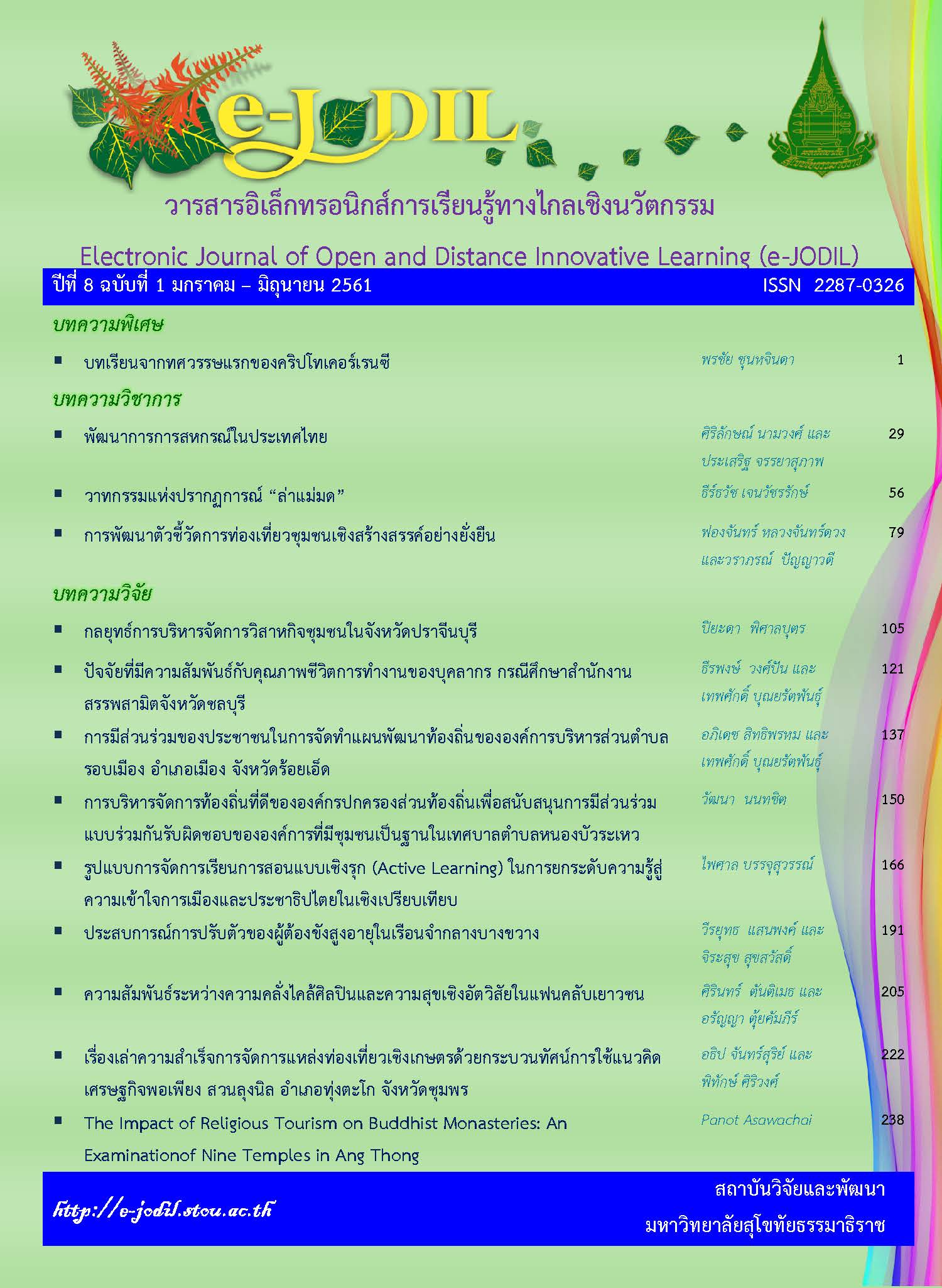
Lessons from the First Decade of Cryptocurrencies
Article Sidebar
Main Article Content
Abstract
Since its introduction in 2008 as a peer-to-peer electronic cash system, cryptocurrency (Bitcoin) technology has been developed from being a breakthrough network innovation to a worldwide speculative target. Nowadays, not only being widely considered by software developers, cryptocurrency also captures public’s attention. Moreover, the backbone of the groundbreaking virtual token (Blockchain) has tremendous potential to disrupt numerous activities. The effect is massive enough to create an advanced business cluster, called financial technology (FinTech). Unfortunately, this complex technology is not flawless. Without a thoughtful protection, some drawbacks may cause vastly difficulties. For these reasons, this paper aims to support a general public’s understanding about cryptocurrency, especially from financial viewpoint.
Downloads
Article Details
บทความ ข้อความ ภาพประกอบ ตารางประกอบ ที่ตีพิมพ์ในวารสารเป็นความคิดเห็นและความรับผิดชอบของผู้เขียนแต่เพียงผู้เดียว ไม่เกี่ยวข้องกับมหาวิทยาลัยสุโขทัยธรรมาธิราชแต่อย่างใด
บทความที่เสนอพิจารณาในวารสาร e-JODIL ต้องเป็นบทความที่ไม่เคยส่งไปลงพิมพ์ เผยแพร่ หรืออยู่ระหว่างการพิจารณาของวารสารอื่น
กองบรรณาธิการขอสงวนสิทธิ์ในการพิจารณาและตัดสินการตีพิมพ์บทความในวารสาร
References
Australian Securities and Investments Commission. (2017). Information Sheet 225 (Info 225). Australian Securities and Investments Commission.
Balcilar M., Bouri E., Gupta R., and Roubaud D. (2017). Can Volume Predict Bitcoin Returns and Volatility? A Quantiles-Based Approach. Economic Modelling. 64. pp. 74 - 81.
Barrdear J. and Kumhof M. (2016). The Macroeconomics of Central Bank Issued Digital Currencies. Bank of England. Working Paper. bitcoin.org. (2009). About bitcoin.org. Web site: ttps://bitcoin.org/en/about-us
Board of Governors of the Federal Reserve System. (2018). How much does It Cost to Produce Currency and Coin?. Federal Reserve Bank.
Brenig C., Accorsi R., and Müller G. (2015). Economic Analysis of Cryptocurrency Backed Money Laundering. Twenty-Third European Conference on Information Systems. ECIS 2015 Completed Research Papers.
Chunhachinda P. (2017). FinTech: Towards Thailand 4.0. Electronic Journal of Open and Distance Innovative Learning (e-JODIL). 7 (1). pp. 1 – 23.
Cocco L., Concas G., and Marchesi M. (2017). Using an Artificial Financial Market for studying a Cryptocurrency Market. Journal of Economic Interaction and Coordination. 12 (2). pp 345 – 365.
CoinDesk. (2018). Bitcoin (USD) Price. Web site: https://www.coindesk.com/price/
CoinMarketCap. (2018). Cryptocurrency Market Capitalizations.Web site: https://coinmarketcap.com/
CoinMarketCap. (2018). 24 Hour Volume Rankings (Exchange). Website: https://coinmarket cap.com/exchanges/volume/24-hour/all/
Cointelegraph. (2018). Post-ICO Review: What Happens to the Tokens of the Largest ICOs?. Website: https://cointelegraph.com/news/post-ico-review-what-happens-to-the-tokens-of-the-largest-icos
Forbes. (2018). The Richest People in Cryptocurrency.Web site:https://www.forbes.com/richest-in-cryptocurrency/#508342f71d49
Fry J. and Cheah E. (2016). Negative Bubbles and Shocks in Cryptocurrency Markets. International Review of Financial Analysis. 47. pp. 343 - 352.
Gandal N. and Halaburda H. (2016). Can We Predict the Winner in a Market with Network Effects? Competition in Cryptocurrency Market. Games. 7 (3). pp. 1 - 21.
Gjermundrød H. and Dionysiou I. (2014). Recirculating Lost Coins in Cryptocurrency Systems. International Conference on Business Information Systems. Conference Paper. pp 229 - 240.
Harwick C. (2016). Cryptocurrency and the Problem of Intermediation. The Independent Review. 20 (4). pp. 569 - 588.
Hayes A.S. (2017). Cryptocurrency Value Formation: An Empirical Study Leading to a Cost of Production Model for Valuing Bitcoin. Telematics and Informatics. 34 (7). pp. 1308 -1321.
ICOdata. (2018). Funds raised in 2018. Web site: https://www.icodata.io/stats/2018
Katsiampa P. (2017). Volatility Estimation for Bitcoin: A Comparison of GARCH Models. Economics Letters. 158. pp. 3 - 6.
Kim Y.B., Kim J.G., Kim W., Im J.H., Kim T.H., Kang S.J., and Kim C.H. (2016). Predicting Fluctuations in Cryptocurrency Transactions Based on User Comments and Replies. PLoS ONE. 11 (8). pp. 1 - 17.
Lee T. (2018). As Bitcoin's Price Plunges, Skeptics Say the Cryptocurrency has No Value. Here’s One Argument for Why They're Wrong. CNBC. Website: https://www.cnbc.com/2018/01/16/skeptics-say-bitcoin-has-no-value-heres-why-theyre-wrong.html
Li X. and Wang C.A. (2017). The Technology and Economic Determinants of Cryptocurrency Exchange Rates: The Case of Bitcoin. Decision Support Systems. 95. pp. 49 - 60.
Nadarajah S. and Chu J. (2017). On the Inefficiency of Bitcoin. Economics Letters. 150. pp. 6 - 9.Nakamoto S. (2008). Bitcoin: A Peer-to-Peer Electronic Cash System. Web site: https://bitcoin.org/bitcoin.pdf
Nakamoto S. (2008). Bitcoin P2P e-Cash Paper.Web site: https://www.mail-archive.com/search?l=cryptography@metzdowd.com&q=from:%22Satoshi+Nakamoto%22
Panigirtzoglou N. (2017). JPMorgan Strategist: Bitcoin Futures can 'Add Legitimacy' to Potential Emerging Asset Class. CNBC. Web site: https://www.cnbc.com/2017/12/01/jpmorgan-strategist-bitcoin-futures-can-add-legitimacy.html
Peterson T. (2017). Metcalfe’s Law as a Model for Bitcoin’s Value. Working Paper.
Pieters G. and Vivanco S. (2017). Financial Regulations and Price Inconsistencies across Bitcoin Markets. Information Economics and Policy. 39. pp. 1 - 14.
Powell J. (2018). Cryptocurrency Market will hit $1 Trillion Valuation This Year. CNBC. Website: https://www.cnbc.com/2018/02/13/cryptocurrency-market-to-hit-1-trillion-valuation-in-2018 rakenceo.html
Raymaekers W. (2015). Cryptocurrency Bitcoin: Disruption, Challenges and Opportunities. Journal of Payments Strategy & Systems. 9 (1). pp. 30 - 46.
Saito K. and Iwamura M. (2018). How to Make a Digital Currency on a Blockchain Stable. Working Paper.
Scott B. (2016). How Can Cryptocurrency and Blockchain Technology Play a Role in Building Social and Solidarity Finance?. United Nations Research Institute for Social Development (UNRISD). Working Paper.
Securities and Exchange Commission. (2017). Report of Investigation Pursuant to Section 21(a) of the Securities Exchange Act of 1934: The DAO. Securities and Exchange Commission.
Stiglitz J. (2017). Bitcoin ‘Ought to Be Outlawed,’ Nobel Prize Winner Stiglitz Says. Bloomberg. Web site: https://www.bloomberg.com/news/articles/2017-11-29/bitcoin-ought-to-be-outlawed-nobel-prize-inner- stiglitz-says-jal10hxd
Urquhart A. (2016). The Inefficiency of Bitcoin. Economics Letters. 148. pp. 80 - 82.
Van Vliet B. (2018). An Alternative Model of Metcalfe’s Law for Valuing Bitcoin. Economics Letters. 165. pp. 70 - 72.Wang J.C. (2014). A Simple Macroeconomic Model of Bitcoin. Working Paper.
World Economic Forum. (2017). In 2020 Bitcoin will Consume more Power than the World does Today. World Economic Forum. Website: https://www.weforum.org/agenda/2017/12/bitcoin-consume-more-power-than-world-2020/
