
The Development of Critical Reading Abilities by Using Multiple of Reading Strategies for Undergraduate Students
Article Sidebar
Main Article Content
Abstract
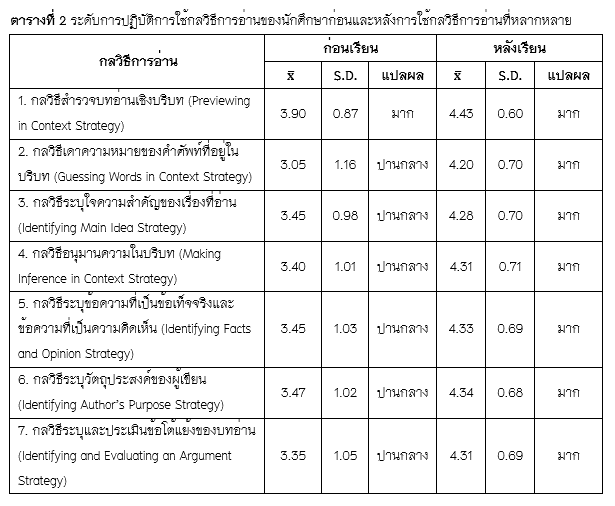
The objectives of this research were to; 1) compare students’ critical reading abilities between pre-test and post-test after using multiple reading strategies 2) compare students’ using reading strategies between before and after using multiple reading strategies 3) study the students ‘opinions toward using multiple reading strategies. The samples of this research were 36 students of second-year students who are studying in English major, Faculty of Education, Kanchanaburi Rajabhat University selected by purposive selection sampling technique. The research tools for this study were 1) 8 lesson plans, 3 hours each 2) 8 reading passages 3) 30 items of critical reading abilities pre-test and post-test by using multiple reading strategies 4) questionnaires toward the level of students’ using reading strategies between before and after using multiple reading strategies 5) questionnaires for students’ opinions toward using multiple reading strategies. The quantitative data were analyzed by mean, standard deviation, and t-test dependent.
The research results were as follows: 1) The students’ critical reading ability scores obtained in post-test after using multiple reading strategies were significantly higher than pre-test at .05 level of statistical significance 2) The level of students after using multiple reading strategies were significantly higher than before applying 3) The students had opinion toward using multiple reading strategies in the aspects of learning management process and the benefit from English reading text by using multiple reading strategies at a good level.
Downloads
Article Details

This work is licensed under a Creative Commons Attribution-NonCommercial-NoDerivatives 4.0 International License.
The articles published are copyrighted by the Graduate School, Chiang Mai Rajabhat University.
The opinions expressed in each article of this academic journal are solely those of the individual authors and do not reflect the views of Chiang Mai Rajabhat University or its faculty members. The responsibility for the content of each article rests entirely with the respective authors. In the event of any errors, the authors alone are responsible for their own articles.
References
วิจารณ์ พานิช. (2556). การสร้างการเรียนรู้สู่ศตวรรษที่ 21. สืบค้นจาก https://www.scbfoundation.com/media_knowledge/unknown/292/5466
วิภาดา พูลศักดิ์วรสาร. (2555). การพัฒนารูปแบบการสอนอ่านเน้นภาระงานโดยใช้กลวิธีอภิปัญญาสำหรับผู้ใหญ่
เพื่อส่งเสริมความเข้าใจในการอ่านภาษาอังกฤษ. (วิทยานิพนธ์ดุษฎีบัณฑิต, สาขาวิชาหลักสูตรและการสอน มหาวิทยาลัยศิลปากร).
วิสาข์ จัติวัตร์. (2543). การสอนอ่านภาษาอังกฤษ. นครปฐม: คณะศึกษาศาสตร์ มหาวิทยาลัยศิลปากร วิทยาเขตพระราชวังสนามจันทร์.
นิธิมา สุธะพินธ์. (2561). การพัฒนารูปแบบการสอนอ่านภาษาอังกฤษธุรกิจอย่างมีวิจารณญาณแบบเน้นภาระงานร่วมกับการอ่านอย่างมีวิจารณญาณเพื่อเสริมสร้างความสามารถในการอ่านอย่างมีวิจารณญาณและการใช้กลวิธีการอ่านสำหรับนักศึกษาระดับปริญญาตรี. (วิทยานิพนธ์ดุษฎีบัณฑิต, สาขาวิชาหลักสูตรและการสอน มหาวิทยาลัยศิลปากร).
มาเรียม นิลพันธุ์. (2558). วิจัยทางการศึกษา. นครปฐม: คณะศึกษาศาสตร์ มหาวิทยาลัยศิลปากร.
มหาวิทยาลัยราชภัฏกาญจนบุรี คณะครุศาสตร์. (2562). หลักสูตรครุศาสตรบัณฑิต สาขาวิชาภาษาอังกฤษ (4 ปี)
หลักสูตรปรับปรุง พ.ศ. 2562. (อัดสำเนา).
Abdullah, K. (1998). Critical reading skills: Some notes for teachers. REACT National Institute of Education (Singapore), 1998(1), 32-36
Almasi, J. F. (2003). Teaching srategies processes in reading (f. b. M. Pressley Ed.). New York: The Guilford Press.
Education First (EF). (2021). EF English proficiency index. Retrieved from https://www.ef.co.th/assetscdn/WIBIwq6RdJvcD9bc8RMd/cefcom-epi-site/reports/2021/ef-epi-2021-english.pdf
Fadel, C. (2008). 21st century skills: How can you prepare students for the new global economy?. Retrieved from https://www.oecd.org/site/educeri21st /40756908.pdf
Grabe, W. (2009). Reading in a second language. UK: Cambridge University Press.
Groarke, L. & Tindale, C. W. (2004). Good reasoning matters’: A constructive approach to critical thinking. Toronto, New York: Oxford University Press.
Joyce, B., Weil, M., & Calhoun, E. (2009). Models of teaching. (8th ed.). New York: Allyn & Bacon.
Kadir, N. A., Subki, R. N., Jamal, F. H. A., & Ism, J. (2014). The importance of teaching critical reading skills in
Malaysian reading classroom. In The 2014 WEI International Academic Conference Proceedings (p. 208-219). May 18-21, 2014. Bali, Indonesia: The West East Institute.
Kelly, M. (2020). Bloom's taxonomy questions: Question stems to help apply Bloom's taxonomy. Retrieved from https://www.thoughtco.com/blooms-taxonomy-questions-7598
Khabiri, M., & Pakzad, M. (2012). The effect of teaching critical reading strategies on EFL learners’ vocabulary retention. The Journal of Teaching Language Skills, 4(1), 73-106.
Li, H. (2010). Developing a hierarchical framework of critical reading proficiency. Chinese Journal of Applied Linguistics, 33(6), 40-54.
Luke, A. (2000). Critical Literacy in Australia: A Matter of Context and Standpoint. Journal of Adolescent & Adult Literacy, 43(5), 448-461.
Nunan, D. (2001). Second language teaching and learning. Beijing: Foreign Language Teaching and Research Press.
Oliveras, B., Marquez, C. & Sanmarti, N. (2011). The use of newspaper articles as a tool to develop critical thinking in science classes. International Journal of Science Education, 35(6), 1-21. Retrieved from https://www.researchgate.net/publication/239797685_The_Use_of_Newspaper_Articles_as_a_Tool_to_Develop_Critical_Thinking_in_Science_Classes
ParamitaDharmayanti, P. A., Tantra, D.K., & Artini, L., P. (2013). The effect of modified collaborative strategic reading and vocabulary mastery on the reading competency of the second semester students of English Education Study Program of Mahasaraswati Denpasar University. e-Journal Program Pascasarjana Universitas Pendidikan Ganesha Program Studi Pendidikan Bahasa Inggris, 2013(1). Retrieved from https://ejournal-pasca.undiksha.ac.id/index.php/jpbi/article/view/685/470
Pirozzi, R. (2003). Critical reading, critical thinking. (2nd ed.). New York: Longman.
Raphael, T. E., George, M., Weber, C. M., & Nies, A. (2009). Approaches to teaching reading comprehension. In Handbook of research on reading comprehension. New Jersey: Routledge Taylor & Francis Group.
Salisbury University. (2015). 7 critical reading strategies. Retrieved from http://www.salisbury.edu/counseling/new/7_
Sattar, S., & Salehi, H. (2014). The role of teaching reading strategies in enhancing reading comprehension. International Journal of Current Life Sciences, 4(11), 10922-10928.
Wallace, C. (2003). Critical reading in language education. New York: Palgrave Macmillan.
Yu, J. (2015). Analysis of critical reading strategies and its effect on college English reading. Theory and Practice in Language Studies, 5(1), 134-138.
