
Synthesis of Research on Thai Language and Thai Studies Research Funded Paper Published on CNKI Database During 2013 – 2020
Article Sidebar
Main Article Content
Abstract
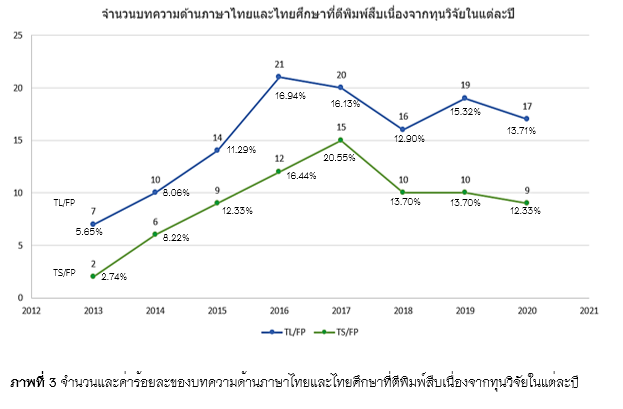
This paper aims to synthesize and summarize the research on Thai language and Thai studies in terms of the content of research, the area of publication, universities, publishing year, and type of research funding by using the documentary research method. The study sample consisted of 197 articles published on CNKI Database (China National Knowledge Infrastructure) in China during 2013-2020 by purposive random sampling. The research was synthesized according to five main features: 1) the content of the research 2) the field of publication 3) the universities 4) the year of publication and 5) the type of research funding. The research result was then presented through descriptive analysis and quantitative data were shown in percentages. The results showed that 62.8% of the articles are in Thai language subjects, and 37.2% are in Thai studies. The majority of research content in Thai language is linguistic 55.65%, followed by Thai teaching and learning 32.30%. While Thai studies articles are primarily on teaching Chinese as a foreign language 46.60%, followed by ethnic studies 13.70%. There are 49 funded papers granted more than one type of fund with accounted for 24.87%. Most of the funded papers were mainly published in Guangxi Zhuang autonomous region at 41.12%, followed by Yunnan Province at 27.41%. Baise University has the highest frequency of published funded papers, followed by Guangxi University of Nationalities with 29.63% and 22.22% respectively. The most published year is 2016 to 2017 at 32.5% and 40.3%, respectively. The highest frequency of research grants is provincial funds 42.54%, followed by university funds 28.73%.
Downloads
Article Details

This work is licensed under a Creative Commons Attribution-NonCommercial-NoDerivatives 4.0 International License.
The articles published are copyrighted by the Graduate School, Chiang Mai Rajabhat University.
The opinions expressed in each article of this academic journal are solely those of the individual authors and do not reflect the views of Chiang Mai Rajabhat University or its faculty members. The responsibility for the content of each article rests entirely with the respective authors. In the event of any errors, the authors alone are responsible for their own articles.
References
จรัสศรี จิรภาส. (2562). “ศึกษาไทย” และ “ไทยศึกษา” ในประเทศจีน. วารสารภาษาและวัฒนธรรม, 38(2), 95-118.
สยงหลิง เฉิน และเพ็ญพิสุทธิ์ สีกาแก้ว. (2565). ยุทธศาสตร์ BRI กับนโยบายการพัฒนาบุคลากรผู้เชี่ยวชาญด้านภาษาไทยในประเทศจีน. สืบค้นจาก https://www.dpu.ac.th/dpurdi/analysis/32
สุรสิทธิ์ อมรวนิชศักดิ์. (2556). การสำรวจองค์ความรู้ด้านไทยศึกษาในฐานข้อมูล CNKI ของจีน: กรณีศึกษาวิทยานิพนธ์ระดับมหาบัณฑิตและดุษฎีบัณฑิต. วารสารจีนศึกษา มหาวิทยาลัยเกษตรศาสตร์, 6(6), 277-302.
อรกัญญา โรจนวานิชกิจ. (2563). การสังเคราะห์งานวิจัยเปรียบเทียบภาษาจีนและภาษาไทยในฐานข้อมูล CNKI ของประเทศจีน. วารสารศิลปศาสตร์ มหาวิทยาลัยสงขลานครินทร์, 12(2), 147-157.
Bo, W. Z. (2007). The status of Thai language and culture major in Peking University. In Chinese non-universal foreign language teaching and research: Thai language inaugural conference, December 14-17, 2007 Guangdong University of Foreign Studies (p.81-88). China. Guangdong University of Foreign Studies.
Chen, X. L., Sikakaew, P., Wang, X. R. (2022). The application of Thai language teaching as China’s soft power in Yunnan and Guangxi provinces under the belt and road initiative. In Proceedings of the 7th RSU International Research Conference on Social Science and Humanities, Education, and Management, April 29, 2022 Online Conference via Zoom webinar program (p. 361-368). Thailand. Research Institute of Rangsit University.
Liu, Q. (2015). The Development and transformation of Chaoshan culture in Thai Society. Journal of Shantou University (Humanities & Social Sciences Edition), 31(4), 42-51.
Luo, S. N. (2013) An analysis of the similarity between Chinese and Thai tones. Journal of Yunnan Normal University (Teaching and Research on Chinese as a Foreign Language Edition), 11(1), 80-84.
Shang, G. W. (2016). An economics approach to linguistics landscape: Singapore, Malaysia and Thailand as a case. Chinese Journal of Language Policy and Planning, 4(4), 83-91.
Sikakaew, P., Thamsatitsuk, K., Mo, L. F., Huang, X. C., & Chen, X. L. (2022a). Synthesis of doctoral dissertation in Thai linguistic research on CNKI database during 2015-2020. Journal of China ASEAN Studies, 2(1), 27-34.
Sikakaew, P., Thamsatitsuk, K., Mo, L. F., Huang, X. C., & Chen, X. L. (2022b). The tendency analysis of Thai language research in China during 2013-2020: A study on CNKI database. In DPU International Conference on Business, Innovation and Social Sciences 2022, May 25-27, 2022 Dhurakij Pundit University (p. 166-175). Thailand. Chinese International College, Dhurakij Pundit University.
Yang, Y. M., and Zhao, X. Q. (2560). Language situations in the countries along the belt and road. Beijing: The commercial press.
Xu, R. J. and Sun, R. (2018). Thai grammar study in China from year 2004 to 2016. Cross Road Southeast Asian Studies, 6, 62-67.
