
Improving English Reading Skills Using English Morality Tale Series in Local Contexts Through Outcome-Based Education for Grade Five Students in Three Southern Border Provinces
Article Sidebar
Main Article Content
Abstract
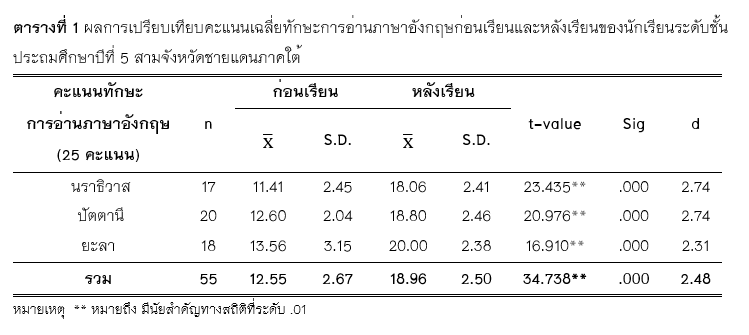
The purposes of this research were to 1) improve English reading skills and desirable characteristics using English morality tale series in local contexts through outcome-based education for grade 5 students and 2) study students’ opinions on English morality tale series in local contexts through outcome-based education. The subjects of this research were 55 grade 5 students from Narathiwat, Pattani, and Yala Provinces. They were selected based on a purposive sampling method. This study was conducted during the second semester of the academic year 2021. The instruments used in this study were English Morality Tale Series, a teacher’s manual in learning management, an English reading proficiency test, an evaluation form of the desirable characteristics, and a student opinion questionnaire on English Morality Tale Series. The data were analyzed using mean, standard deviation, t-test, and relative gain scores. The research findings revealed that the English reading ability and the desirable characteristics of grade 5 students from Narathiwat, Pattani, and Yala Provinces were significantly higher at the .01 level after learning via English morality tale series in local contexts through outcome-based education. The effect size value was at a large level. Moreover, students’ improvement in English reading skills was at a high level while their improvement in the desirable characteristics was at the highest level. In addition, students’ opinions on English morality tale series in local contexts through outcome-based education were also highly positive.
Downloads
Article Details

This work is licensed under a Creative Commons Attribution-NonCommercial-NoDerivatives 4.0 International License.
The articles published are copyrighted by the Graduate School, Chiang Mai Rajabhat University.
The opinions expressed in each article of this academic journal are solely those of the individual authors and do not reflect the views of Chiang Mai Rajabhat University or its faculty members. The responsibility for the content of each article rests entirely with the respective authors. In the event of any errors, the authors alone are responsible for their own articles.
References
Anderson, N. (1999). Exploring second language reading: Issues and strategies. Boston: Heinle & Heinle Publishers.
Anderson, L. W. & Krathwohl, D. R. (2001). A taxonomy for learning, teaching, and assessing: A revision of Bloom’s taxonomy of educational objectives. New York: Longman.
Andon, P., Maneekosol, C. & Phuvipadawat, P. (2017). Development of English reading comprehension skills through a local content supplementary book for matthayomsuksa 1 students of Thairathwittaya 79 (Ban-Nong-Ab-Chang) School, Chom Thong District, Chiang Mai Province. Ganesha Journal, 13(1), 59-71. [In Thai]
Best, J. W. (1977). Research in education. (3rd edition). New Jersey: Prentice Hall Inc.
Biggs, J. & Tang, C. (2011). Teaching for quality learning at university. (4th edition). UK: Open University Press.
Binmadnee, P., Abdulsata, S. & Haji, S. (2018). Study the problem condition and the solution of English studying in the upper secondary Islamic private school students in three southern border provinces. Al-Nur Journal of Graduate School of Fatoni University, 13(2), 25-37. {In Thai}
Brock, M. N. (1990). The case for localized literature in the ESL classroom. English Teaching Forum, 28(3), 22-25.
Brookbank, D., Grover, S., Kullberg, K., & Strawser, C. (1999). Improving student achievement through organization of student learning. TESOL Quarterly, 19(1), 167-168.
Bunparit, C. (2014). Using English tales in EFL classrooms. Journal of Humanities and Social Sciences, 20(1), 185-201.
Bunyakarn, C. (2014). Psychology of reading. (2nd edition). Bangkok: Suweeriyasan. {In Thai}
Bureau of Academic Affairs and Educational Standards. (2010). Learning management guideline according to the basic education core curriculum B.E. 2551 (A.D. 2008). Bangkok: The Agricultural Cooperative Federation of Thailand. [In Thai]
Carrell, P. (1987). Content and formal schemata in ESL reading. TESOL Quarterly, 21(3), 461-481.
Chanaroke, U. & Niemprapan, L. (2020). The current issues in teaching English in Thai contexts. EAU Heritage Journal, Social Science and Humanity, 10(2), 34-45.
Chidthong, P. & Kosito, P. (2017). The role of teachers in promoting learning skills in the 21st century for Thai graduates. Ganesha Journal, 13(1), 1-11. {In Thai}
Chonburi, I., Panichplinchai, T. & Wibunrangsan, S. (2010). The development of a story activities package enhancing morality and ethics of phrathomsuksa IV students. Journal of Education, Naresuan University, 12(3), 97-112. {In Thai}
Department of Academic Affairs. (2002). Guidelines for foreign language learning management. Bangkok: Printing Press of the Express Transportation Organization of Thailand (ETO). {In Thai}
Dhammasajjakarn, W., Dhammasajjakarn, A., Jeni, Y., Promin, S., Jaroensuk, N. & Hanghon, P. (2019). The problems and encouragement of English teaching and learning in elementary schools of municipality in three southern border provinces. Journal of Education, Prince of Songkla University, Pattani Campus, 30(2), 122-135. {In Thai}
Harwell, J. M. (2001). Complete learning disabilities handbook: Ready-to-use strategies and activities for teaching students with learning disabilities. (2nd edition). US: Jossey-Bass Publishers.
Keshavarzi, A. (2012). Use of literature in teaching English. Procedia Social and Behavioral Sciences, 46, 554-559.
Kottong, K. & Chattiwat, W. (2015). The development of English reading exercises based on Asian folktales through the storyline method for Prathomsuksa six students of Banpao (Samranchaiwittaya) School, Chaiyaphumi Province. Veridian E-Journal, Silpakorn University, 8(2), 2255-2270. {In Thai}
Lalusama, H. (2019). English learning management using supplementary folk tale books encouraged reading about culture and folk game in 3 southern border provinces. Journal of Educational Technology and Communications, 2(5), 49-62. {In Thai}
Madeeyoh, C. & Charumanee, N. (2013). The use of Islamic context texts to improve Muslim students’ English reading skills. Journal of Liberal Arts, Prince of Songkla University, 5(2), 46-58. [In Thai]
Madoma, S. (2020). The development of English morality tale series in local contexts to improve English reading skills for upper elementary school students in Yala province. Faculty of Education: Yala Rajabhat University. {In Thai}
Ministry of Education. (2008). Basic education core curriculum B.E. 2551 (A.D. 2008). Bangkok: The Agricultural Cooperative Federation of Thailand. [In Thai]
Monyanont, P. & Anurit, T. (2019). Storytelling: A method to enhance reading achievement and attitudes toward English reading of Thai primary school learners. Journal of Liberal Arts, Prince of Songkla University, 11(2), 96-123.
Office of the Basic Education Commission. (2019). OBEC policy 2019. Retrieved from https://www.obec.go.th/
wpcontent/uploads/2018/10/OBECPolicy62.pdf. {In Thai}
Organisation for Economic Co-operation and Development. (2021). Thailand-country report-PISA 2018 results. Bangkok: Organisation for Economic Co-operation and Development (OECD). {In Thai}
Oxford, R. (1993). Instructional implications of gender differences in second/foreign language learning styles and strategies. Applied Language Learning, 4, 66-94.
Panich, V. (2012). Innovative pathway of learning in the 21st century. (4th edition). Bangkok: Sodsri – Saritwong Foundation. {In Thai}
Regional Education Office No.7. (2021). Ordinary National Educational Test Summary Report for the academic year 2021. Yala: Regional Education Office No.7. {In Thai}
Ruamsuk, P., Sasiwongsaroj, K., Doungphummes, N. & Wonggarasin, K. (2015). The development of tales to enhance generosity in children in early childhood. Veridian E-Journal, Silpakorn University, 8(1), 903-922. {In Thai}
Ruddell, B. R. (2002). Teaching children to read and write: Becoming an effective literacy teacher. (3rd edition). Boston: Allyn and Bacon.
Sakolnakorn, P. N., Churngchaw, C. & Laeheem, K. (2017). Development guidelines for government units to management of English language education in three southern border provinces. Journal of Education, Prince of Songkla University, Pattani Campus, 28(3), 24-36. [In Thai]
Sangkhapinyo, P. (2020). The problem of reading in Thai society: The educational system and supporting factors context. Journal of Humanities and Social Sciences, 12(1), 1-32. {In Thai}
Taylor, E. K. (2000). Using folktales. New York: Cambridge University Press.
Thanompongchart, P. (2019). The development of English achievements and moral of grade 4 and 5 students by using Aesop’s fables and the Cornell note taking method. Faculty of Education: Chulalongkorn University. {In Thai}
Thipakorn, B. (2017). My 2 Satangs: Outcome-based education. Retrieved from https://www.c4ed.kmutt.ac.th/
copy-of-my2satangstqf. {In Thai}
Thongmark, S., Neimted, W., Choosuwan, R. & Sittichai, R. (2018). Looking backwards and forwards of educational quality in three southern border provinces in Thailand. Princess of Naradhiwas University Journal of Humanities and Social Sciences, 5, 186-198. {In Thai}
Wongkaew, J. & Sithsungnoen, C. (2020). The development of English reading comprehension skills by using Collaborative Strategic Reading (CSR) through local information of Kanchanaburi for Prathomsuksa sixth students. Silpakorn Educational Research Journal, 12(2), 189-206. [In Thai]
Zaro, J. J. & Salaberri, S. (1995). Storytelling. Oxford: Macmillan Publishers.
