
Teak Wood Jewelry Design: An Integration of Deconstruction Theory and Sung Men Sub-District Identity
Article Sidebar
Main Article Content
Abstract
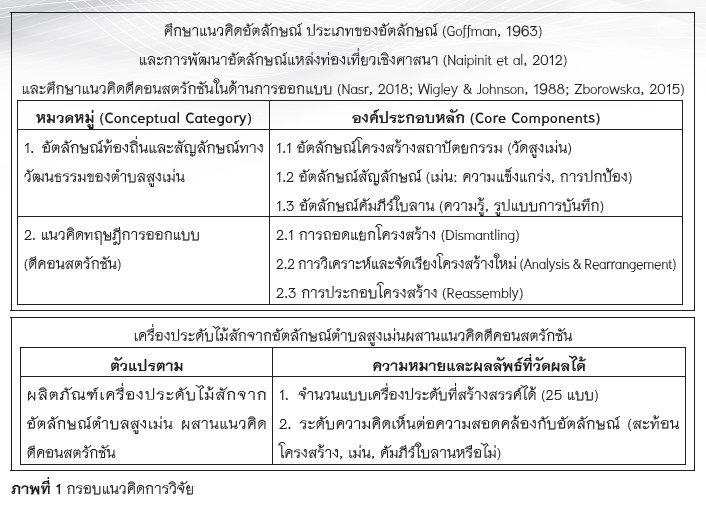
This research aimed to: 1. study the identity of Sung Men Sub-district and the concept of deconstruction for application in designing teak wood jewelry; and 2. create teak wood jewelry products that reflected the identity of Sung Men Sub-district combined with the concept of deconstruction. The target population consisted of Thai nationals residing in Sung Men Sub-district, Phrae Province. A purposive sampling method was employed, selecting 30 participants who were Thai nationals living in Sung Men Sub-district with knowledge and familiarity with local sites and tourist attractions. This qualitative research gathered data through in-depth interviews.
The research findings showed that, regarding the identity of Sung Men Sub-district, the most prominent feature was Wat Sung Men, which could be categorized into three identity components: architectural structure, the hedgehog (symbolic animal), and palm-leaf manuscripts. The study of the deconstruction concept revealed three main components: decomposition, structural analysis and rearrangement, and reconstruction. The researcher applied the findings from the identity of Sung Men and the deconstruction concept in designing teak wood jewelry, resulting in the creation of 25 teak wood jewelry designs. The designs incorporated elements inspired by the hedgehog, architectural structures, and palm-leaf manuscripts, combined with the principles of deconstruction, which included: 1. Hedgehog of Faith, 2. Wheel of the Hedgehog, 3. Patterns from the Ubosot (Ordination Hall), 4. Hedgehog Quills from the Scripture/Text, 5. Hedgehog Scales and Ubosot Patterns, 6. Essence of the Structure, 7. Lanna Script/Pattern (Palm-Leaf Manuscript Pattern), 8. Lion of Transformation, 9. Architecture from the Scripture/Text, 10. Sacred Elephant, 11. Hedgehog from the Ubosot (Ordination Hall), 12. Hedgehog Scripture/Text, 13. Hedgehog Fur/Hair Pattern, 14. Phra That (Relic/Stupa) Patterns, 15. Hedgehog of Knowledge, 16) Structure of the Hongsa (Mythical Swan), 17. Structure of the Garuda, 18. Studying the Scripture/Text, 19. Hedgehog Relic/Stupa (Phra That Hedgehog), 20. Guardian Dragon, 21. Hedgehog and Lanna Script/Pattern, 22. Hedgehog Pendant/Charm, 23. Cycle/Circulation of the Hedgehog, 24. Hedgehog of Wisdom, and 25. Hedgehog from the Sky.
Downloads
Article Details

This work is licensed under a Creative Commons Attribution-NonCommercial-NoDerivatives 4.0 International License.
The articles published are copyrighted by the Graduate School, Chiang Mai Rajabhat University.
The opinions expressed in each article of this academic journal are solely those of the individual authors and do not reflect the views of Chiang Mai Rajabhat University or its faculty members. The responsibility for the content of each article rests entirely with the respective authors. In the event of any errors, the authors alone are responsible for their own articles.
References
Chumkate, J. (2017). Product development from local wisdom to increase the efficiency of community-based management with sustainability in Thai-Muslim village, Amphur Cha Am, Phetchaburi Province. (Unpublished master’s thesis, Silpakorn University). [In Thai]
Effinity Co., Ltd. (2019). Final report (revised edition): Creative industry development plan – Handicrafts sector, 2019. Creative Economy Agency (Public Organization). Retrieved from https://resource.tcdc.or.th/ebook/CEA.Crafts.Strategy.Report.pdf?utm_source=chatgpt.com [In Thai]
Goffman, E. (1963). Stigma: Notes on the management of spoiled identity. New Jersey: Prentice-Hall.
Hanphakdeeniyom, A. & Panyarien, S. (2019). Development potential of OTOP products for ASEAN Buddhist way. Journal of Nakhon Lampang Buddhist College, 8(1), 303 – 312. [In Thai]
Keatvipak, K. (2019). Cultural dimension approach concept to confusing creative design. Institute of Culture and Arts Journal Srinakharinwirot University, 21(2), 20–41. Retrieved from https://so02.tcithaijo.org/index.php/jica/article/view/166998 [In Thai]
Lohatepanont, M. (2021). Revitalizing Thai handicrafts: How to target effectively? Bangkok Biz News. Retrieved from https://www.bangkokbiznews.com/blogs/columnist/127798 [In Thai]
Ministry of Culture. (2023). Soft power driving plan to elevate culture and transform Thailand into a global stage. Public Relations Department. Retrieved from https://www.prd.go.th/th/content/category/detail/id/33/iid/199731 [In Thai]
Naipinit, A., Maneenetr, T., Promsaka Na Sakolnakorn, T., & Kroeksakul, P. (2012). The study of potential approaches in religion tourism of “Roi Kaen Sarn Sin” cluster provinces. Panyapiwat Journal, 5(1), 31–40.
Nasr, M. (2018). Deconstruction and reconstruction trend in designing fashion accessories. International Design Journal, 8(4), 321–335.
Saokhong, P., Rattanachudech, P., Chatuma, T., & Khadwichai, A. (2022). The synthesis of Lanna art knowledge. Journal of Buddhist Studies, 13(1), 222–232. Retrieved from https://so02.tcithaijo.org/index.php/JBS/article/view/257234 [In Thai]
The Cloud. (2017). From local to global: Turning ways of life into design to preserve local wisdom. Retrieved from https://readthecloud.co/designer-4/ [In Thai]
Wigley, M. & Johnson, P. (1988). Deconstructivist architecture. New York: Museum of Modern Art.
Zborowska, A. (2015). Deconstruction in contemporary fashion design: Analysis and critique. International Journal of Fashion Studies, 2(2), 185–201. Retrieved from https://www.researchgate.net/publication/283538459_Deconstruction_in_contemporary_fashion_design_Analysis_and_critique
