Language on Place Name Signs in Tourist Attractions of Surat Thani Province: A Linguistic Landscape Study
Article Sidebar
Main Article Content
Abstract
The objective of this research is to analyze and compare the languages used on public and private sector place name signs in tourist attractions in Surat Thani Province, based on the linguistic landscape approach. Data were systematically collected by photographing 60 place name signs, equally divided between 30 public sector signs and 30 private sector signs, situated in 3 areas: (1) Talat Subdistrict, Mueang Surat Thani District, (2) Phum Riang Subdistrict, Chaiya District, and (3) Bo Phut Subdistrict, Ko Samui District. The analysis focused on three aspects: (1) the number and variety of languages on the signs, (2) language patterns based on Backhaus (2007), and (3) language salience based on Ben-Rafael. The results revealed that bilingual signs were the most common, followed sequentially by monolingual, trilingual, and quadrilingual signs. Public sector agencies predominantly employed monolingual Thai signs, whereas private sector agencies used bilingual Thai–English signs the most. Analysis of language patterns indicated that monophonic signs were most prevalent, followed by mixed, homophonic, and polyphonic. Public sector signs across all three study areas were predominantly monophonic, whereas private sector signs were mostly mixed. The language salience analysis indicated that Thai was the most prominent language, particularly on public sector signs in all 3 study areas, while English, Chinese, Korean, and Hebrew appeared more prominently on private sector signs in Bo Phut, Ko Samui. These findings demonstrate the different roles of languages appearing on public and private sector place name signs, reflecting government policies, social dimensions, and the influence of English and other foreign languages in shaping the linguistic landscape of tourist areas in Surat Thani Province. The findings may contribute to proposing linguistic landscape policies for tourist destinations or guidelines to support effective tourism development.
Downloads
Article Details

This work is licensed under a Creative Commons Attribution-NonCommercial-NoDerivatives 4.0 International License.
The articles published are copyrighted by the Graduate School, Chiang Mai Rajabhat University.
The opinions expressed in each article of this academic journal are solely those of the individual authors and do not reflect the views of Chiang Mai Rajabhat University or its faculty members. The responsibility for the content of each article rests entirely with the respective authors. In the event of any errors, the authors alone are responsible for their own articles.
References
Abdullah, C. U. & Wulung, S. R. P. (2021). Spatial patterns of linguistic landscapes in tourism area. Journal of Engineering Science and Technolog, 16(5), 4298-4308. Retrieved from https://jestec.taylors.edu.my/Vol%2016%20Issue%205%20October%202021/16_5_47.pdf
Aemdit, C., Sirikanerat, T., Maklai, S., and Kantong, E. (2023). Language in Thai forbidding signs: A linguistic landscape study. Journal of Chandrakasemsarn, 29(1), 65 – 80. Retrieved from https://li01.tci-thaijo.org/index.php/crujournal/article/download/256127/176249 [in Thai]
Backhaus, P. (2006). Multilingualism in Tokyo: A look into the linguistic landscape. International Journal of Multilingualism, 3(1), 52 – 66. DOI:10.1080/14790710608668385
Backhaus, P. (2007). Linguistics landscape: A comparative study of urban multilingualism in Tokyo. Clevedon, Buffalo, Toronto: Multilingual Matters.
Bangkom, K. (2024). Learning while walking the streets of Rayong: Combining linguistic landscape and language awareness through action research with children. rEFLections, 31(3), 875–895. https://doi.org/10.61508/refl.v31i3.275382
Ben-Refael, E., Shohamy, E., Amara, M. H., & Trumper-Hecht, N. (2006). Linguistic landscape as symbolic construction of the public space: The case of Israel. International Journal of Multilingualism, 3(1), 7-30. https://doi.org/10.1080/14790710608668383
Chamninok, K. and Jitbanjong, D. (2024). Language used and writing patterns apparent in business and service signs on Silom road, Bangrak district, Bangkok: A study toward linguistic landscape. Journal of Humanities and Social Sciences, Mahasarakham University, 43(4), 582–595. Retrieved from https://so03.tci-thaijo.org/index.php/humsujournal/article/view/270370/185250 [in Thai]
Choeirod, R. & Chanthao, R. (2023). Linguistic landscape at Patong, Phuket, Thailand: Language perception on public signs. NeuroQuantology, 21(1), 250–261. DOI: 10.48047/nq.2023.21.01.NQ20017
Giles, H. & Coupland, N. (1991). Language: contexts and consequences. Milton Keynes: Open University Press.
Gorter, D. (Ed.). (2006). Linguistic landscape: A new approach to multilingualism. Clevedon, UK: Multilingual Matters.
Huebner, T. (2006). Bangkok’s linguistic landscapes: Environmental print, codemixing and language change. International Journal of Multilingualism, 3(1), 31-51. DOI: 10.1080/14790710608668384
Landry, R. & Bourhis, R. Y. (1997). Linguistic landscape and ethnolinguistic vitality: An empirical study. Journal of Language and Social Psychology, 16(1), 23-49.
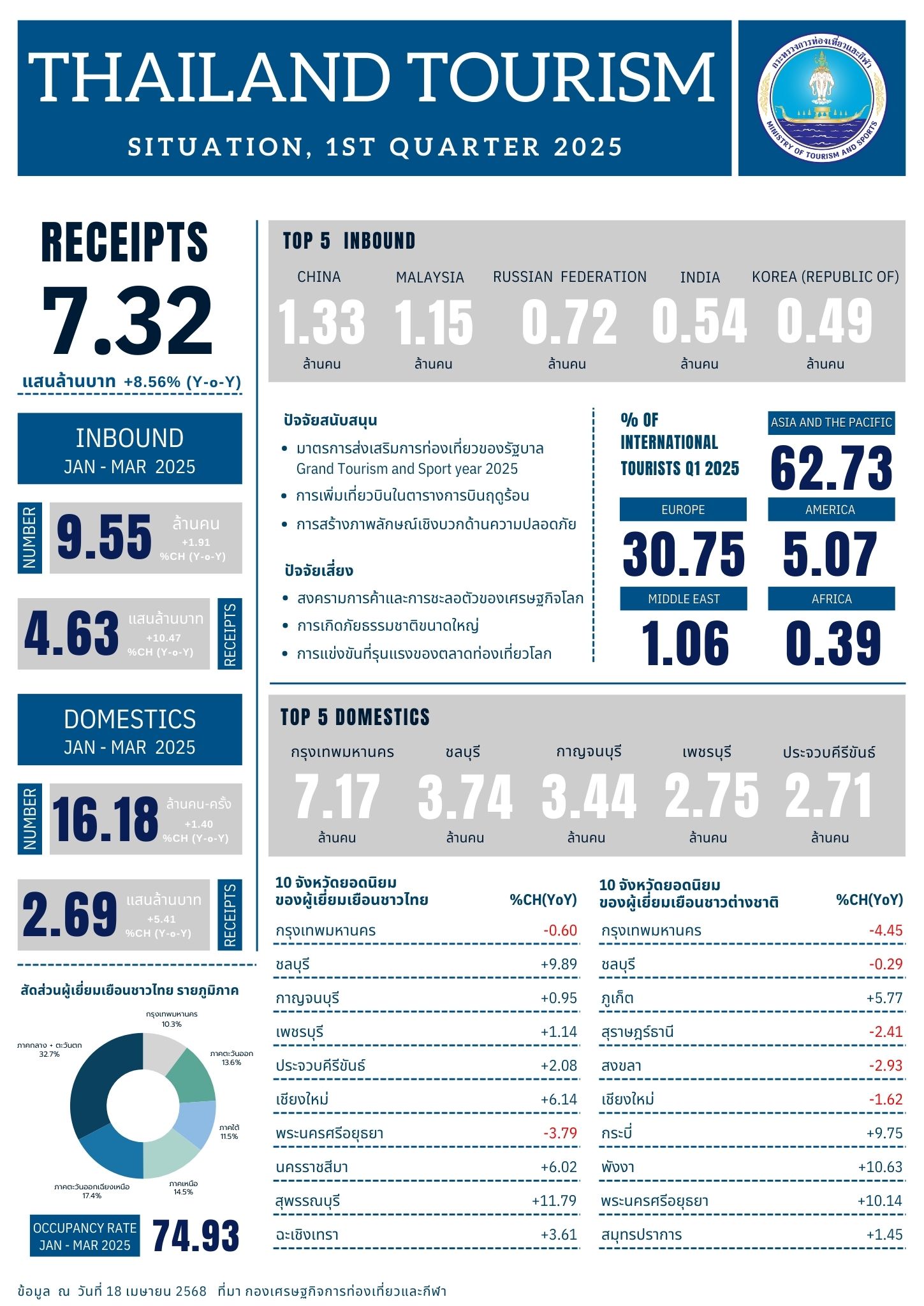
Ministry of Tourism and Sports. (2025). Thailand tourism situation, 1st quarter 2025. Retrieved from https://www.mots.go.th/images/v2022_17452242167024LiH4Liy4LiZIEluZm8g4Lij4Liy4Lii4LmA4LiU4Li34Lit4LiZIDY4LmpwZw==.jpg [in Thai]
Pathanasin, S. (2025). A study of the linguistic landscape on Phuket Island: Identity, tourism and policy. rEFLections, 32(1), 213–233. https://doi.org/10.61508/refl.v32i1.279617
Prasert, K. & Zilli, P. J. (2019). A linguistic landscape analysis of Pattaya, Thailand’s Sin City. Discourse and Interaction, 26(1), 75 - 95. https://doi.org/10.5817/DI2019-1-75
Putri, N. D., Tazkiyatul, W., Tiara, A., Rosyida, E. (2022). Linguistic landscape of Sumenep tourism destination. Prosodi: Jurnal IImu Bahasa dan Sastra, 16(1), 70-81.
Rhekhalilit, K. (2020). Language choice of public signage in Thai universities a case study of Chulalongkorn University and Kasetsart University. Manutsayasat Wichakan, 27(2), 310 – 341. [in Thai]
Rungswang, A. (2023). Linguistic landscape: Forms and functions of signs on Khaosan Road, Thailand. Journal of Roi Kaensarn Academi, 8(10), 399 – 415. Retrieved from https://so02.tci-thaijo.org/index.php/JRKSA/article/view/262989/177721
Seangyen, J. (2015). Linguistic landscape on billboards in Mueang district, Udon Thani province. Mekong Chi Mun Art and Culture Journal, 1(2), 13-36. [in Thai].
Siwina, P. (2020). Multilinguistic landscape in Thailand’s border areas. (Dissertation, Department of Linguistics, Faculty of Arts, Chulalongkorn University). [in Thai]
Siwina, P. and Prasithrathsint, A. (2020). Multilingual landscapes on Thailand’s borders. Journal of Mekong Societies, 16(1), 112 – 131.
Thongtong, T. (2016). A linguistic landscape study of signage on Nimmanhemin Road: A Lanna Chiang Mai chill-out street. MANUSYA Journal of Humanities, 19(3), 72 – 87. DOI:10.1163/26659077-01903006
Vivas-Peraza, A.C. (2020). English in the linguistic landscape of Thailand: A case study of public signs in Hat Yai. Language Value, 13(1), 23–57.
Wu, H. & Techasan, S. (2016). Chinatown in Bangkok: The multilingual landscape. Manusya, Journal of Humanities, Special Issue(22), 38–52.