
The Structural Dimensions of the Night Street Food Tourism Experience: A Grounded Theory Study
Article Sidebar
Main Article Content
Abstract
This research aimed 1) study the meaning and origin of the night street food tourism experience, 2) study the dimensions of the night street food tourism experience, and 3) develop a measurement scale for the components of the night street food tourism experience. The study employed a Mixed Methods Approach. For the qualitative phase, the research utilized Grounded Theory to study the social phenomenon and derive theoretical conclusions from the perspectives and views of Thai tourists who had experienced night street food consumption in Bangkok. A total of 20 informants were purposively selected from four popular night markets in Bangkok, and data were collected through in-depth interviews. For the quantitative phase, the Delphi Technique was employed with the same group of key informants to confirm the suitability and validity of the developed measurement scale, analyzing the Median (Mdn) and Interquartile Range (IQR).
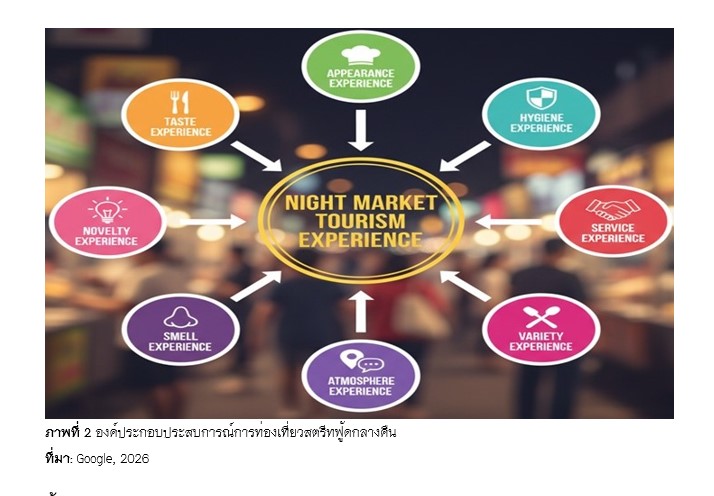
The research results established the definition of the night street food tourism experience and discovered a structural framework comprising eight main dimensions and 24 sub-components. These dimensions included 1) Taste Experience, 2) Appearance Experience, 3) Scent Experience, 4) Hygiene Experience, 5) Novelty Experience, 6) Variety Experience, 7) Service Experience, and 8) Atmosphere Experience. The Delphi Technique analysis confirmed that all 24 variables possessed high suitability, with the Median (Mdn) ranging between 4 – 5 (indicating a level of suitability from high to highest), and the Interquartile Range (IQR) being ≤ 1.5, which demonstrated a high consensus among the key informants.
Downloads
Article Details

This work is licensed under a Creative Commons Attribution-NonCommercial-NoDerivatives 4.0 International License.
The articles published are copyrighted by the Graduate School, Chiang Mai Rajabhat University.
The opinions expressed in each article of this academic journal are solely those of the individual authors and do not reflect the views of Chiang Mai Rajabhat University or its faculty members. The responsibility for the content of each article rests entirely with the respective authors. In the event of any errors, the authors alone are responsible for their own articles.
References
Agmapisarn, C., Khetjenkarn, S., & Tachochalalai, S. (2020). A study of Bangkok street food consumption and its effects on consumer attitude and behavioral intention. Chulalongkorn Business Review, 42(1), 21-42. [In Thai]
Behsudi, A. (2020, December). Tourism-dependent economies are among those harmed the most by the pandemic. Finance & Development, 37-39. https://www.imf.org/en/Publications/fandd/issues/2020/12/impact-of-the-pandemic-on-tourism-behsudi
Bichler, B. F., Pikkemaat, B., & Peters, M. (2020). Exploring the role of service quality, atmosphere and food for revisits in restaurants by using a e-mystery guest approach. Journal of Hospitality and Tourism Insights, 4(3), 351-369. https://doi.org/10.1108/jhti-04-2020-0048
Charmaz, K. (2006). Constructing grounded theory: A practical guide through qualitative analysis. Sage Publications.
Chantawibul, A. (2017). Development of street food to improve the quality of life, urban society and support the Thai economy and tourism: A case study of Phuket Province (The charming Andaman). Diplomatic Executive Course, Devawongse Varopakarn Institute of Foreign Affairs, Ministry of Foreign Affairs. [In Thai]
Cifci, I., Atsız, O., & Gupta, V. (2021). The street food experiences of the local-guided tour in the meal-sharing economy: the case of Bangkok. British Food Journal, 123(12), 4030-4048. https://doi.org/10.1108/BFJ-01-2021-0069
Correia, A., & Kozak, M. (2016). Tourists' shopping experiences at street markets: Cross-country research. Tourism Management, 56, 85-95. https://doi.org/https://doi.org/10.1016/j.tourman.2016.03.026
Delisle, H. (1990). Patterns of urban food consumption in developing countries: Perspective from the 1980’s. The Food Policy and Nutrition, de Montréal.
Denzin, N. K., & Lincoln, Y. S. (2001). The qualitative inquiry reader. SAGE Publications, Inc.
Elimelech, E., Ert, E., Parag, Y., & Hochman, G. (2024). Exploring the Impact of Visual Perception and Taste Experience on Consumers’ Acceptance of Suboptimal Fresh Produce. Sustainability, 16, 2698. https://doi.org/10.3390/su16072698
Google. (2026). Gemini [Artificial intelligence software]. https://gemini.google.com
Holbrook, M. B., & Hirschman, E. C. (1982). The experiential aspects of consumption: Consumer fantasies, feelings, and fun. Journal of Consumer Research, 9(2), 132-140. https://doi.org/https://doi.org/10.1086/208906
Jung, D., & Cho, M.-H. (2015). A discovery of the positive travel experience in pre-trip, on-site and post-trip stage. https://scholarworks.umass.edu/server/api/core/bitstreams/8b92e50b-58a7-429e-870b-a61b48215efb/content
Kalnaovakul, K., & Promsivapallop, P. (2021). Dimensions of Night Market Visit Experience of International Tourists: An Analysis of Google Reviews of Night Markets in Phuket, Thailand. Asia-Pacific Social Science Review, 21(3), Article 6.https://doi.org/https://doi.org/10.59588/2350-8329.1386
Kiatphaibool, T. (2024). Presentation of the tourism market promotion direction for 2025 by Ms. Thapanee Kiatphaibool, Governor of the Tourism Authority of Thailand. TAT Review Magazine. https://tatreviewmagazine.com/article/thailand-tourism-trends-2025/ [In Thai]
Kim, J.-H., & Ritchie, J. R. B. (2014). Cross-Cultural Validation of a Memorable Tourism Experience Scale (MTES). Journal of Travel Research, 53(3), 323-335. https://doi.org/10.1177/0047287513496468
Kim, J.-H., Ritchie, J. R. B., & McCormick, B. (2012). Development of a Scale to Measure Memorable Tourism Experiences. Journal of Travel Research, 51(1), 12-25. https://doi.org/10.1177/0047287510385467
Kotler, P., & Keller, K. L. (2012). Marketing Management (14th ed.). Pearson Education.
Maklan, S., & Klaus, P. (2011). Customer experience: Are we measuring the right things. International Journal of Market Research, 53(6), 771-792. https://www.researchgate.net/publication/285475313_Customer_experience_Are_we_measuring_the_right_things
Krungthai Card Public Company Limited. (2024). What is Customer Engagement? What are its components? Strategies and interesting examples. https://www.ktc.co.th/article/knowledge/business/what-customer-engagement [In Thai]
Naeem, M., Ozuem, W., Howell, K., & Ranfagni, S. (2023). A step-by-step process of thematic analysis to develop a conceptual model in qualitative research. International Journal of Qualitative Methods, 22. https://doi.org/10.1177/16094069231205789
Penn, M. (2018). Microtrends squared: The new small forces driving today's big disruptions. Simon & Schuster.
Pine, B. J., & Gilmore, J. H. (2011). The experience economy. Harvard Business Review Press.
Poolphatchawin, J. (2003). EDFR future research technique. Journal of Education Studies, 32(1), Article 1. http://doi.org/10.58837/CHULA.EDUCU.32.1.1 [In Thai]
Promsivapallop, P., & Kannaovakun, P. (2019). Destination food image dimensions and their effects on food preference and consumption. Journal of Destination Marketing & Management, 11, 89-100. https://doi.org/https://doi.org/10.1016/j.jdmm.2018.12.003
Rakha, A., Fatima, M., Bano, Y., Khan, M. A., Chaudhary, N., & Aadil, R. M. (2022). Safety and quality perspective of street vended foods in developing countries. Food Control, 138, 109001. https://doi.org/https://doi.org/10.1016/j.foodcont.2022.109001
Robinic, J., Marković, S., & Đorđević, A. (2025). The influence of the appearance of food products on consumer perception. In Global Challenges Through the Prism of Rural Development in the Sector of Agriculture and Tourism: GIRR 2025 (pp. 388-399). Academy of Applied Studies Šabac. https://doi.org/10.46793/GIRR25.388R
Sezgin, A. C. (2016). Street food consumption in terms of the food safety and health. Journal of Human Sciences, 13(3), 4072-4081. https://doi.org/10.14687/jhs.v13i3.3925
Singlor, T. (2021). The prolonged COVID-19 pandemic cost global tourism $2 trillion in lost revenue in 2021, according to UNWTO estimates. https://www.sdgmove.com/2021/12/01/unwto-global-tourism-industry-losts-2-trillions-usdollars-due-to-pandemic/ [In Thai]
Skavronskaya, L., Moyle, B., & Scott, N. (2020). The experience of novelty and the novelty of experience. Frontiers in Psychology, 11, Article 322. https://doi.org/10.3389/fpsyg.2020.00322
Spence, C. (2022). On the use of ambient odours to influence the multisensory experience of dining. International Journal of Gastronomy and Food Science, 27, 100444. https://doi.org/https://doi.org/10.1016/j.ijgfs.2021.100444
Thairath Money. (2024, February 19). Thai tourism in 2024 is expected to generate 2.52 trillion baht in revenue, with foreigners spending nearly 10 times more than Thais. Thairath. https://www.thairath.co.th/money/economics/thailand_econ/2764434 [In Thai]
Uriely, N. (2005). The tourist experience: Conceptual Developments. Annals of Tourism Research, 32(1), 199-216. https://doi.org/https://doi.org/10.1016/j.annals.2004.07.008
