
โครงสร้างมิติองค์ประกอบประสบการณ์การท่องเที่ยวสตรีทฟู้ดกลางคืน: การศึกษาเพื่อสร้างทฤษฎีฐานราก
Article Sidebar
Main Article Content
บทคัดย่อ
งานวิจัยนี้มีวัตถุประสงค์เพื่อ 1) ศึกษาความหมายและที่มาของประสบการณ์การท่องเที่ยวสตรีทฟู้ดกลางคืน 2) ศึกษาองค์ประกอบของประสบการณ์การท่องเที่ยวสตรีทฟู้ดกลางคืน 3) สร้างแบบวัดองค์ประกอบประสบการณ์การท่องเที่ยวสตรีทฟู้ดกลางคืน โดยใช้การวิจัยแบบผสมผสาน (Mixed Methods Approach) สำหรับการวิจัยเชิงคุณภาพศึกษาปรากฏการณ์ทางสังคมด้วยวิธีวิทยาการสร้างทฤษฎีฐานราก (Grounded Theory) เพื่อหาข้อสรุปเชิงทฤษฎีจากมุมมองและทัศนะของนักท่องเที่ยวชาวไทยที่มีประสบการณ์บริโภคอาหารสตรีทฟู้ดกลางคืนในกรุงเทพมหานคร คัดเลือกผู้ให้ข้อมูลหลักแบบเจาะจง จาก 4 ตลาดนัดกลางคืนยอดนิยมในกรุงเทพมหานคร จำนวน 20 ราย ทำการเก็บข้อมูลด้วยการสัมภาษณ์เชิงลึก สำหรับงานวิจัยเชิงปริมาณใช้เทคนิคเดลฟาย (Delphi Technique) กับผู้ให้ข้อมูลหลักกลุ่มเดิม โดยวิเคราะห์ค่ามัธยฐาน (Median) และค่าพิสัยระหว่างควอไทล์ (IQR) เพื่อยืนยันความเหมาะสมและความเที่ยงตรงของแบบวัดองค์ประกอบประสบการณ์การท่องเที่ยวสตรีทฟู้ดกลางคืน
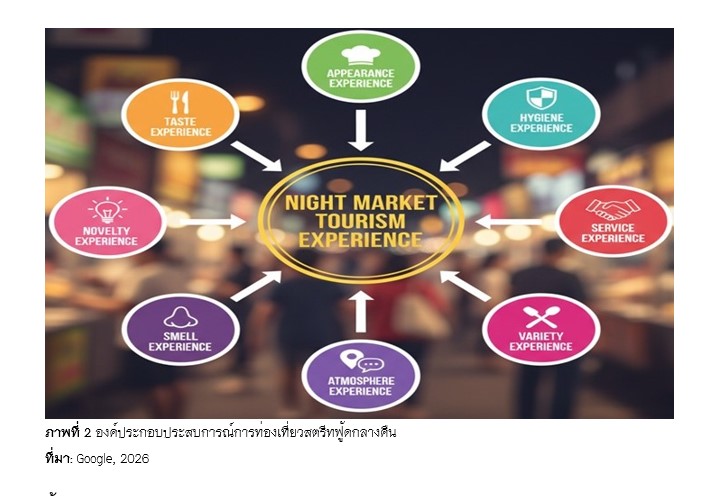
ผลการวิจัยได้คำนิยามความหมายของประสบการณ์การท่องเที่ยวสตรีทฟู้ดกลางคืน และค้นพบโครงสร้างองค์ประกอบประสบการณ์การท่องเที่ยวสตรีทฟู้ดกลางคืนที่มี 8 องค์ประกอบหลัก และ 24 องค์ประกอบย่อย ได้แก่ 1) ประสบการณ์ด้านรสชาติ 2) ประสบการณ์ด้านรูปลักษณ์ 3) ประสบการณ์ด้านกลิ่น 4) ประสบการณ์ด้านสุขอนามัย 5) ประสบการณ์ด้านความแปลกใหม่ 6) ประสบการณ์ด้านความหลากหลาย 7) ประสบการณ์ด้านการบริการ และ 8) ประสบการณ์ด้านบรรยากาศ ผลการวิเคราะห์เทคนิคเดลฟายยืนยันว่า องค์ประกอบทั้ง 24 ตัวแปรมีความเหมาะสมสูง โดยมีค่ามัธยฐาน (Mdn) อยู่ในช่วง 4 – 5 แสดงถึงองค์ประกอบมีระดับความเหมาะสมอยู่ในเกณฑ์มากถึงมากที่สุด และมีค่าพิสัยระหว่างควอร์ไทล์ (IQR} ≤ 1.5 ซึ่งแสดงถึงความสอดคล้องทางความคิดเห็นของผู้ให้ข้อมูลหลัก
Downloads
Article Details

อนุญาตภายใต้เงื่อนไข Creative Commons Attribution-NonCommercial-NoDerivatives 4.0 International License.
บทความที่ได้รับการตีพิมพ์เป็นลิขสิทธิ์ของบัณฑิตวิทยาลัย มหาวิทยาลัยราชภัฎเชียงใหม่
ข้อความที่ปรากฏในบทความแต่ละเรื่องในวารสารวิชาการเล่มนี้เป็นความคิดเห็นส่วนตัวของผู้เขียนแต่ละท่านไม่เกี่ยวข้องกับมหาวิทยาลัยราชภัฎเชียงใหม่ และคณาจารย์ท่านอื่นๆ ในมหาวิทยาลัยฯ แต่อย่างใด ความรับผิดชอบองค์ประกอบทั้งหมดของบทความแต่ละเรื่องเป็นของผู้เขียนแต่ละท่าน หากมีความผิดพลาดใด ๆ ผู้เขียนแต่ละท่านจะรับผิดชอบบทความของตนเองแต่ผู้เดียว
เอกสารอ้างอิง
Agmapisarn, C., Khetjenkarn, S., & Tachochalalai, S. (2020). A study of Bangkok street food consumption and its effects on consumer attitude and behavioral intention. Chulalongkorn Business Review, 42(1), 21-42. [In Thai]
Behsudi, A. (2020, December). Tourism-dependent economies are among those harmed the most by the pandemic. Finance & Development, 37-39. https://www.imf.org/en/Publications/fandd/issues/2020/12/impact-of-the-pandemic-on-tourism-behsudi
Bichler, B. F., Pikkemaat, B., & Peters, M. (2020). Exploring the role of service quality, atmosphere and food for revisits in restaurants by using a e-mystery guest approach. Journal of Hospitality and Tourism Insights, 4(3), 351-369. https://doi.org/10.1108/jhti-04-2020-0048
Charmaz, K. (2006). Constructing grounded theory: A practical guide through qualitative analysis. Sage Publications.
Chantawibul, A. (2017). Development of street food to improve the quality of life, urban society and support the Thai economy and tourism: A case study of Phuket Province (The charming Andaman). Diplomatic Executive Course, Devawongse Varopakarn Institute of Foreign Affairs, Ministry of Foreign Affairs. [In Thai]
Cifci, I., Atsız, O., & Gupta, V. (2021). The street food experiences of the local-guided tour in the meal-sharing economy: the case of Bangkok. British Food Journal, 123(12), 4030-4048. https://doi.org/10.1108/BFJ-01-2021-0069
Correia, A., & Kozak, M. (2016). Tourists' shopping experiences at street markets: Cross-country research. Tourism Management, 56, 85-95. https://doi.org/https://doi.org/10.1016/j.tourman.2016.03.026
Delisle, H. (1990). Patterns of urban food consumption in developing countries: Perspective from the 1980’s. The Food Policy and Nutrition, de Montréal.
Denzin, N. K., & Lincoln, Y. S. (2001). The qualitative inquiry reader. SAGE Publications, Inc.
Elimelech, E., Ert, E., Parag, Y., & Hochman, G. (2024). Exploring the Impact of Visual Perception and Taste Experience on Consumers’ Acceptance of Suboptimal Fresh Produce. Sustainability, 16, 2698. https://doi.org/10.3390/su16072698
Google. (2026). Gemini [Artificial intelligence software]. https://gemini.google.com
Holbrook, M. B., & Hirschman, E. C. (1982). The experiential aspects of consumption: Consumer fantasies, feelings, and fun. Journal of Consumer Research, 9(2), 132-140. https://doi.org/https://doi.org/10.1086/208906
Jung, D., & Cho, M.-H. (2015). A discovery of the positive travel experience in pre-trip, on-site and post-trip stage. https://scholarworks.umass.edu/server/api/core/bitstreams/8b92e50b-58a7-429e-870b-a61b48215efb/content
Kalnaovakul, K., & Promsivapallop, P. (2021). Dimensions of Night Market Visit Experience of International Tourists: An Analysis of Google Reviews of Night Markets in Phuket, Thailand. Asia-Pacific Social Science Review, 21(3), Article 6.https://doi.org/https://doi.org/10.59588/2350-8329.1386
Kiatphaibool, T. (2024). Presentation of the tourism market promotion direction for 2025 by Ms. Thapanee Kiatphaibool, Governor of the Tourism Authority of Thailand. TAT Review Magazine. https://tatreviewmagazine.com/article/thailand-tourism-trends-2025/ [In Thai]
Kim, J.-H., & Ritchie, J. R. B. (2014). Cross-Cultural Validation of a Memorable Tourism Experience Scale (MTES). Journal of Travel Research, 53(3), 323-335. https://doi.org/10.1177/0047287513496468
Kim, J.-H., Ritchie, J. R. B., & McCormick, B. (2012). Development of a Scale to Measure Memorable Tourism Experiences. Journal of Travel Research, 51(1), 12-25. https://doi.org/10.1177/0047287510385467
Kotler, P., & Keller, K. L. (2012). Marketing Management (14th ed.). Pearson Education.
Maklan, S., & Klaus, P. (2011). Customer experience: Are we measuring the right things. International Journal of Market Research, 53(6), 771-792. https://www.researchgate.net/publication/285475313_Customer_experience_Are_we_measuring_the_right_things
Krungthai Card Public Company Limited. (2024). What is Customer Engagement? What are its components? Strategies and interesting examples. https://www.ktc.co.th/article/knowledge/business/what-customer-engagement [In Thai]
Naeem, M., Ozuem, W., Howell, K., & Ranfagni, S. (2023). A step-by-step process of thematic analysis to develop a conceptual model in qualitative research. International Journal of Qualitative Methods, 22. https://doi.org/10.1177/16094069231205789
Penn, M. (2018). Microtrends squared: The new small forces driving today's big disruptions. Simon & Schuster.
Pine, B. J., & Gilmore, J. H. (2011). The experience economy. Harvard Business Review Press.
Poolphatchawin, J. (2003). EDFR future research technique. Journal of Education Studies, 32(1), Article 1. http://doi.org/10.58837/CHULA.EDUCU.32.1.1 [In Thai]
Promsivapallop, P., & Kannaovakun, P. (2019). Destination food image dimensions and their effects on food preference and consumption. Journal of Destination Marketing & Management, 11, 89-100. https://doi.org/https://doi.org/10.1016/j.jdmm.2018.12.003
Rakha, A., Fatima, M., Bano, Y., Khan, M. A., Chaudhary, N., & Aadil, R. M. (2022). Safety and quality perspective of street vended foods in developing countries. Food Control, 138, 109001. https://doi.org/https://doi.org/10.1016/j.foodcont.2022.109001
Robinic, J., Marković, S., & Đorđević, A. (2025). The influence of the appearance of food products on consumer perception. In Global Challenges Through the Prism of Rural Development in the Sector of Agriculture and Tourism: GIRR 2025 (pp. 388-399). Academy of Applied Studies Šabac. https://doi.org/10.46793/GIRR25.388R
Sezgin, A. C. (2016). Street food consumption in terms of the food safety and health. Journal of Human Sciences, 13(3), 4072-4081. https://doi.org/10.14687/jhs.v13i3.3925
Singlor, T. (2021). The prolonged COVID-19 pandemic cost global tourism $2 trillion in lost revenue in 2021, according to UNWTO estimates. https://www.sdgmove.com/2021/12/01/unwto-global-tourism-industry-losts-2-trillions-usdollars-due-to-pandemic/ [In Thai]
Skavronskaya, L., Moyle, B., & Scott, N. (2020). The experience of novelty and the novelty of experience. Frontiers in Psychology, 11, Article 322. https://doi.org/10.3389/fpsyg.2020.00322
Spence, C. (2022). On the use of ambient odours to influence the multisensory experience of dining. International Journal of Gastronomy and Food Science, 27, 100444. https://doi.org/https://doi.org/10.1016/j.ijgfs.2021.100444
Thairath Money. (2024, February 19). Thai tourism in 2024 is expected to generate 2.52 trillion baht in revenue, with foreigners spending nearly 10 times more than Thais. Thairath. https://www.thairath.co.th/money/economics/thailand_econ/2764434 [In Thai]
Uriely, N. (2005). The tourist experience: Conceptual Developments. Annals of Tourism Research, 32(1), 199-216. https://doi.org/https://doi.org/10.1016/j.annals.2004.07.008
