
Cultural Tourism Through the Identity of the Catholic Vietnamese Community in Ongkharak District, Nakhon Nayok Province
Article Sidebar
Main Article Content
Abstract
The objective of this research aimed to 1) explore the identity components of the Catholic Vietnamese community; 2) develop and design a cultural tourism route based on the identity of the Catholic Vietnamese community in Ongkharak District, Nakhon Nayok Province; and 3) evaluate the cultural tourism route developed from the community's identity in Ongkharak District, Nakhon Nayok Province. This qualitative research utilized key informant interviews with academics, community leaders, entrepreneurs, and other relevant stakeholders. The data were verified for completeness, analyzed for content, and interpreted according to key themes to present the results in line with the research objectives.
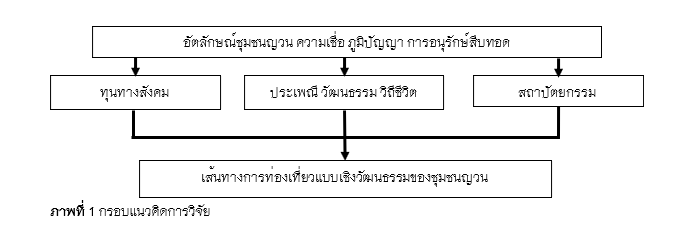
Research Findings, 1. The survey of the Catholic Vietnamese community identity in Ongkharak District, Nakhon Nayok Province, revealed that the Catholic Vietnamese community in Ongkharak District, Nakhon Nayok Province, had its roots in Vietnamese people in Bangkok's Samsen area, whose ancestors immigrated to serve as Siamese soldiers during the reigns of King Rama I and King Rama III. The Vietnamese lived alongside Christian Khmers. As the population grew, the Vietnamese migrated to Ongkharak around 1903 to engage in agriculture and freshwater fishing, led by the Wiang family. During the reign of Field Marshal P. Phibunsongkhram, the community adopted Thai surnames, such as Thong Wiang and Chanthawiriyakun. In line with nationalist policies. The Vietnamese initially used their members' homes as a place for religious ceremonies. As the community grew and became more mature, they jointly built a Catholic church called "Wat Phra Phuttha Saovabha" (The Redeemer's Church) as a religious and community center. The Vietnamese still maintain the Vietnamese language as a means of communication, possessing social capital, including human capital, federation capital, and community networks. Local foods are still eaten, such as mam toi, kai euak, moo euak, pla euak, ka jaa, ban tak, ban duc, Vietnamese bua loy, and Vietnamese dipping sauce. Important community traditions include church celebrations, Christmas, Chinese New Year, Songkran, and the "Long Khaek". Significant community landmarks include the church, cemetery, and church museum, clearly reflecting the fusion of Vietnamese culture and Thai way of life.
2. Cultural tourism route with the Identity of the Catholic Vietnamese community in Ongkharak District, Nakhon Nayok Province, interviews with key informants revealed that the Vietnamese community-based tourism route included the first stop: Wat Phra Phuttha Saovabha Church; the second stop: the temple museum; the third stop: the 100-year-old market; and the fourth stop: the Ongkharak Shrine.
3. The evaluation of the cultural tourism route and the refinement of tourist attractions, conducted through focus group discussions following the implementation of cultural tourism activities in the Catholic Vietnamese community, revealed that parking and the design of the 100-Year Market should be improved to attract tourists. This requires cooperation from all sectors, including the government, local government, education, and private sectors.
Downloads
Article Details

This work is licensed under a Creative Commons Attribution-NonCommercial-NoDerivatives 4.0 International License.
The articles published are copyrighted by the Graduate School, Chiang Mai Rajabhat University.
The opinions expressed in each article of this academic journal are solely those of the individual authors and do not reflect the views of Chiang Mai Rajabhat University or its faculty members. The responsibility for the content of each article rests entirely with the respective authors. In the event of any errors, the authors alone are responsible for their own articles.
References
Chulalongkorn University, Intellectual Property Institute. (2562). A study of approaches to promoting intellectual property in the tourism industry. Chulalongkorn University Intellectual Property Institute. [In Thai]
Deeprom, N. & Lertphuttharak, S. (2021). Cultural tourism management: A case study of Nakhon Nayok Province. Burapha Business Review Journal, 16(2), 1-14. https://so02.tci-thaijo.org/index.php/GSC/article/view/244920 [In Thai]
Buhalis, D. (2020). Technology in tourism—from information communication technologies to eTourism and smart tourism towards ambient intelligence tourism: A perspective article. Tourism Review, 75(1), 267–272. https://doi.org/10.1108/TR-06-2019-0258
Howard, P. J. (2006). Tourism development in ethnic areas of Southern China [Doctoral dissertation, Griffith University]. https://doi.org/10.25904/1912/1187
Khamwan, S. (2019). Constructing a contractual nationalism: A case study of the Viet Kieu community in Nakhon Phanom [Doctoral dissertation, Naresuan University]. https://harrt.in.th/handle/123456789/7560 [In Thai]
Piwphong, W. (2021). From displaced people to “Vietnamese refugees”: Lives of the Vietnamese in the upper northeast Thailand, 1945–1976 [Master's thesis, Chulalongkorn University]. Chulalongkorn University Theses and Dissertations. https://doi.org/10.58837/CHULA.THE.2021.737 [In Thai]
Pongtratik, C., Nimnatipun, S., & Malarat, A. (2021). Development of cultural tourism strategies in Prachuap Khiri Khan Province. MCU Journal of Buddhist Wisdom Review, 6(3), 77–91. https://so03.tci-thaijo.org/index.php/jmbr/article/view/256405 [In Thai]
Richards, G. (2010). Increasing the attractiveness of places through cultural resources. Tourism Culture & Communication, 10(1), 47-58. https://doi.org/10.3727/109830410X12629765735678
Schrock, J. (1970). Minority groups in Thailand. Headquaters Department of the Army.
Solima, L., & Minguzzi, A. (2014). Territorial development through cultural tourism and creative activities. Mondes du Tourisme, (10), 6-16. https://doi.org/10.4000/tourisme.366
Um, S., & Crompton, J. L. (1990). Attitude determinants in tourism destination choice. Annals of Tourism Research, 17(3), 432-448. https://doi.org/10.1016/0160-7383(90)90008-F
Wattanasan, P., Muangkaew, C., Pibool, S., & Plianplan, R. (2022). The identity of Thai people of Vietnamese descent who are Roman Catholic: A case study of Saowapa Phongsri Community, Ongkharak District, Nakhon Nayok Province, Thailand. Journal of Positive School Psychology, 6(6), 10721–10729. https://journalppw.com/index.php/jpsp/article/view/7352 [In Thai]
Wongwichian, W. (2008). The lifestyle changes of the Catholic Vietnamese Thais: A case study of a Vietnamese village in Ongkharak District, Nakhon Nayok Province (Master's thesis, Mahasarakham University). [In Thai]
