
An Analysis of Figurative Language in Facial Skincare Advertisements on Instagram
Article Sidebar
Main Article Content
Abstract
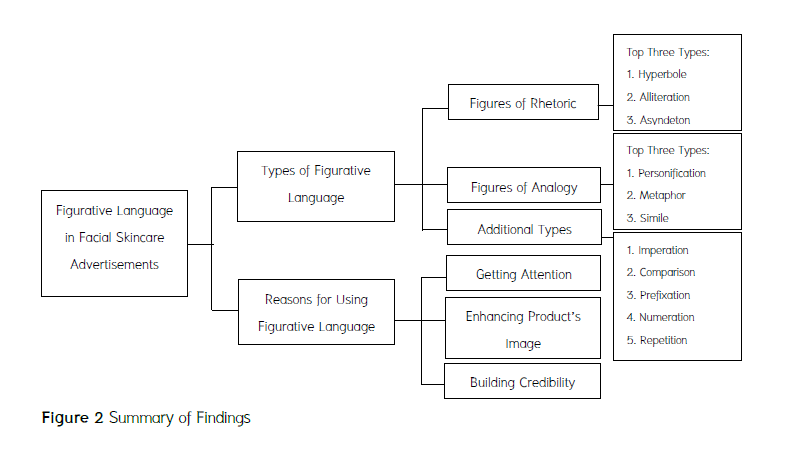
This research aimed to study the types and reasons for using figurative language in facial skincare product advertisements on Instagram. The data was collected from 100 advertising captions posted on Instagram of top five best-selling facial skincare brands during 2024 to 2025 based on purposive sampling. A mixed-methods approach was utilized for data analysis in this study. Quantitative method was employed to investigate the types of figurative language used in facial skincare advertisements on Instagram by using descriptive statistics. Figures of speech framework proposed by Keraf was adopted to analyze the data. Qualitative approach was conducted to describe the reasons of advertisers to employ those types of figurative language through content analysis. The findings revealed that there were 406 utterances out of 100 facial skincare advertisement captions on Instagram containing figurative language. Twenty-eight figurative language types based on Keraf’s framework were found while five additional figurative language types were discovered. The top three types of figurative language included Hyperbole (64 times, 15.96%), followed by Personification (44 times, 10.83%), and Alliteration (37, 9.11%), respectively. The top three types of figures of rhetoric were Hyperbole (64 times, 27.11%), followed by Alliteration (37 times, 15.67%), and Asyndeton (35 times, 14.83%), respectively. Moreover, the top three types of figures of analogy were Personification (44 times, 46.80%), followed by Metaphor (11 times, 11.70%), Simile and Comparison (10 times, 10.63% each), respectively. The results from content analysis revealed three categories of reasons advertisers used figurative language to present the products to their customers, namely getting attention, enhancing a product’s image, and building credibility.
Downloads
Article Details

This work is licensed under a Creative Commons Attribution-NonCommercial-NoDerivatives 4.0 International License.
The articles published are copyrighted by the Graduate School, Chiang Mai Rajabhat University.
The opinions expressed in each article of this academic journal are solely those of the individual authors and do not reflect the views of Chiang Mai Rajabhat University or its faculty members. The responsibility for the content of each article rests entirely with the respective authors. In the event of any errors, the authors alone are responsible for their own articles.
References
Alexander, B. N. (2025, November 25). What is Instagram? Everything you can do on the popular photo-sharing app. Reader’s Digest. https://www.rd.com/article/what-is-instagram/
Amalina, A. (2023). Language use in skincare product advertisements found in Instagram to persuade buyers based on Fairclough’s three-dimensional frameworks. International Journal of Multicultural and Multireligious Understanding, 10(7), 45-52. http://dx.doi.org/10.18415/ijmmu.v10i7.4782
Anastari, I., Agustina, H. N., & Suharto, R. P. (2024). An Analysis of Figurative Language Used in Fashion and Beauty Advertisements of Red Digital Magazine. British (Jurnal Bahasa dan Sastra Inggris), 13(1), 65-76. https://doi.org/10.31314/british.13.1.65-76.2024
Arjulayana, A., & Enawar, E. (2022). Cosmetics advertisement language through discursive psychology. Linguists Journal of Linguistics and Language Teaching, 8(2), 205-215. https://doi.org/10.29300/ling.v8i2.8016
Atmaja, K. (2022). Internet analysis of figurative language in automotive advertisement slogans. Journal of Pragmatics Research, 4(1), 18-28. https://doi.org/10.18326/jopr.v4i1.18-28
Bahadur, S. A., Ahmed, R. Z., & Iqbal, R. H. (2025). Analyzing Conceptual Metaphors in Beauty Cream Advertisements: A Corpus-Based Study. ACADEMIA International Journal for Social Sciences, 4(3), 825-850. https://doi.org/10.63056/ACAD.004.03.0417.
Caesary, A.D. P., Sunra, L., & Mustikawati, Y. (2022). Language style at advertisement in CNN. Journal of English Literature and Linguistic Studies, 1(1), 1-12. https://doi.org/10.26858/jells.v1i1.40859
Chamba, M., Reinoso, M., & Rengifo, E. (2019). Authentic materials to foster writing skills in college EFL learners. English Language Teaching, 12(6), 112-127. https://doi.org/10.5539/elt.v12n6p112
Gong, N., & Seo, J. (2025). The influence of advertising language and brand loyalty on consumers’ purchase intentions. Asia Pacific Journal of Marketing and Logistics, 37(11), 3464–3481. https://doi.org/10.1108/APJML-09-2024-1282
Hesti, H., Tang, M. R., & Aj, A. A. (2022). Functions of rhetoric and figurative language in Instagram social media skin care ads. Journal of Asian Multicultural Research for Social Sciences Study, 3(2), 44-48. https://doi.org/10.47616/jamrsss.v3i2.282
Hutagalung, N. A., Buulolo, S., & Purba, D. (2023). An analysis of figurative language used in Cosmetic Advertisement on Indonesian Television. JURNAL LITTERA: Fakultas Sastra Darma Agung, 2(1), 1-8. https://doi.org/10.46930/littera.v2i1.3172
Keraf, G. (2005). Definition of language. Smarapradipha
Keraf, G. (2010). Diksi dan gaya bahasa. Gramedia Pustaka Utama.
Ketaren, S. V., Sipahutar, S. R., Marpaung, E. M., & Saragih, E. (2021). Figurative language use in song lyrics in English textbook senior high school. Linguistic, English Education and Art (LEEA) Journal, 4(2), 300-305. https://doi.org/10.31539/leea.v4i2.1997
Lakkam, P. (2017). The lexical collocations used in facial skincare product online advertisements [Master thesis, Thammasat University]. ttp://ethesisarchive.library.tu.ac.th/thesis/2017/TU_2017_5921040373_9112_7285.pdf
Larasati, C. A., & Pariyanto. (2022). An analysis of word formation process on cosmetic product descriptions in U.S celebrities’ beauty brands. Journal of English Teaching, 7(2), 179-188. https://doi.org/10.36456/jet.v7.n02.2022.6332
Mandala AI. (2025, July 10). Updated analysis of the cosmetics market structure. https://blog.mandalasystem.com/th/cosmetics-market-in-thailand
Meredith, E. (2022). Figure of speech. EBSCO Knowledge Advantage. https://www.ebsco.com/research-starters/literature-and-writing/figure-speech
Merriam-Webster Dictionary. (2025, October 10). Figurative language. https://www.merriam-webster.com/grammar/figurative-language
Mukhammadovna, J. M., & Matluba, A. (2025). The use of imperative verbs in radio advertising texts. Journal of Innovation in Educational and Social Research, 3(3), 59-62. https://journals.proindex.uz/index.php/JIESR/article/view/2270
Naser, H. S. (2021). A multimodal analysis of hyperbolic devices in advertisements of health and beauty products. Journal of the College of Languages, 44, 94-118. https://doi.org/10.36586/jcl.2.2021.0.44.0094
Nurlanbek Kyzy, M. (2025) Multimodal advertising strategies in the beauty industry: A case of cosmetic brand. Open Access Library Journal, 12(11), 1-18. https://doi.org/10.4236/oalib.1114420
Pathumratanathan, P., & Tapinta, P. (2012). An investigation on figurative language employed in English advertisements in in-flight magazines. Journal of Studies in the Field of Humanities, 19(1), 215-232.
Pho-Klang, K. (2020). Figurative language in social media captions for clothing advertisements. Rangsit Journal of Social Sciences and Humanities, 7(2), 33-40. https://so12.tci-thaijo.org/index.php/jcsh/article/view/3681/2634
Qader, K. S., Hamza, P. A., Othman, R. N., Anwer, S. A., Hamad, H. A., Gardi, B., & Ibrahim, H. K. (2022). Analyzing different types of advertising and its influence on customer choice. International Journal of Humanities and Education Development (IJHED), 4(6), 8-21. https://doi.org/10.22161/jhed.4.6.2
Salim, S., & Purwaningtyas, I. (2022). Analysis of language styles: Rhetoric and figurative language in makeup advertisement on Instagram. Proceedings of the 2nd International Conference on Language, Literature, Education, and Culture, ICOLLEC 2022 (pp. 1-10). ICOLLEC. https://doi.org/10.4108/eai.11-11-2022.2329359
Septiana, A. K. (2022). The Use of Language Function in Maybelline New York Cosmetic Advertisements. Wacana Saraswati Majalah Ilmiah Tentang Bahasa Sastra Dan Pembelajarannya, 22(1). https://doi.org/10.46444/wacanasaraswati.v22i1.398
Shi, J. (2021). On application of rhetorical devices to cosmetic advertisements. Open Journal of Modern Linguistics, 11(3), 315-326. https://doi.org/10.4236/ojml.2021.113025
Srichaiwong, P. (2020). English for communication in cosmetic advertisements from web pages. Academy Journal of Northern, 7(2), 29-39. https://so09.tci-thaijo.org/index.php/AJntc/article/view/1440
Statista. (2025, June 12). Number of Instagram users worldwide from 2013 to 2025. https://www.statista.com/statistics/183585/instagram-number-of-global-users
Today Bizview. (2024, July 11). 10 Most valuable skincare and cosmetics brands in the world. https://www.workpointtoday.com
Trakulkasemsuk, W. (2018). Roles of English in facial cosmetic advertisements in Thai magazines. Journal of English Studies, 13(1), 24-43. https://so04.tci-thaijo.org/index.php/jsel/article/view/159271
Yusuf, A. H. S. M., & Abas, N. M. (2024). Exploring the impact of language in advertising on consumers’ purchase intentions: A thematic literature analysis. International Journal of Research and Innovation in Social Science, 8(9), 3560-3572. https://dx.doi.org/10.47772/IJRISS.2024.8090297
Zuhriani, V. (2022). The analysis of cosmetic advertising language by using presupposition approach. Journal of Languages Studies, 10(2), 20-28. https://doi.org/10.26740/lh.v10n2.p20-28
