
An Analysis of the Intangible Cultural Heritage Regarding “Thai Respectful Conduct” for Thai Cultural Learning Among Chinese Learners of Thai as a Foreign Language
Article Sidebar
Main Article Content
Abstract
The objective of this article was to analyze the content of the intangible cultural heritage regarding “Thai respectful conduct” and to examine the perspectives and learning conditions of Chinese learners of Thai as a Foreign Language this cultural practice. This qualitative study employed qualitative content analysis of 12 documentary and official sources, together with semi-structured interviews and open-ended questions. The participants consisted of 50 second-year Chinese undergraduate students majoring in Thai at higher-education institutions in the Guangxi Zhuang Autonomous Region, the People's Republic of China,They were selected through purposive sampling.
The findings revealed that: 1) Thai respectful conduct was closely related to Buddhism, as reflected in the gesture of joining the palms (Anjali), the Wai, prostration, and forms of respectful conduct used on specific occasions; and 2) In the Thai social context, Thai respectful conduct transmitted values of gratitude and acknowledgement of beneficence, functioned as a system of interaction that regulated behavior and interpersonal relationships, and served as a “cultural language” through which Thai cultural meanings were conveyed.
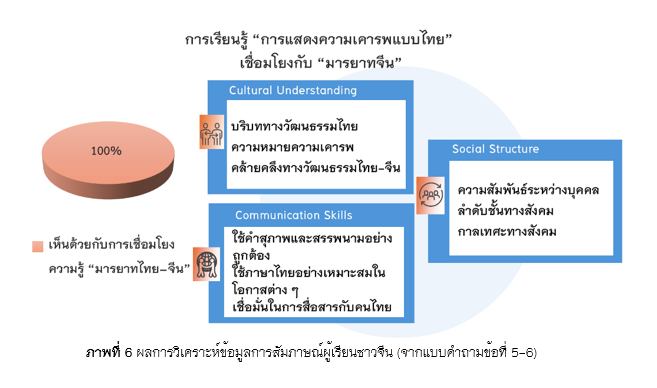
In addition, analysis of the interview and open-ended-question data yielded three key themes: 1) Superficial learning: mastering “gestures” without understanding “contexts”; 2) Chinese learners’ interest in and needs for learning “Thai respectful conduct”; and 3) Learning Thai respectful conduct through comparison with Chinese etiquette. The findings further indicated that most Chinese learners were familiar only with the forms or gestures of the Wai and prostration but still required a deeper understanding of their cultural meanings in order to use respectful gestures and language accurately and appropriately in authentic Thai social situations.
Downloads
Article Details

This work is licensed under a Creative Commons Attribution-NonCommercial-NoDerivatives 4.0 International License.
The articles published are copyrighted by the Graduate School, Chiang Mai Rajabhat University.
The opinions expressed in each article of this academic journal are solely those of the individual authors and do not reflect the views of Chiang Mai Rajabhat University or its faculty members. The responsibility for the content of each article rests entirely with the respective authors. In the event of any errors, the authors alone are responsible for their own articles.
References
Burgoon, J. K., & Saine, T. J. (1978). The unspoken dialogue: An introduction to nonverbal communication. Houghton Mifflin. https://archive.org/details/unspokendialogue0000burg
Byram, M. (1997). Teaching and assessing intercultural communicative competence. Multilingual Matters.
Chen, C. (2025). Huaxia chuantong liyi [Traditional rituals of Huaxia]. Jiangsu People's Publishing House. [In Chinese]
Department of Cultural Promotion (DCP). (2016). Social practices, rituals, and festive events: National intangible cultural heritage. Printing Office, Veterans Welfare Organization under Royal Patronage. [In Thai]
Department of Cultural Promotion & Ministry of Culture (DCP & MOC). (2025a). Thai etiquette and social etiquette. Department of Cultural Promotion. https://book.culture.go.th/etiquette/then/#p=1 [In Thai]
Department of Cultural Promotion & Ministry of Culture (DCP & MOC). (2025b). The Wai in Thailand and abroad. Department of Cultural Promotion. https://book.culture.go.th/wai/#p=1 [In Thai]
Encyclopedia of China Publishing House. (2025). Zhongguo da baike quanshu [Encyclopedia of China]. https://www.zgbk.com/ecph/words?SiteID=1&ID=1npR2S&Type=bkzyb&SubID=257725 [In Chinese]
GAR-Higher Education Rankings. (2024). Ranking of Thai majors - Competitiveness ranking of Chinese universities by major. http://school.nseac.com/spe.php?speid=050220 [In Chinese]
Hai, Y. (2021). Liyi Zhongguo [Etiquette in China]. Beijing Normal University Press. [In Chinese]
Hu, A., Han, L., & Chen, L. (2018). Zhongguo liyi wenhua [Chinese etiquette and culture]. China Travel & Tourism Press. [In Chinese]
Kramsch, C. (1993). Context and culture in language teaching. Oxford University Press.
Li, Y. (2019). The study of politeness in communication between Thai and Chinese [Master’s thesis, Chiang Mai Rajabhat University]. Chiang Mai Rajabhat University Intellectual Repository. http://cmruir.cmru.ac.th/handle/123456789/2508 [In Thai]
Ministry of Education (MOE). (2010). Good manners in public places. https://www.moe.go.th/มารยาทดีๆ-ในที่สาธารณะ/ [In Thai]
Office of the Royal Society. (2018). Draft Strategic Plan under the National Language Policy (2018–2021). https://www.orst.go.th/royindev/iwfm_list.asp?n=g&b=e&i=0020000402001002%2F64G%24P4328009 [In Thai]
Office of the National Culture Commission (ONCC). (2010). Thai etiquette. Department of Cultural Promotion. https://www.boonjit.ac.th/backoffice/ckfinder/administration/files/marayatthai.pdf [In Thai]
Oppici, L., Mathias, B. Narciss, S., & Proske, A. (2023). Benefits of enacting and observing gestures on foreign language vocabulary learning: A systematic review and meta-analysis. Behavioral Sciences, 13(11), 920. https://doi.org/10.3390/bs13110920
Peng, L. (2017). Zhonghua chuantong liyi gaiyao [An overview of traditional Chinese etiquette]. Higher Education Press. [In Chinese]
Phra Dhammakittiwong (Thongdi Suratecho). (2005). Dictionary for Buddhist studies: Temple terms. Liang Chiang Press. [In Thai]
Prasithrathsint, A. (2005). Language in Thai society: Diversity, change, and development. Chulalongkorn University Press. [In Thai]
Princess Maha Chakri Sirindhorn Anthropology Centre (SAC). (2011). Thailand cultural encyclopedia. https://db.sac.or.th/thailand-cultural-encyclopedia/detail.php?id=7739 [In Thai]
Punyarit, S. (2001). Thai etiquette. Thammasapa. [In Thai]
Ren, Z., Bunpiem, S., & Mahakhan, P. (2012). A Study of Cross-Cultural Adaptation of Chinese Students in Thailand: Case Study Burapha University. Faculty of Humanities and Social Sciences, 20(34), 185-201. http://dspace.lib.buu.ac.th/xmlui/handle/1234567890/2563 [In Thai]
Somdet Phra Buddhaghosacariya (P. A. Payutto). (2023). Dictionary of Buddhism: Vocabulary compendium (34th ed.). Phra Dhammapitaka Foundation for Peace Education. [In Thai]
Thamvaja, W. (2021). A Study of Cognition and Factors Affecting Learning Thai Culture of Chinese Exchange Students in Huachiew Chalermprakiet University. Academic and Research Journal of Liberal Arts (Online), 16(2), 1–17. https://so04.tci-thaijo.org/index.php/larhcu/article/view/251303 [In Thai]
The Government Public Relations Department. (2024, January 16). The Wai as a national identity: Types of Thai greeting and showing respect. https://www.prd.go.th/th/content/category/detail/id/31/iid/250558 [In Thai]
The Secretariat of the Cabinet. (2024). Cabinet resolution approving the Wai as a national identity for Thai greeting and paying respect. https://www.soc.go.th/wp-content/uploads//2024/06/v67_256.pdf [In Thai]
The Editorial Committee of Chinese Etiquette Culture. (2020). Da Zhongguo shangxia wuqiannian: Zhongguo liyi wenhua [The great China throughout five thousand years: Chinese etiquette and culture]. Foreign Languages Press. [In Chinese]
Thomas, J. (1983). Cross-Cultural Pragmatic Failure. Applied Linguistics, 4 (2), 91–112. https://doi.org/10.1093/
applin/4.2.91
The United Nations Educational, Scientific and Cultural Organization (UNESCO). (2003). Text of the Convention for the Safeguarding of the Intangible Cultural Heritage. https://ich.unesco.org/en/convention
The United Nations Educational, Scientific and Cultural Organization (UNESCO). (2015). Intangible cultural heritage and sustainable development (Safeguarding project “Kit of the Convention for the Safeguarding of the Intangible Cultural Heritage”). https://ich.unesco.org/en/kit
Wongphinanwatana, W. (2019). Thai Language Usage in Cross-cultural Communication Process of Foreigner Students. Journal of Language, Religion and Culture, 8(2), 1-15. https://so03.tci-thaijo.org/index.php/gshskku/article/view/174901 [In Thai]
Zhang, C., Wannapaisan, C., & Mangkhang, C. (2021). The Impacts of Chinese students’ Thai cultural competency in teaching and learning in Chiang Mai University. Journal of Education Studies, 49(2),1-15. https://digital.car.chula.ac.th/educujournal/vol49/iss2/12 [In Thai]
Zhou, R., Samad, A., & Perinpasingam, T. (2024). A systematic review of cross-cultural communicative competence in EFL teaching: insights from China. Humanities and Social Sciences Communications, 11(29), 1-11. https://doi.org/10.1057/s41599-024-04071-5
