
การวิเคราะห์มรดกภูมิปัญญาทางวัฒนธรรมเรื่อง “การแสดงความเคารพแบบไทย” เพื่อการเรียนรู้วัฒนธรรมไทยสำหรับผู้เรียนชาวจีนที่เรียนภาษาไทยในฐานะภาษาต่างประเทศ
Article Sidebar
Main Article Content
บทคัดย่อ
บทความนี้มีวัตถุประสงค์เพื่อวิเคราะห์เนื้อหามรดกภูมิปัญญาทางวัฒนธรรมเรื่อง “การแสดงความเคารพแบบไทย” และศึกษามุมมองและสภาพการเรียนรู้เกี่ยวกับ “การแสดงความเคารพแบบไทย” ของผู้เรียนชาวจีนที่เรียนภาษาไทยในฐานะภาษาต่างประเทศ การวิจัยครั้งนี้เป็นการวิจัยเชิงคุณภาพ (Qualitative Research) โดยวิธีการวิเคราะห์เนื้อหา (Qualitative Content Analysis) จากเอกสารและแหล่งข้อมูลทางการจำนวน 12 แหล่ง และวิธีการสัมภาษณ์แบบกึ่งโครงสร้างร่วมกับแบบคำถามปลายเปิด (Open-ended Question) กลุ่มตัวอย่างที่ใช้ในการวิจัยเป็นนักศึกษาชาวจีนชั้นปีที่ 2 สาขาวิชาภาษาไทยของสถาบันอุดมศึกษาในเขตปกครองตนเองกว่างซีจ้วง สาธารณรัฐประชาชนจีน จำนวน 50 คน ซึ่งได้มาโดยการเลือกแบบเจาะจง (Purposive Sampling)
ผลการวิจัยพบว่า 1) การแสดงความเคารพแบบไทยสัมพันธ์กับพุทธศาสนา ได้แก่ การประนมมือ การไหว้ การกราบและการแสดงความเคารพที่ใช้โอกาสเฉพาะ 2) การแสดงความเคารพแบบไทยในบริบทสังคมไทย ได้แก่ การสืบทอดค่านิยมความกตัญญูและการยอมรับบุญคุณ การเป็นระบบปฏิสัมพันธ์ที่กำกับพฤติกรรมและความสัมพันธ์ระหว่างบุคคลในสังคมไทย และการเป็น “ภาษาทางวัฒนธรรม” ที่ถ่ายทอดและสื่อความหมายทางวัฒนธรรมไทย
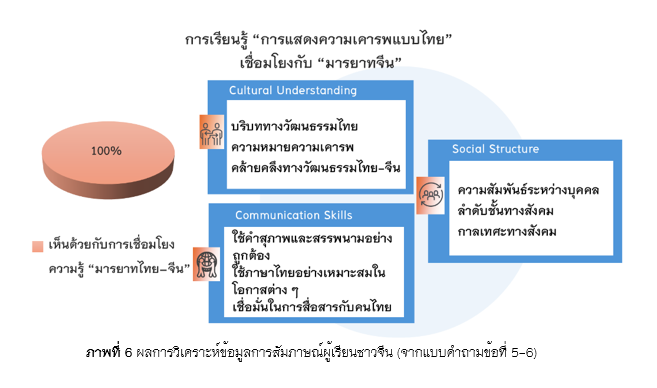
นอกจากนี้ จากการวิเคราะห์ข้อมูลการสัมภาษณ์โดยใช้แบบคำถามกับผู้เรียนชาวจีน สรุปเป็น 3 ประเด็น ได้แก่ 1) การเรียนรู้แบบผิวเผิน: เรียนรู้ “ท่าทาง” แต่ไม่เข้าใจ “บริบท” 2) ความสนใจและความต้องการของผู้เรียนชาวจีนต่อการเรียนรู้เรื่อง "การแสดงความเคารพแบบไทย" 3) การเรียนรู้การแสดงความเคารพแบบไทยโดยเชื่อมโยงกับมารยาทจีน โดยพบว่า ผู้เรียนชาวจีนเรียนรู้เรื่อง “การแสดงความเคารพแบบไทย” ส่วนใหญ่รู้จักเพียงรูปแบบหรือท่าทางการไหว้และการกราบ แต่ยังต้องการมีความเข้าใจเชิงความหมายของวัฒนธรรมมากขึ้น เพื่อสามารถใช้กิริยาและภาษาได้อย่างถูกต้องและเหมาะสมในสถานการณ์จริงของสังคมไทย
Downloads
Article Details

อนุญาตภายใต้เงื่อนไข Creative Commons Attribution-NonCommercial-NoDerivatives 4.0 International License.
บทความที่ได้รับการตีพิมพ์เป็นลิขสิทธิ์ของบัณฑิตวิทยาลัย มหาวิทยาลัยราชภัฎเชียงใหม่
ข้อความที่ปรากฏในบทความแต่ละเรื่องในวารสารวิชาการเล่มนี้เป็นความคิดเห็นส่วนตัวของผู้เขียนแต่ละท่านไม่เกี่ยวข้องกับมหาวิทยาลัยราชภัฎเชียงใหม่ และคณาจารย์ท่านอื่นๆ ในมหาวิทยาลัยฯ แต่อย่างใด ความรับผิดชอบองค์ประกอบทั้งหมดของบทความแต่ละเรื่องเป็นของผู้เขียนแต่ละท่าน หากมีความผิดพลาดใด ๆ ผู้เขียนแต่ละท่านจะรับผิดชอบบทความของตนเองแต่ผู้เดียว
เอกสารอ้างอิง
Burgoon, J. K., & Saine, T. J. (1978). The unspoken dialogue: An introduction to nonverbal communication. Houghton Mifflin. https://archive.org/details/unspokendialogue0000burg
Byram, M. (1997). Teaching and assessing intercultural communicative competence. Multilingual Matters.
Chen, C. (2025). Huaxia chuantong liyi [Traditional rituals of Huaxia]. Jiangsu People's Publishing House. [In Chinese]
Department of Cultural Promotion (DCP). (2016). Social practices, rituals, and festive events: National intangible cultural heritage. Printing Office, Veterans Welfare Organization under Royal Patronage. [In Thai]
Department of Cultural Promotion & Ministry of Culture (DCP & MOC). (2025a). Thai etiquette and social etiquette. Department of Cultural Promotion. https://book.culture.go.th/etiquette/then/#p=1 [In Thai]
Department of Cultural Promotion & Ministry of Culture (DCP & MOC). (2025b). The Wai in Thailand and abroad. Department of Cultural Promotion. https://book.culture.go.th/wai/#p=1 [In Thai]
Encyclopedia of China Publishing House. (2025). Zhongguo da baike quanshu [Encyclopedia of China]. https://www.zgbk.com/ecph/words?SiteID=1&ID=1npR2S&Type=bkzyb&SubID=257725 [In Chinese]
GAR-Higher Education Rankings. (2024). Ranking of Thai majors - Competitiveness ranking of Chinese universities by major. http://school.nseac.com/spe.php?speid=050220 [In Chinese]
Hai, Y. (2021). Liyi Zhongguo [Etiquette in China]. Beijing Normal University Press. [In Chinese]
Hu, A., Han, L., & Chen, L. (2018). Zhongguo liyi wenhua [Chinese etiquette and culture]. China Travel & Tourism Press. [In Chinese]
Kramsch, C. (1993). Context and culture in language teaching. Oxford University Press.
Li, Y. (2019). The study of politeness in communication between Thai and Chinese [Master’s thesis, Chiang Mai Rajabhat University]. Chiang Mai Rajabhat University Intellectual Repository. http://cmruir.cmru.ac.th/handle/123456789/2508 [In Thai]
Ministry of Education (MOE). (2010). Good manners in public places. https://www.moe.go.th/มารยาทดีๆ-ในที่สาธารณะ/ [In Thai]
Office of the Royal Society. (2018). Draft Strategic Plan under the National Language Policy (2018–2021). https://www.orst.go.th/royindev/iwfm_list.asp?n=g&b=e&i=0020000402001002%2F64G%24P4328009 [In Thai]
Office of the National Culture Commission (ONCC). (2010). Thai etiquette. Department of Cultural Promotion. https://www.boonjit.ac.th/backoffice/ckfinder/administration/files/marayatthai.pdf [In Thai]
Oppici, L., Mathias, B. Narciss, S., & Proske, A. (2023). Benefits of enacting and observing gestures on foreign language vocabulary learning: A systematic review and meta-analysis. Behavioral Sciences, 13(11), 920. https://doi.org/10.3390/bs13110920
Peng, L. (2017). Zhonghua chuantong liyi gaiyao [An overview of traditional Chinese etiquette]. Higher Education Press. [In Chinese]
Phra Dhammakittiwong (Thongdi Suratecho). (2005). Dictionary for Buddhist studies: Temple terms. Liang Chiang Press. [In Thai]
Prasithrathsint, A. (2005). Language in Thai society: Diversity, change, and development. Chulalongkorn University Press. [In Thai]
Princess Maha Chakri Sirindhorn Anthropology Centre (SAC). (2011). Thailand cultural encyclopedia. https://db.sac.or.th/thailand-cultural-encyclopedia/detail.php?id=7739 [In Thai]
Punyarit, S. (2001). Thai etiquette. Thammasapa. [In Thai]
Ren, Z., Bunpiem, S., & Mahakhan, P. (2012). A Study of Cross-Cultural Adaptation of Chinese Students in Thailand: Case Study Burapha University. Faculty of Humanities and Social Sciences, 20(34), 185-201. http://dspace.lib.buu.ac.th/xmlui/handle/1234567890/2563 [In Thai]
Somdet Phra Buddhaghosacariya (P. A. Payutto). (2023). Dictionary of Buddhism: Vocabulary compendium (34th ed.). Phra Dhammapitaka Foundation for Peace Education. [In Thai]
Thamvaja, W. (2021). A Study of Cognition and Factors Affecting Learning Thai Culture of Chinese Exchange Students in Huachiew Chalermprakiet University. Academic and Research Journal of Liberal Arts (Online), 16(2), 1–17. https://so04.tci-thaijo.org/index.php/larhcu/article/view/251303 [In Thai]
The Government Public Relations Department. (2024, January 16). The Wai as a national identity: Types of Thai greeting and showing respect. https://www.prd.go.th/th/content/category/detail/id/31/iid/250558 [In Thai]
The Secretariat of the Cabinet. (2024). Cabinet resolution approving the Wai as a national identity for Thai greeting and paying respect. https://www.soc.go.th/wp-content/uploads//2024/06/v67_256.pdf [In Thai]
The Editorial Committee of Chinese Etiquette Culture. (2020). Da Zhongguo shangxia wuqiannian: Zhongguo liyi wenhua [The great China throughout five thousand years: Chinese etiquette and culture]. Foreign Languages Press. [In Chinese]
Thomas, J. (1983). Cross-Cultural Pragmatic Failure. Applied Linguistics, 4 (2), 91–112. https://doi.org/10.1093/
applin/4.2.91
The United Nations Educational, Scientific and Cultural Organization (UNESCO). (2003). Text of the Convention for the Safeguarding of the Intangible Cultural Heritage. https://ich.unesco.org/en/convention
The United Nations Educational, Scientific and Cultural Organization (UNESCO). (2015). Intangible cultural heritage and sustainable development (Safeguarding project “Kit of the Convention for the Safeguarding of the Intangible Cultural Heritage”). https://ich.unesco.org/en/kit
Wongphinanwatana, W. (2019). Thai Language Usage in Cross-cultural Communication Process of Foreigner Students. Journal of Language, Religion and Culture, 8(2), 1-15. https://so03.tci-thaijo.org/index.php/gshskku/article/view/174901 [In Thai]
Zhang, C., Wannapaisan, C., & Mangkhang, C. (2021). The Impacts of Chinese students’ Thai cultural competency in teaching and learning in Chiang Mai University. Journal of Education Studies, 49(2),1-15. https://digital.car.chula.ac.th/educujournal/vol49/iss2/12 [In Thai]
Zhou, R., Samad, A., & Perinpasingam, T. (2024). A systematic review of cross-cultural communicative competence in EFL teaching: insights from China. Humanities and Social Sciences Communications, 11(29), 1-11. https://doi.org/10.1057/s41599-024-04071-5
