
Space and Marginalized Selfhood : A Sociopsychoanalytic Analysis of Characters in the Novel Wiman Nam
Article Sidebar
Main Article Content
Abstract
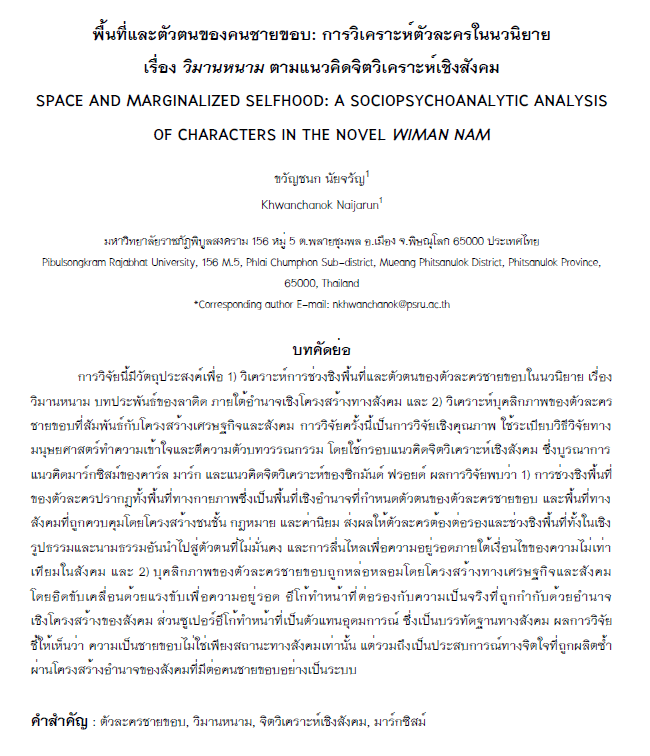
This research aimed (1) to analyze the contestation over space and selfhood of marginalized characters in Wiman Nam under conditions of structural social power, and (2) to examine the formation of marginalized characters’ personalities in relation to economic and social structures. The study employed a qualitative research approach and adopted a humanities-based methodology, focusing on interpretative literary textual analysis. The analytical framework was grounded in Sociopsychoanalytic Analysis, integrating Marxist concepts of space derived from the ideas of Karl Marx with Sigmund Freud’s psychoanalytic theory. The findings revealed that (1) the contestation over space among the characters was manifested in both physical space, which functioned as a site of power determining the selfhood of marginalized characters, and social space, which was regulated by class structure, legal systems, and social values. These conditions compelled the characters to negotiate and struggle over space in both tangible and intangible forms, resulting in unstable and fluid selfhood shaped by the need for survival under conditions of social inequality. (2) The personalities of marginalized characters were formed under the influence of economic and social structures: the Id was driven primarily by survival instincts, the Ego functioned as a mechanism that negotiated with realities governed by structural social power, and the Superego operated as a representation of ideology embodied in social norms and values. Overall, the findings demonstrated that marginalization was not merely a social status but a psychological experience that was systematically reproduced through structures of social power.
Downloads
Article Details

This work is licensed under a Creative Commons Attribution-NonCommercial-NoDerivatives 4.0 International License.
The articles published are copyrighted by the Graduate School, Chiang Mai Rajabhat University.
The opinions expressed in each article of this academic journal are solely those of the individual authors and do not reflect the views of Chiang Mai Rajabhat University or its faculty members. The responsibility for the content of each article rests entirely with the respective authors. In the event of any errors, the authors alone are responsible for their own articles.
References
Changharn, M. (2017). The marginality and the otherness of characters in short stories of the Naiin Award [Master’s thesis, Mahasarakham University]. http://khoon.msu.ac.th/_dir/fulltext/fulltextman/full4/mingmanut10989/titlepage.pdf [In Thai]
Chantavanich, S. (2022). Sociological theory (10th ed.). Chulalongkorn University Press. [In Thai]
Chotiudompant, S. (2024). Western literary criticism theory from Plato to the early twentieth century. Chulalongkorn University Press. [In Thai]
Kaewkangwan, S. (2018). Personality psychology theories: Knowing ourselves and others (17th ed.). Moh-Chao-Ban Publishing. [In Thai]
Ladid. (2025). Wiman nam [The palace of thorns]. Biblio. [In Thai]
Osborn, R. (2022). Marxism and psychoanalysis (Chomphu, Trans.). Sayam Publishing. [In Thai]
Prachakul, N. (2009). Yok akson, yon khwam khit (Vol. 1): On literature. Arn Publishing. [In Thai]
Rodsawat, D., Samphiphatthanathada, S., Noppawong Na Ayuttaya, P., & Jitkhongkha, Ch. (2024). Analyzing the dark behavior of the female protagonist in the novel Krong Karm. Journal of MBU Humanities, 16(1), 1-17. https://so06.tci-thaijo.org/index.php/JoMbuHu/article/view/271016/183526 [In Thai]
Storr, A. (2019). Freud (S. Suphuttamongkol, Trans.). Bookscape. (Original work published 1989). [In Thai]
Xu, Z., & Buranakorn, P. (2023). Reflections of the marginalized in Thai novels, from 1997 to 2022. Liberal Arts Review, 18(2), 145-168. https://so04.tci-thaijo.org/index.php/larhcu/article/view/266686/181676 [In Thai]
