
Narrative Structure and Meaning of Amnesia in Thai Romance Novels
Article Sidebar
Main Article Content
Abstract
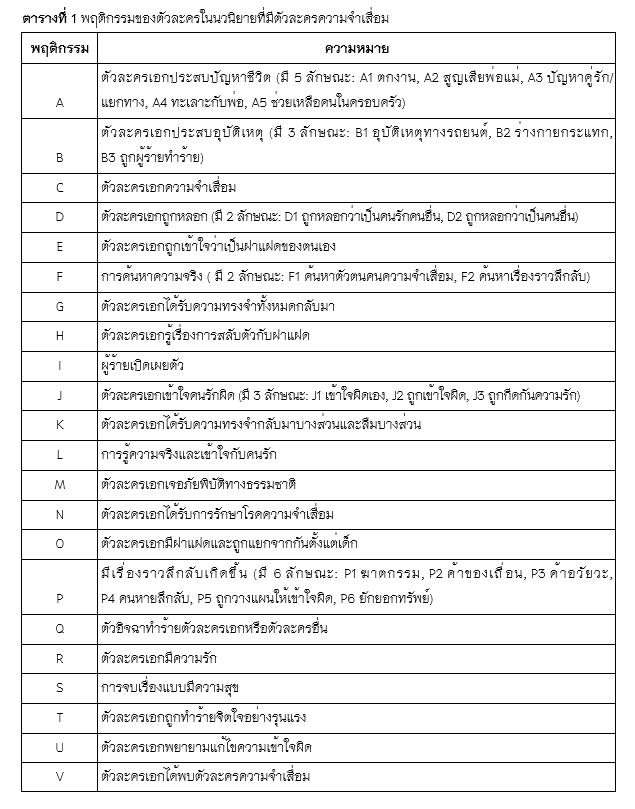
This research aimed to examine the narrative structures and the underlying meanings of amnesia in Thai Romance novels. Using a qualitative approach, the study conducted a textual analysis of 28 novels published in book form, applying Vladimir Propp's narrative structure theory and Louis Althusser's ideology theory as the analytical framework. The findings revealed that character behaviors could be categorized into 22 distinct types (Behaviors A-V), which subsequently led to the classification of five narrative patterns: 1) Romance and the quest for identity; 2) Romance and suspense involving an amnesiac protagonist; 3) Romance and suspense where the protagonist interacted with an amnesiac character; 4) Romance involving twins; and 5) Romance with complex or recurring amnesia. Regarding the underlying meanings, the study found that Thai novels did not present amnesia through medical or scientific dimensions. Instead, it was employed as a literary device to create conflict, conveying four primary meanings: 1) An opportunity for a new beginning; 2) A test of true love; 3) A mechanism to prove one's inner virtue; and 4) A safe space. Furthermore, amnesia functioned to erase fractured past relationships, restoring them to a state of purity and resulting in a positive resolution. Although these were romance novels that prioritizing emotional appeal over scientific realism, the ideologies present in these works continued to uphold traditional values and honor those with inherent goodness, ensuring they received a rewarding conclusion.
Downloads
Article Details

This work is licensed under a Creative Commons Attribution-NonCommercial-NoDerivatives 4.0 International License.
The articles published are copyrighted by the Graduate School, Chiang Mai Rajabhat University.
The opinions expressed in each article of this academic journal are solely those of the individual authors and do not reflect the views of Chiang Mai Rajabhat University or its faculty members. The responsibility for the content of each article rests entirely with the respective authors. In the event of any errors, the authors alone are responsible for their own articles.
References
Althusser, L. (2014). Ideology and ideological state apparatuses (K. Kaewthep, Trans.; P. Bulsathaporn, Ed.). Siam Paritut. (Original work published 1970) [In Thai]
Busayamas. (2003). Kulap son nam 1-2. Chokchai Tewet. [In Thai]
Busaba Pa Fun. (2011). Game rai... game rak (2nd ed.). SE-ED Education. [In Thai]
Chalamlai. (2010). Pratthana phayabat. Saengdao. [In Thai]
Chanthasok, P. (2012). Love in Books. Reading Culture Promotion Foundation. https://www.happyreading.in.th/article/ความรักในหนังสือ/ [In Thai]
Chomulan. (2010). Rang rak phrang chai. Happy Banana. [In Thai]
Choengkhiri, P. (1999). A study of Thai folktales based on Vladimir Propp’s structural theory [Unpublished master’s thesis]. Chulalongkorn University. [In Thai]
Chun-chai, P. (2016). Thai online game novels: Structure and relationship with other literary genres [Unpublished master’s thesis]. Silpakorn University. [In Thai
Dinsosichompu. (2011). Dao klang chai. Namnueng. [In Thai]
Gankanish. (2012). Krong rak theppabut thuean. Light of Love. [In Thai]
Gaokalchana. (2011). Sane nang that. Inlove Publishing. [In Thai]
Inphayung, P. (2016). “Ugly Duckling” novel series by Jamsai Publishing: Narrative patterns and concepts of female beauty in Thai society [Unpublished master’s thesis]. Silpakorn University. [In Thai]
Irin. (2000). Nguan ritsaya 1-2. Ruamsarn. [In Thai]
Jarujorn, S. (1998). Archetypal characters in romantic novels between 1937-1973 [Unpublished master’s thesis]. Mahasarakham University. [In Thai]
Kangkao. (2015). Sami niranam. Amarin Book Center. [In Thai]
Ketuadi. (2006). Chaosua muannim. Tawisitsora-at. [In Thai]
Khojitmet, A. (2012). Sao noi. Saengdao. [In Thai]
Kingchat. (1998). Dang fai tai nam. Arun. [In Thai]
Klin-ueang. (2014). Phirun phram rak. Satapornbooks. [In Thai]
Mallika. (2008). Duang chai Phumin 1-2. SE-ED Education. [In Thai]
Nabdao. (2012). Kon rak chang chai. Arun Amarin Printing and Publishing. [In Thai]
Na Thalang, S. (2001). Waiyakon khong nithan: Kan suksa nithan choeng khrongsang. Chulalongkorn University. [In Thai]
Nanaspace. (2012). Plai fon ton rak After the Rain. Arun Amarin Printing and Publishing. [In Thai]
Oraphim. (2009). Pom parichat. Satapornbooks. [In Thai]
Phanchomphu, J. (n.d.). Awenchi nai duang chai. Hunsa. [In Thai]
Phannarai, S. (2009). Dang sawan sap. Beauty Book. [In Thai]
Phakbung. (2021). Krong namphueng. Satapornbooks. [In Thai]
Plaisingha. (2008). Le phrom. Fine Book. [In Thai]
Plaithangfan. (2012). Phayu ron son rak. Kled Thai. [In Thai]
Rakmanee, S. (2015). Novel Writing. Sampachanya Publishing. [In Thai]
Saijanthuek, P. (2008). Pho malai rim thang. The Knowledge Center. [In Thai]
Sakkasem, P. (2002). Laplae lai mek. Double Nine. [In Thai]
Saengkrajang, C. (2005). Ban mai ru roy. Kled Thai. [In Thai]
Sounsamut, P. (2009). The ideology of love in popular Thai tragic romance, 1997–2007 [Unpublished doctoral dissertation]. Chulalongkorn University.
Thepsrimuang, J. (2017). Contemporary Thai Literature. Department of Thai Language, Faculty of Humanities and Social Sciences, Udon Thani Rajabhat University. [In Thai]
Thienkeaw. (2009). Sami ti thabian. Bongkoch Publishing. [In Thai]
Thilaya. (n.d.). Ubat rak raeng khaen. Amarin Book Center. [In Thai]
Thuwadara. (2009). Nueng rak pak chai. Smart Books. [In Thai]
Yu, H., & Petket, S. (2025). The tale type in A. Chaiworasin’s novels. Ganesha Journal, 21(1), 1-15. [In Thai]
