
The Development of Ability to Read Words with Mismatched Final Consonants with Activity-Based Learning Management and Gamification Techniques for Students in Grade 2
Article Sidebar
Main Article Content
Abstract
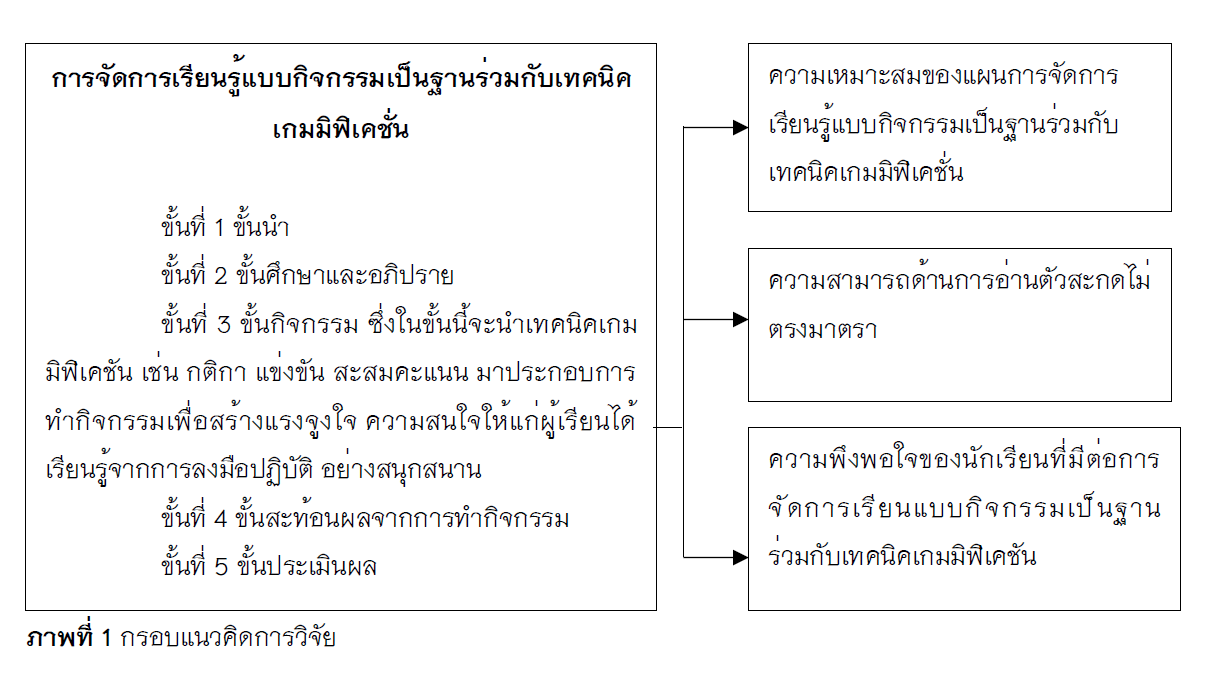
This research aimed to develop the lesson plans of activity-based learning management and gamification technique for developing reading ability in spelling different ending consonants for Grade 2 students, to compare the reading ability in spelling different ending consonants for Grade 2 students before and after learning with the activity-based learning management and gamification technique, and to investigate the satisfaction on the development of reading ability in spelling different ending consonants with the activity-based learning management and gamification technique for Grade 2 students. The sample group was 12 Grade 2 students from Bannamrin School in the academic year 2023, chosen by simple random sampling using a lottery method randomized as a school unit. The research instrument included the lesson plans of activity-based learning management and gamification technique for spelling different ending consonants, a test to measure reading ability in spelling different ending consonants, and a student satisfaction questionnaire on activity-based learning management and gamification technique for spelling different ending consonants. The data were analyzed by using basic statistics such as mean () and standard deviation (S.D.). The research results found that the lesson plans suitability of activity-based learning management and gamification technique for developing reading ability in spelling different ending consonants for Grade 2 students was at the highest level (
= 4.63, S.D. = 0.52). The reading ability in spelling different ending consonants for Grade 2 with activity-based learning management and gamification technique, after learning was higher than before learning, and students' satisfaction on the development of reading ability in spelling different ending consonants with the activity-based learning management and gamification technique for Grade 2 students was at a high level (
= 2.76, S.D. = 0.43).
Downloads
Article Details

This work is licensed under a Creative Commons Attribution-NonCommercial-NoDerivatives 4.0 International License.
The articles published are copyrighted by the Graduate School, Chiang Mai Rajabhat University.
The opinions expressed in each article of this academic journal are solely those of the individual authors and do not reflect the views of Chiang Mai Rajabhat University or its faculty members. The responsibility for the content of each article rests entirely with the respective authors. In the event of any errors, the authors alone are responsible for their own articles.
References
Anand, A. (2021). What Is activity based learning? Here’re some examples to boost your kids learning experience. Retrieved from https://therealschool.in/blog/what-activity-based-learning-some-examples-boost-your-kids/
Boonsouykhwan, S. (2022). The development of Thai literature learning achievement and the happiness learning of Matthayomsuksa 3 students by using gamification approach with giving feedback. (Master thesis, Faculty of Education Silpakorn University). [In Thai]
Chiengkul, W. (2009). Country whose people do not have reading habits cannot compete with other countries in any way. Journal of Library and Information Science Srinakharinwirot University, 2(1), 1-6. [In Thai]
Chirawat, W. (2018). The development of learning activity package by concentrated language encounters to enhance pronunciation ability of non – corresponding final consonants words for grade 2 students. (Independent Study M.Ed., Faculty of Education, Naresuan University). [In Thai]
Chitchayavanich, K. (2019). Learning management. Bangkok: Chulalongkorn University. [In Thai]
Ham, H. (2021). 2 Ways to bring games into your classroom. Retrieved from https://www.edutopia.org/article/two-ways-bring-games-your-classroom/
Glover, I. (2013). Play as you learn: Gamification as a technique for motivating learners. United Kingdom: Sheffied Hallam University.
Koonkaew, A. (2022). New approaches to test measurement and evaluation. Phetchabun: Phetchabun Rajabhat University. [In Thai]
Lohaprasert, K., Manoosawet, C., & Thusaro, C. (2009). The development of reading skill practice package in combination with gamification techniques to improve Thai language reading skills of Prathomsuksa 2 Students Affiliated to Office of The Private Education Songkhla Province. Phikun Journal, 21(2), 233-252. [In Thai]
Meksamoot, A., Boonlue, S., & Tansatien, K. (2017). The development of the ability in Thai diphthong reading by the reading book which using augmented reality technology with gamifications technique for grade 3 students. Veridian E-Journal, 10(1), 550-564. [In Thai]
Ministry of Education. (2008). The basic education core curriculum of academic year 2008. Bangkok: The Agricultural Cooperatives Federation of Thailand Company Limited. [In Thai]
Norarian, P. (2019). Managing activity-based learning combined with multimedia to develop listening and speaking ability for Prathomsueksa 2 students. (Master’s Thesis, Faculty of Education, Silpakorn University). [In Thai]
Phonchai, B. (2013). Reading for learning. Journal of Library Boromarajonani College of Nursing Nakhon Phanom, 57(1), 36. [In Thai]
Pinyoyang, W. (2013). Marketing ideas. Bangkok: Krungthep Turakij Media Company Limited. [In Thai]
Rattanakran, P. & Sirichaisin, K. (2021). Development of Thai-speaking communication curriculum using activity-based learning for 8th grade foreign students. Sikkha Journal of Education, 8(1), 132-140. [In Thai]
Registration and Evaluation Affair of Bannamrin School. (2022). The report result of reading and writing ability screenings of grade 1 – 6 students from Bannamrin School. Chiang Mai: Bannamrin School. [In Thai]
Smile, F. (2022). How activity-based learning can help in knowledge retention. Retrieved from https://www.smilefoundationindia.org/blog/how-activity-based-learning-can-help-in-knowledge-retention/
Sodiam, S. (2022). Development of Thai reading skills and reading motivation primary students (grade 4-6) by using reading and spelling method with gamification. (Master thesis, Faculty of Education Dhurakij Pundit University). [In Thai]
Suksai, N. (2018). Effects of flipped classroom and gamification on ability in applying computer knowledge of upper secondary school students. (Master thesis, Faculty of Education, Chulalongkorn University). [In Thai]
Talabklang, P. (2019). The development of vocabulary learning achievement using activity-based learning for Prathomsuksa 2 Students of Wat Khian Khet School. (Independent Study M.Ed., Faculty of Education, Silpakorn University). [In Thai]
Thongrung, K., Longsap, P., Chermthaisong, R., & Pansawai, P. (2022). Proactive activity-based learning to improve reading achievements in Thai language of grade 5 students. In Proceeding of the 17th UTCC National Graduate Research Conference 2022. (p. 1-9). August 10, 2022. Bangkok: Thailand: The Thailand Research Fund. Graduate School of Rangsit University.
Wadeecharoen, W., Lertnaisat, R., and Teekasap, S. (2017). Research methodology: Concept to practice. Bangkok: SE Education Public Company Limited. [In Thai]
