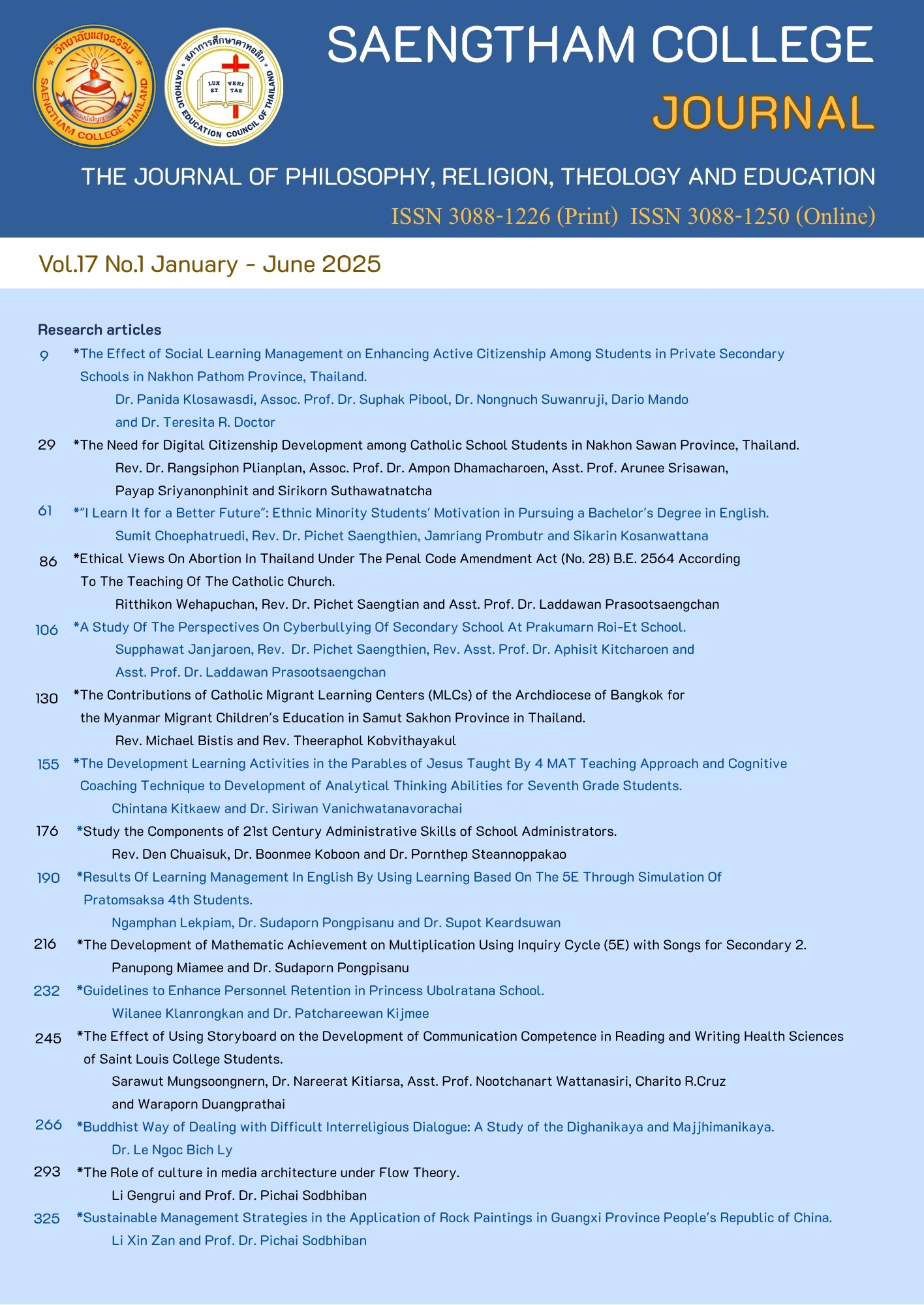
The Effect of Social Learning Management on Enhancing Active Citizenship Among Students in Private Secondary Schools in Nakhon Pathom Province, Thailand
Article Sidebar
Main Article Content
Abstract
The main objective of this research project was to analyze the effect of social learning management on enhancing active citizenship among students in private secondary schools in Nakhon Pathom province, Thailand. This quantitative study involved administrators and teachers of high school students in private secondary schools in Nakhon Pathom province, with a sample size of 167 participants using the Krejcie and Morgan Tables. The research instrument used was a questionnaire, and the statistical methods employed included Mean, Pearson Product Moment Correlation, VIF, and Multiple Regression Analysis. The study’s findings revealed that: 1) Overall, students’ social learning for enhancing active citizenship was at a high level. 2) Overall, students’ active citizenship was at a high level. 3) Social learning through teachers live modeling and verbal description or instruction models had an impact on students’ active citizenship enhancement. 4) Multiple Regression Analysis provided a linear equation to predict students’ overall active citizenship: Ytotal = 0.946 + 0.364 (Teacher’s Live Modeling) + 0.368 (Instruction Model), with a predictive efficiency of 43 percent (R2 = 0.430).
Article Details

This work is licensed under a Creative Commons Attribution-NonCommercial-NoDerivatives 4.0 International License.
- The academic and research articles, as well as the content and opinions expressed therein, published in Saengtham College Journal are solely the responsibility of the respective author(s).
- Articles published in Saengtham College Journal are the property of Saengtham College. Reproduction, modification, or dissemination of all or part of the content in any form without written permission from Saengtham College is prohibited.
- Articles published in Saengtham College Journal are protected under the Copyright Act.
References
Akomkong, S., & Puncreobutr, V. (2016). Transformational leadership and organizational culture of institutions along Thai Lao borders. Rupkatha Journal on Interdisciplinary Studies in Humanities, 8(2), 111–116.
Bandura, A. (1977). Social learning theory (3rd ed.). Prentice-Hall.
Hoskins, B. L., & Mascherini, M. (2009). Measuring active citizenship through the development of a composite indicator. Social Indicators Research, 90(3), 459–488.
Julamang, S. (2021). The development of guidelines for promoting good citizenship among upper secondary school students under the Office of the Private Education Commission (OPEC) in the Educational Service Area 17. https://reo17.moe.go.th/wp-content/uploads/2022/08/พลเมืองดี.pdf
Moolnee, K. (2018). A model for developing citizenship among lower secondary school students under the Secondary Educational Service Area Office 26 [Doctoral dissertation, Rajabhat Mahasarakham University]. RMU Library Catalog. https://opac.rmu.ac.th
Office of the Education Council. (2019). Thailand's national education standards 2018. Phrikwan Graphics Co., Ltd.
Phengwan, S., Prasertsang, P., & Kalam, S. (2022). The development of healthy behaviors by learning management according to the social learning theory in health education and physical education for Grade 7 students. Journal of MCU Ubon Review, 7(2), 469–482.
Phinla, W. (2016). Learning activities in social studies for the development of good citizenship through democratic approach among the 21st century learners. Journal of Education and Social Development, 12(1), 20–34.
Puncreobutr, V. (2016). Linking work integrated learning and competency of graduates pursuing graduate diploma in teaching profession. Journal of Education and Practice, 7(10), 121–127.
Ross, A. (2007). Multiple identities and education for active citizenship. British Journal of Educational Studies, 55(3), 286–303.
Siripongnapat, V. (2023). The enhancement of active citizenship for learners through Socratic questioning. Journal of Education Studies, Chulalongkorn University, 51(1), 1–13. https://doi.org/10.14456/educu.2023.8
Tangwancharoen, S., & Rungwachira, O. (2021). Guidelines for educational management towards the goals of Thailand's national education standards. Journal of UBRU Educational Review, 1(1), 77–96.
Wattanasan, P., & Puncreobutr, V. (2021). Conceptual framework for transferring lessons learned from work for the development of best practice. Turkish Online Journal of Qualitative Inquiry, 12(7), 4848–4856.
Westheimer, J., & Kahne, J. (2004). What kind of citizen: The politics of educating for democracy. American Educational Research Journal, 41(2), 237–269.
