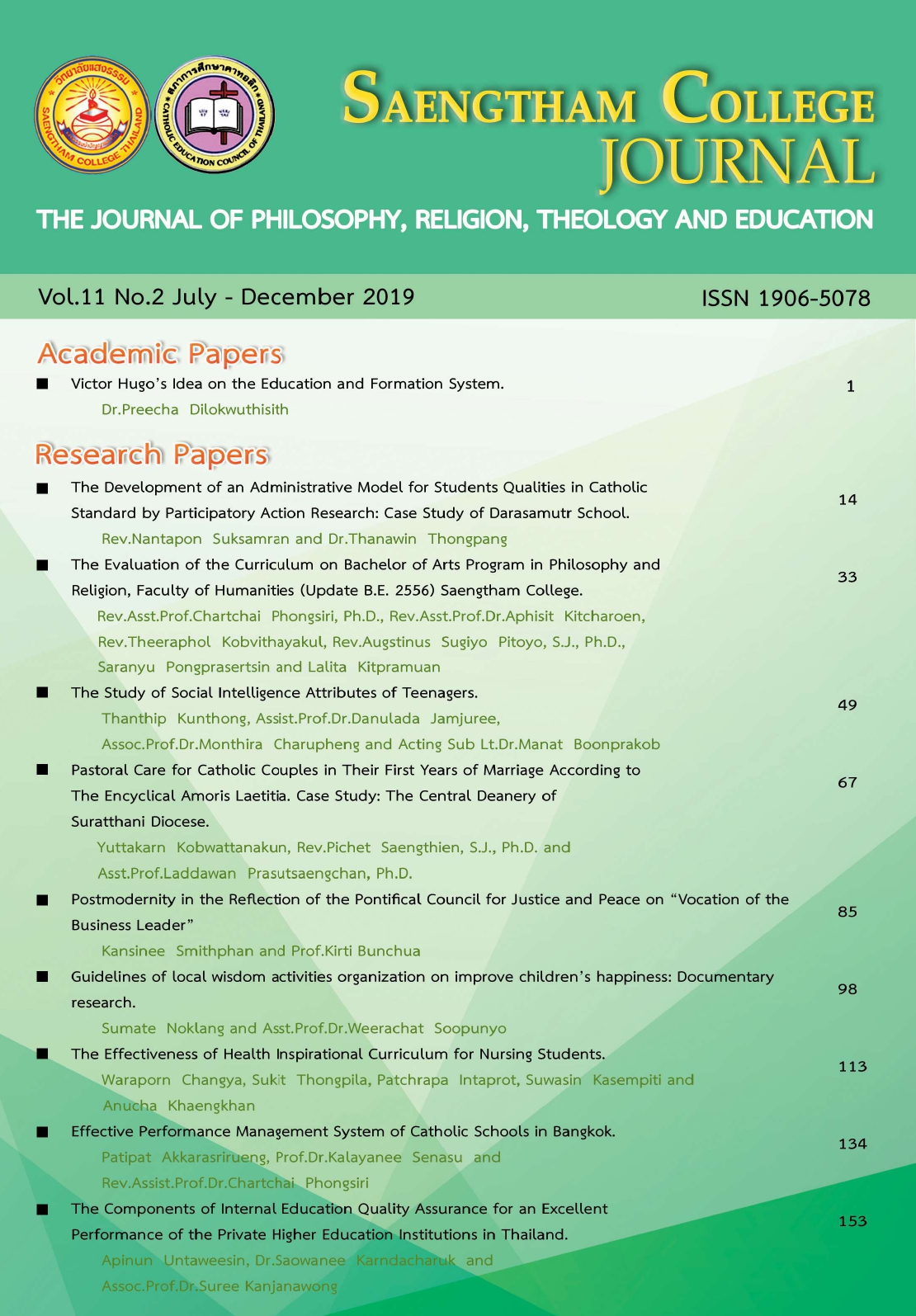
The Effectiveness of Health Inspirational Curriculum for Nursing Students
Article Sidebar
Main Article Content
Abstract
The objectives of this quasi-experimental research were 1) to develop the effectiveness of health inspirational curriculum for nursing students 2) study the effectiveness of health inspirational curriculum for nursing students 3) study the satisfaction of the nursing students towards the curriculum to inspire health the focus on learners to develop and promote health aspirations for nursing students in 2 areas, thinking and action by applying Pender's health promotion theory, perceived self-efficacy theory of Bandura with the method of learning Gagné’s Nine Events of Instruction , advance organizer model, Group Investigation Instructional Model and role play. The sample were used simple random sampling in the 20 second-year nursing students. The research instrument is a health inspirational program for nursing students to collect data. The content validity from 3 experts, IOC with over 0.67. Reliability of the questionnaire was 0.75. Data is collected from March to May 2018. Data analysis by percentage, mean, standard deviation and paired t-test. The result show that: The development of health inspirational curriculum for nursing students consists of concepts, principles, and curriculum. Course Objectives Course content structure learning activities learning Media Measurement and evaluation. The content structure of the curriculum is divided into 3 units, each unit is 6 hours, consisting of 1) Awakening the aspirations of the health personnel. 2) The power of conquering the target. And 3) inspiration in their own, creating a model of health education that is based on learners, allowing learners to learn by themselves in real practice to inspire health With the teaching style of learning management based on method of learning Gagné’s Nine Events of Instruction , advance organizer model, Group Investigation Instructional Model and role play by measuring and evaluating learning in 3 parts: Assessment for learning Assessment as learning and Assessment of learning The effectiveness of the health inspirational curriculum for nursing students show that most of the sample groups were female (85 percent). The conceptual dimensions were found to be at all good levels. With the highest average score of positive expectation (x̅=4.61 S.D.=0.43) self-efficacy (x̅=4.46 S.D.=0.66) coping (x̅=4.38 S.D.=0.73) the aspect of the explanation (x̅ =4.37 S.D.=0.65) and aspect of self-regulation (x̅=4.18 S.D.=0.65), respectively. The dimension of action showed that nursing students had health aspirations in their practice. In health promotion was significantly higher than before learning p<0.05 The satisfaction of nursing students toward the curriculum of health inspirational courses found that the sample group was satisfied with the overall good level (x̅=4.54, S.D.=0.26) when considered in each dimension it found that from the highest to the lowest mean were, it was found that the curriculum structure (x̅=4.79, S.D.=0.34) learning process (x̅=4.73, S.D.=0.31) measurement and evaluation (x̅=4.49, S.D.=0.66) and duration of the course (x̅=4.14, S.D.=0.38) respectively
Article Details

This work is licensed under a Creative Commons Attribution-NonCommercial-NoDerivatives 4.0 International License.
- The academic and research articles, as well as the content and opinions expressed therein, published in Saengtham College Journal are solely the responsibility of the respective author(s).
- Articles published in Saengtham College Journal are the property of Saengtham College. Reproduction, modification, or dissemination of all or part of the content in any form without written permission from Saengtham College is prohibited.
- Articles published in Saengtham College Journal are protected under the Copyright Act.
References
กมลทิพย์ ตั้งหลักมั่นคง และกาญจนา ปัญญาธร. (2559). ปัจจัยแห่งความสำเร็จของบุคคลต้นแบบในการสร้างความเข้มแข็งให้กับระบบปฐมภูมิ. วารสารวิทยาลัยพยาบาลพระปกเกล้า. 27(1): 132-137.
ดรุณี ชมศร และคณะ. (2561). ปัจจัยที่มีความสัมพันธ์กับความผูกพันต่อองค์การของบุคลากรคณะพยาบาลศาสตร์มหาวิทยาลัยบูรพา. วารสารเครือข่ายวิทยาลัยพยาบาลและการสาธารณสุขภาคใต้. 5(1): 268-280.
ทัศนีย์ นนทะสร, สุนีย์ ละกำปั่น, สุลี ทองวิเชียร และพิมพ์พรรณ ศิลปะสุวรรณ. (2545). กลวิธีการกำกับตนเองเพื่อการเรียนรู้ของนักศึกษาหลักสูตรวิทยาศาสตรมหาบัณฑิตสาธารณสุขศาสตร์ คณะสาธารณสุขศาสตร์ มหาวิทยาลัยมหิดล ปีการศึกษา 2540-2542. วารสารพยาบาลสาธารณสุข. 10: 36-49.
ธนพร ธรรมทักษ์. (2552). ความสัมพันธ์ระหว่างความเครียด ความมีคุณค่าในตนเองกับพฤติกรรมส่งเสริมสุขภาพของวัยรุ่น เขตกรุงเทพมหานคร. วิทยานิพนธ์วิทยาศาสตร์มหาบัณฑิต มหาวิทยาลัยมหิดล.
ธนากร ธนวัฒน์. (2552). Health-promoting Behavior of physical therapy student in Khon Kaen. เผยแพร่ในการประชุมวิชาการนานาชาติที่ชิบาประเทศญี่ปุ่น. [Online]. Available: http://gsmis.ga.kku.ac.th/publish/details/5214. Retrieved June 29, 2018.
บุญทิวา สู่วิทย์ และคณะ. (2561). ผลของการใช้รูปแบบการเรียนรู้โดยเน้นการพยาบาลแบบองค์รวมเพื่อส่งเสริมการดูแลผู้ป่วยที่ได้รับการดูแลแบบประคับประคอง อย่างเป็นองค์รวมของนักศึกษาพยาบาลคณะพยาบาลศาสตร์เกื้อการุณย์ มหาวิทยาลัยนวมินทราธิราช. วารสารพยาบาลทหารบก. 19(1): 210-220.
ปราณี อ่อนศรี. (2561). แนวทางการพัฒนาศักยภาพด้านการวิจัยในวิชาชีพพยาบาลยุคประเทศไทย 4.0. วารสารพยาบาลทหาบก. 19(1): 24-29.
ปราโมทย์ ธรรมรัตน์. (2555). ความสำคัญของการสร้างแรงบันดาลใจเพื่อเปลี่ยนแปลงชีวิตสู่ความสำเร็จ. กรุงเทพมหานคร: สถาบันค้นคว้าและพัฒนาผลิตภัณฑ์อาหาร มหาวิทยาลัยเกษตรศาสตร์.
ผจงสุข เนียมประดิษฐ์ และจันทร์ชลี มาพุทธ. (2555). การพัฒนารูปแบบกิจกรรมการส่งเสริมสุขภาพสำหรับนิสิตมหาวิทยาลัยในภาคตะวันออก. วารสารการศึกษาและพัฒนาสังคม. 8(1): 61-72.
ภาวดา ธาราศรีสุทธ. (2550). ภาวะผู้นำและจริยธรรมสำหรับผู้บริหารการศึกษา. กรุงเทพมหานคร: คณะศึกษาศาสตร์ มหาวิทยาลัยรามคำแหง.
ภูเบศร์ สมุทรจักร. (2552). Inspiration…พลังแห่งลมหายใจ ไฟในการทำงาน. Productivity World 21 March –April 2009. ฝ่ายวิจัยและวางแผน มหาวิทยาลัยธุรกิจบัณฑิตย์. (ออนไลน์). เข้าถึงได้จาก: http://www. dpu.ac.th/ laic/ upload/ content/ file/article _ instructor /ta57/14_79_2552.pdf. วันที่สืบค้นข้อมูล: 1 พฤษภาคม 2561.
มณี อาภานันทิกุล, พรรณวดี พุธวัฒนะ และจริยา วิทยะศุภร. (2554). ภาวะสุขภาพและการปฏิบัติตัวด้านสุขภาพของนักศึกษาพยาบาลไทย. วารสารสภาการพยาบาล. 26(4): 123-136.
ราชบัณฑิตยสถาน. (2554). พจนานุกรมฉบับราชบัณฑิตยสถาน พ.ศ. 2554. กรุงเทพมหานคร: บริษัทศิริวัฒนาอินเตอร์พริ้นท์ จำกัด.
ศศิวิมล ปานุราช และเยาวรัตน์ มัชฌิม. (2561). การประเมินคุณภาพชีวิตของพยาบาล. วารสารพยาบาลสงขลานครินทร์. 38(1): 129-143.
ศิวาพร ทองสุข, พรรณวดี พุธวัฒนะ และพิศสมัย อรทัย. (2556). พฤติกรรมสร้างเสริมสุขภาพของนักศึกษาพยาบาลรามาธิบดี. รามาธิบดีพยาบาลสาร. 18(2): 178-189.
ศิริพร โอภาสวัตชัย. (2543). การสอนที่อิงตัวแปรคัดสรรของการเรียนรู้โดยการกำกับตนเองของนักศึกษาพยาบาล. วิทยานิพนธ์ดุษฎีบัณฑิต สาขาหลักสูตรและการสอน จุฬาลงกรณ์มหาวิทยาลัย.
สมคิด รักษาสัตย์. (2550). การจัดการเรียนการสอนในคลินิก. กรุงเทพมหานคร: สำนักพิมพ์แห่งจุฬาลงกรณ์ มหาวิทยาลัย.
สมจิต หนุเจริญกุล. (2554). การพยาบาลศาสตร์ของการปฏิบัติ. กรุงเทพมหานคร: วีเจพริ้นติ้ง.
สิพา สิริลักษณ์. (2558). แรงบันดาลใจสร้างความสดใสให้ชีวิต. กรุงเทพมหานคร: บุ๊กส์วินฟรอนเทียร์ มัลติมีเดีย.
สุภัคกาญจน์ ประกอบแสง และคณะ. (2561). โปรแกรมส่งเสริมพฤติกรรมการออกกำลังกายของนักศึกษาพยาบาลมหาวิทยาลัยราชภัฏอุบลราชธานี. วารสารวิจัยสาธารณสุขศาสตร์ คณะสาธารณสุขศาสตร์มหาวิทยาลัยราชภัฏอุบลราชธานี. 5(2): 5-16.
สายสวาส เผ่าพงษ์, อุไรรักษ์ คัมภิรานนท์ และสิริเพ็ญโสภา จันทรสถาพร. (2554). พฤติกรรมสุขภาพของนักศึกษาพยาบาลวิทยาลัยพยาบาลบรมราชชนนีนครราชสีมา. วารสารวิทยาลัยพยาบาลบรมราชชนนี นครราชสีมา. 17(1): 81-92.
อภิเชษฐ์ จาตุพรพิพัฒน์. (2545). คิดดี คิดถูก คิดบวก คิดใหญ่. กรุงเทพมหานคร: พี.เอ.ลีฟวิ่ง.
อมรรัตน์ อัครเศรษฐสกุลและคณะ. (2553). พฤติกรรมสุขภาพของนักศึกษาพยาบาลศาสตรบัณฑิต วิทยาลัยพยาบาลบรมราชชนนี อุดรธานี ประจำปีการศึกษา 2553.
เอื้อญาติ ชูชื่นและคณะ. (2555). ผลของการพัฒนาศักยภาพการเป็นผู้นำสร้างเสริมสุขภาพที่มีต่อระดับความรู้ ทัศนคติและพฤติกรรมสร้างเสริมสุขภาพของนักศึกษา. วารสารไทยเภสัชศาสตร์และวิทยาการสุขภาพ. 7(3): 127-131.
Bandura, A. (1999). Social cognitive theory of personality. Handbook of personality: Theory and research, 154-196.
Birrell, C. (1999). Breathing like a mountain. Australian Journal of Outdoor Education, 4(1), 61-63.
Castruita, R. M. C. and others. (2018). Functional characteristics of older adults in Mexico and Latin America: Health promotion programs. In Ageing, Physical Activity and Health (pp. 44-57). Routledge.
Chotibang, J., Fongkaew, W., Mo-suwan, L., Meininger, J. C., & Klunklin, P. (2009). Development of a family and school collaborative (FASC) pro-gram to promote healthy eating and physical activity among school-age children. Pacific Rim International Journal of Nursing Research. 13(2): 133-147.
Gagne′, R., M. (1985). The Conditions of Learning and Theory of Instruction. New York: CBS College Publishing.
Gordon, K. A., Carmany, K. E., Baker, J. R., & Goliat, L. M. (2018). Innovative Teaching for Undergraduate Nu rsing Students Through Mastery Modeling. Nursing education perspectives. 39(3): 184-186.
Grimes, C. (2018). Use of Mind-Body Exercise Performed by Nurses to Effectively Decrease Compassion Fatigue: An Integrative Literature Review.
Griskevicius, V., Shiota, M. N., & Neufeld, S. L. (2010). Influence of different positive emotions on persuasion processing: A functional evolutionary approach. Emotion. 10: 190–206.
Jelsoe, E., Thualagant, N., Holm, J., Kjærgard, B., Andersen, H. M., From, D. M., & Pedersen, K. B. (2018). A future task for health-promotion research: Integration of health promotion and sustainable development. Scandinavian journal of public health. 20(46): 106-99.
Khoshnood, Z., Rayyani, M., & Tirgari, B. (2018). Theory analysis for Pender’s health promotion model (HPM) by Barnum’s criteria: a critical perspective. International journal of adolescent medicine and health.
Klein, J. W., Case, T. I., & Fitness, J. (2018). Can the positive effects of inspiration be extended to different domains?. Journal of Applied Social Psychology. 48(1): 28-34.
Luff, P. (2018). Early childhood education for sustainability: origins and inspirations in the work of John Dewey. Education 3-13. 46(4): 447-455.
Mak, Y. W., Kao, A. H., Tam, L. W., Virginia, W. C., Don, T. H., & Leung, D. Y. (2018). Health-promoting lifestyle and quality of life among Chinese nursing students. Primary health care research & development. 8-1.
McNamara, J., Griffin, P., & Richardson, N. (2018). 553 Promotion of farmer’s health through extension in ireland.
Pender, N. J., Murdaugh, C. L., & Parsons, M. A. (2002). Health promotion in nursing Practice (4th ed.). New Jersey: Prentice-Hall.
Stajkovic, A. D., Bandura, A., Locke, E. A., Lee, D., & Sergent, K. (2018). Test of three conceptual models of influence of the big five personality traits and self-efficacy on academic performance: A meta-analytic pathanalysis. Personality and Individual Differences. 120: 238-245.
Thrash, T. M., Elliot, A. J., Maruskin, L. A., & Cassidy, S. E. (2010). Inspiration and the and Social Psychology. 98: 488–506.
Vooijs, M., Bossen, D., Hoving, J. L., Wind, H., & Frings-Dresen, M. H. (2018). 482 Development of a training for the use of a guideline by occupational health professionals.
