
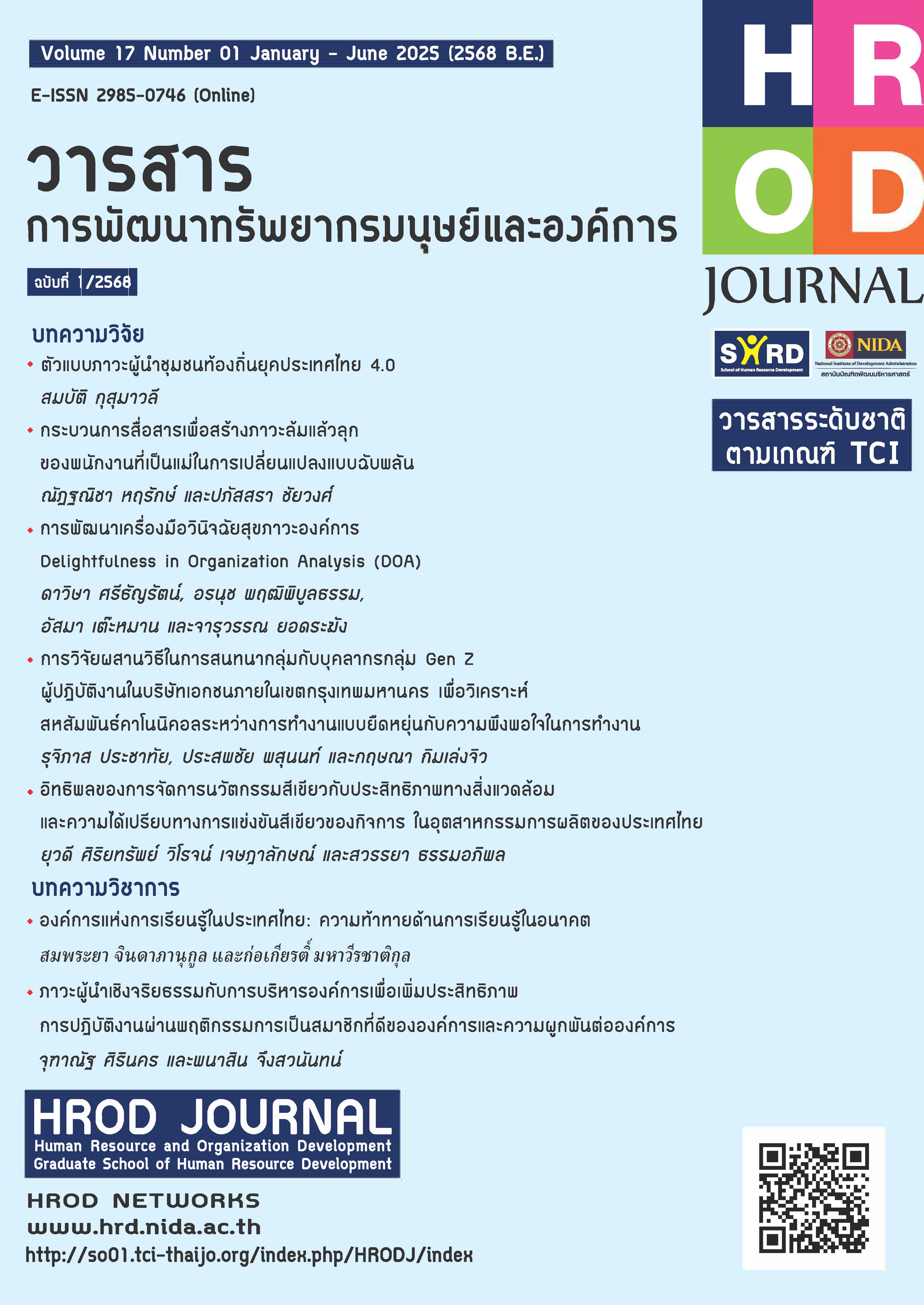
The Mixed Method Research of Focus Group Discussion With Gen Z Personnel Working in Private Companies Within Bangkok for Canonical Correlation Analysis Between Flexible Working and Job Satisfaction
Article Sidebar
Main Article Content
Abstract
This research is mixed-methods research, which focuses on the factors of flexible working from the perspective of Gen Z employees in private companies within Bangkok that are related to job satisfaction. The first phase of the study began with qualitative research using Focus Group Discussion to collect data on the factors of flexible working from the personnel in the Gen Z group. The results of the data analysis revealed that Gen Z personnel have views about flexible working should have 5 important factors: 1) Place flexibility; 2) Time flexibility; 3) Technology providing and supporting; 4) Virtual relationships; and 5) Performance-base management. The researcher then used the results of the first phase of qualitative data analysis as an independent variable for the second phase of research using quantitative research. Aiming to study the relationship between factors of flexible working from the perspective of Gen Z employees and job satisfaction. By collecting actual data using questionnaires as a tool from a sample of Gen Z personnel working in private companies within Bangkok who have worked under the flexible work policy for at least 3 years, a total of 408 people, using the convenience sampling method. Then analyze the data using statistics such as frequency, percentage, mean, standard deviation, and canonical correlation analysis. The results of the study using quantitative methods found that the elements of flexible working from the perspective of Gen Z employees have a high level of canonical relationship with job satisfaction with a canonical coefficient of 0.841. The factor of flexible working from the perspective of Gen Z personnel has a canonical loading between 0.687 – 0.855. Which sample group gives the most importance to the factor of flexibility in working location. As for the work satisfaction factor, the canonical loading was between 0.609 – 0.824. with the sample group giving the most importance to the Equitable rewards factor.
Article Details

This work is licensed under a Creative Commons Attribution-NonCommercial-NoDerivatives 4.0 International License.
1) The content of article in HROD journal is the author’s wholly responsibility to research, analyze, summarize, compile, and reference data. The editorial department will not be responsible in anyway.
2) The submitted articles in HROD journal must be unpublished before and must not be currently under consideration for publication elsewhere. If it is detected for its repetition, the author must be responsible for infringement of copyright.
3) Authors will be asked to transfer copyright of the article to the Publisher. The article is prohibited to reproduce all or part of the text, unless allowed.
References
ชาย โพธิสิตา. (2547). ศาสตร์และศิลป์แห่งการวิจัยเชิงคุณภาพ. กรุงเทพฯ: บริษัทอมรินทร์พริ้นติ้งแอนด์พับบิชชิ่ง.
ประไพพิมพ์ สุธีวสินนนท์ และ ประสพชัย พสุนนท์. (2559). กลยุทธ์การเลือกตัวอย่างสำหรับการวิจัยเชิงคุณภาพ. วารสารปาริชาต, 29(2), 31–48.
พัชสิรี ชมภูคำ และ ณัฐธิดา จักรภีร์ศิริสุข. (2563). ปัจจัยที่มีอิทธิพลต่อความพึงพอใจและแรงจูงใจในการทำงาน: กรณีศึกษาเปรียบเทียบคนเจเนอเรชัน Y และเจเนอเรชัน Z ในเขตกรุงเทพมหานคร. จุฬาลงกรณ์ธุรกิจปริทัศน์, 42(3), 1–18.
เมธารัตน์ จันตะนี. (2565). รูปแบบการวิจัยเชิงคุณภาพ. วารสารวิชาการและนวัตกรรมทางสังคมศาสตร์, 1(4), 233–245.
เมธาสิทธิ์ ธัญรัตนศรีสกุล. (2559). การวิเคราะห์ค่าสหสัมพันธ์คาโนนิคอลสำหรับงานวิจัยทางคณิตศาสตร์ศึกษา. วารสารคณิตศาสตร์ โดย สมาคมคณิตศาสตร์แห่งประเทศไทย ในพระบรมราชูปถัมภ์, 61(690), 13 -26.
สิราวิชญ์ กีรติอุไร, สุวิมล ตั้งประเสริฐ, และ ชคัตตรัย รยะสวัสดิ์. (2565). ความสัมพันธ์เชิงสาเหตุการบริหารค่าตอบแทน และความพึงพอใจในการปฏิบัติงานที่มีต่อสมรรถนะในการปฏิบัติงานของพนักงานในสถาบันอุดมศึกษา มหาวิทยาลัยราชภัฏในเขตอีสานตอนใต้. วารสารชุมชนวิจัย มหาวิทยาลัยราชภัฏนครราชสีมา, 16(4), 187–201. https://so04.tci-thaijo.org/index.php/NRRU/article/view/255177
สุภางค์ จันทวานิช. (2553). วิธีการวิจัยเชิงคุณภาพ. (พิมพ์ครั้งที่18). กรุงเทพมหานคร: สำนักพิมพ์ แห่งจุฬาลงกรณ์ มหาวิทยาลัย
Agarwal, P., Swami, S., & Malhotra, S. K. (2024). Artificial intelligence adoption in the post COVID-19 new-normal and role of smart technologies in transforming business: A review. Journal of Science and Technology Policy Management, 15(3), 506–529. https://doi.org/10.1108/JSTPM-08-2021-0122
Beckel, J. L., & Fisher, G. G. (2022). Telework and worker health and well-being: A review and recommendations for research and practice. International Journal of Environmental Research and Public Health, 19(7), 3879. https://doi.org/10.3390/ijerph19073879
Bellmann, L., & Hubler, O. (2021). Working from home, job satisfaction and work–life balance–robust or heterogeneous links?. International Journal of Manpower, 42(3), 424-441. https://doi.org/10.1108/IJM-10-2019-0458
Blaique, L., & Pinnington, A. (2023). Virtual work challenges and opportunities in the Asia-Pacific region: the role of organizational virtual work climate. Elgar Companion to Managing People Across the Asia-Pacific, 269-288. https://doi.org/10.4337/9781802202250.00023
Bushra, F., Ahmad, U., & Naveed, A. (2011). Effect of transformational leadership on employees' job satisfaction and organizational commitment in banking sector of Lahore (Pakistan). International journal of Business and Social science, 2(18), 261-267.
Carver, L. & Candela, L. (2008). Attaining organizational commitment across different generations of nurses. Journal of Nursing Management. 16, 984-991. https://doi.org/10.1111/j.1365-2834.2008.00911.x
Cascio, W. F., & Montealegre, R. (2016). How technology is changing work and organizations. Annual review of organizational psychology and organizational behavior, 3, 349-375. https://doi.org/10.1146/annurev-orgpsych-041015-062352
Cetin, M. & Halisdemir, M. (2019). School administrator and Generation Z students’ perspectives for a better educational setting. Journal of Education and Training Studies, 7(2), 84-97. https://doi.org/10.11114/jets.v7i2.3773
Chung, Y. & Runsheng, S. (2019). The role Instagram in the UNESCO’s creative city of Gastronomy: A Case Study of Macau. Tourism Management. 75(2019), 257-268. https://doi.org/10.1016/j.tourman.2019.05.011
Cochran, W. G. (1953). Sampling Techniques. New York: John Wiley & Sons.
Cranny, C. J., Smith, P. C., & Stone, E. F. (1992). Job satisfaction: How people feel about their jobs and how it affects their performance. New York, NY: Lexington Books.
Creswell, J. W. (2013). Research design: Qualitative, quantitative, and mixed methods approaches (2nd ed.). Thousand Oaks, CA: SAGE.
Creswell, J. W. (2015). A concise introduction to mixed methods research (2nd ed.). Sage Publications.
Crumas, C., & Pinkanok, W. P. (2022). Work-life balance from work from home of the employees in a private company. Humanity and Social Science Journal Ubon Ratchathani University, 14(1), 250–279.
Deloitte. (2018). 2018 Deloitte Millennial survey: Millennials disappointed in business, unprepared for industry 4.0. Retrieved March 20, 2024, from https://www2.deloitte.com/content/dam/Deloitte/global/Documents/About-Deloitte/gx-2018-millennial-survey-report.pdf
Doosomsak, K., Obgaew, C., Pornphutthipong, T., Khumkhunthod, S., & Rojanatrakul, T. (2023). Generation Z and preparation for entering the labor market. Journal of MCU Social Science Review, 12(2), A41–A50.
Dwyer, R. J. (2009). Prepare for the impact of the multi-generational workforce. Transforming Government: People, Process and Policy, 3(2), 101–110. https://doi.org/10.1108/17506160910960513
Feather, J. (2013). The information society: A study of continuity and change. Facet Publishing.
Gabriele, B., Maria, T., Luca, G., & Mariano, C. (2024). The psychological experience of flexibility in the workplace: How psychological job control and boundary control profiles relate to the wellbeing of flexible workers. Journal of Vocational Behavior, 155, 104059. https://doi.org/10.1016/j.jvb.2024.104059
Ganguli, R., Padhy, S. C., & Saxena, T. (2022). The characteristics and preferences of Gen Z: A review of multi-geography findings. IUP Journal of Organizational Behavior, 21(2), 79–98.
Glass, A. (2007). Understanding generational differences for competitive success. Industrial and Commercial Training, 39(2), 98–103. https://doi.org/10.1108/00197850710732424
Greenfield, C., & Terry, M. (1995). Work/life: From a set of programs to a strategic way of management. Employment Relations Today, 22(3), 67–81. https://doi.org/10.1002/ert.3910220308
Hoppock, R., & Spiegler, J. (1938). Job satisfaction. Occupations: The Vocational Guidance Journal, 16(7), 636–643. https://doi.org/10.1002/j.2164-5892.1938.tb00348.x
Kirchmayer, Z., & Fratričová, J. (2020). What motivates Generation Z at work? Insights into motivation drivers of business students in Slovakia. Proceedings of the Innovation Management and Education Excellence Through Vision, 6019–6030.
Kittiphong, P. (2018). Quality of questionnaire tools: Validity and reliability in public administration research. Academic and Research Journal of Northeastern Universities, 8(2), 104–110.
Laessig, R. E., & Duckett, E. J. (1979). Canonical correlation analysis: Potential for environmental health planning. American Journal of Public Health, 69(4), 353–359. https://doi.org/10.2105/AJPH.69.4.353
Likert, S. (1961). New patterns of management. McGraw-Hill.
Maharani, A. (2024). Back to work or remote work: Trends and challenges. Business and Management in Asia: Disruption and Change, 139–150. https://doi.org/10.1007/978-981-99-9371-0_9
Obiageli, O. L., Uzochukwu, O. C., & Ngozi, C. D. (2015). Work-life balance and employee performance in selected commercial banks in Lagos State. European Journal of Research and Reflection in Management Sciences, 3(4), 63–77.
ADP Research Institute. (2022). People at Work 2022: A Global Workforce View. Retrieved March 20, 2024, from https://www.adpresearch.com/assets/people-at-work-2022-a-global-workforce-view/
Phisit, T., & Phana, C. (2018). The true meaning of the IOC value. Journal of Educational Measurement Mahasarakham University, 24(2), 3–12.
Pumsangthong, C. (2021). Working in the new normal of the Office of the NBTC. NBTC Journal, 5(5), 261–284.
Reuschke, D., & Felstead, A. (2020). Changing workplace geographies in the COVID-19 crisis. Dialogues in Human Geography, 10(2), 208–212. https://doi.org/10.1177/2043820620934249
Robbins, S. P. (2001). Organization behavior. Prentice-Hall.
Robbins, S. P., & Judge, T. A. (2008). Essential organizational behavior. Pearson Education Inc.
Robbins, S. P., & Judge, T. A. (2014). Organizational behavior. Pearson Education.
Robbins, S. P., & Judge, T. A. (2015). Organizational Behavior (16th ed.). Pearson Education, Inc.
Sherry, A., & Henson, R. K. (2005). Conducting and interpreting canonical correlation analysis in personality research: A user-friendly primer. Journal of Personality Assessment, 84(1), 37-48. https://doi.org/10.1207/s15327752jpa8401_10
Song, Y., & Gao, J. (2020). Does telework stress employees out? A study on working at home and subjective well-being for wage/salary workers. Journal of Happiness Studies, 21(7), 2649-2668. https://doi.org/10.1007/s10902-019-00197-9
Techakana, J., & Patcharapinyopong, N. (2020). Mentoring and socializing to develop Gen Y and Gen Z employees to enhance Thailand’s competitiveness. Asia Pacific Journal of Religions and Cultures, 4(2), 165–180.
Thapanan, R., Snitnuth, N., & Phuwanat, B. (2022). Employee preference for flexible work arrangements: A case study of a business service unit in a multinational company in Thailand. Journal of Business Administration and Social Sciences Ramkhamhaeng University, 5(1), 73-85.
Wheatley, D. (2012). Good to be home? Time-use and satisfaction levels among home-based teleworkers. New Technology, Work and Employment, 27(3), 224-241. https://doi.org/10.1111/j.1468-005X.2012.00279.x
Wong, M. C. (2021). Does corporate social responsibility affect generation Z purchase intention in the food industry? Asian Journal of Business Ethics, 10(2), 391-407. https://doi.org/10.1007/s13520-021-00110-5
Zenkteler, M., Hearn, G., Foth, M., & McCutcheon, M. (2022). Distribution of home-based work in cities: Implications for planning and policy in the pandemic era. Journal of Urban and Regional Analysis, 14(2), 187–210. https://doi.org/10.37043/JURA.2022.14.2.2
