
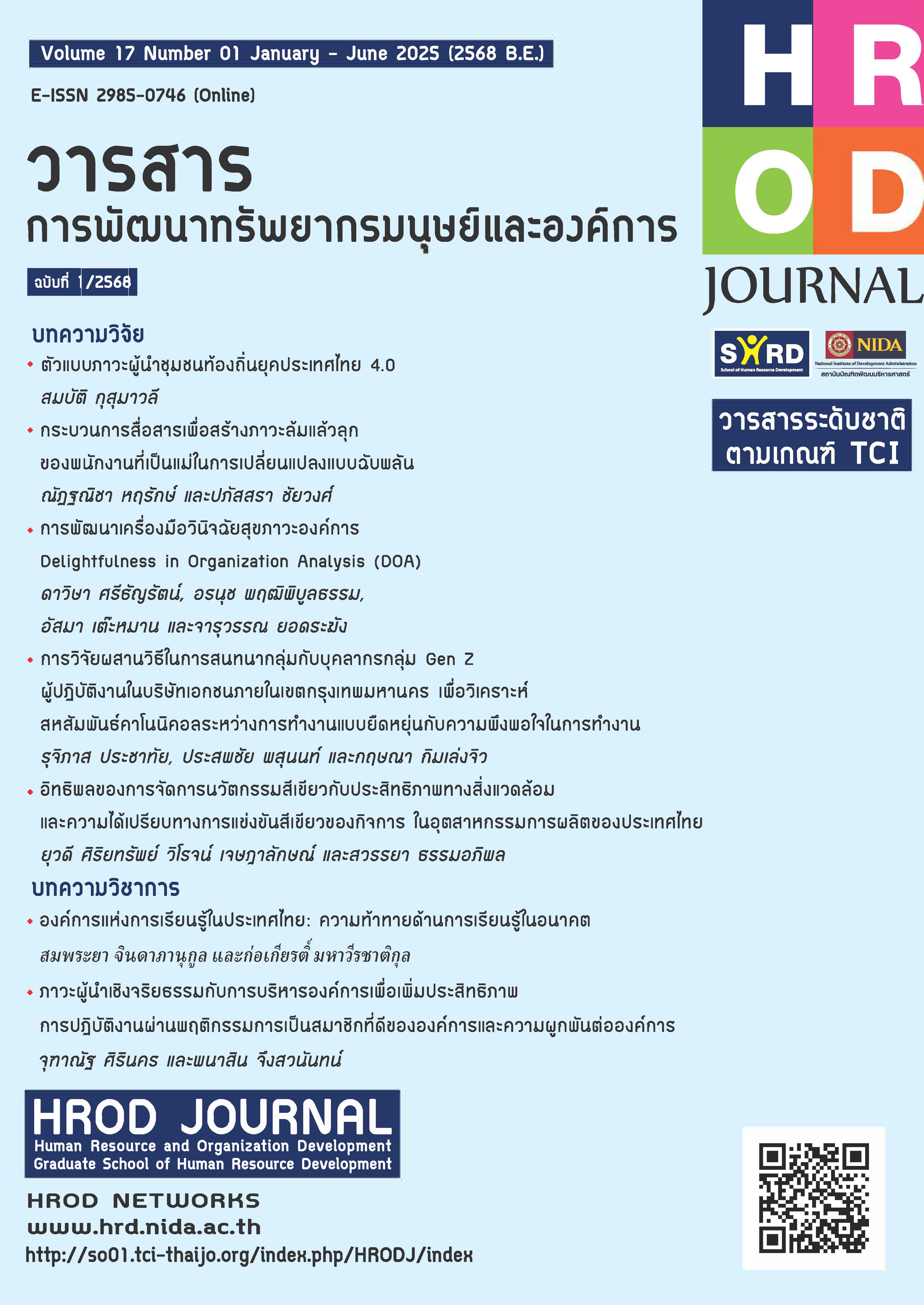
Communication Resilience Process of Thai Working Mothers in Disruptive Life Events
Article Sidebar
Main Article Content
Abstract
The purpose of this qualitative study was to examine the communication processes of Thai working mothers who developed resilience when faced with sudden changes. The primary data collection method was in-depth interviews with 20 participants, including female employees in both management and operational positions at large for-profit Thai organizations. The study identified four categories of intrapersonal communication: 1) encouraging oneself to find solutions, 2) practicing patience, 3) reframing problems as challenges for growth, and 4) viewing change as a normal part of life. These strategies contribute to resilience through five communication processes: 1) crafting normalcy, 2) foregrounding productive action, 3) applying alternative logics to endure challenging situations, 4) affirming identity anchors, and 5) negotiating or reframing identities. At the interpersonal and group communication levels, two key reasons for communicating with their networks emerged: 1) to maintain and utilize communication relationships, and 2) to receive emotional support. At the organizational communication level, the findings suggest that organizational culture and policies that encourage identity expression and emotional communication help working mothers develop resilience.
Article Details

This work is licensed under a Creative Commons Attribution-NonCommercial-NoDerivatives 4.0 International License.
1) The content of article in HROD journal is the author’s wholly responsibility to research, analyze, summarize, compile, and reference data. The editorial department will not be responsible in anyway.
2) The submitted articles in HROD journal must be unpublished before and must not be currently under consideration for publication elsewhere. If it is detected for its repetition, the author must be responsible for infringement of copyright.
3) Authors will be asked to transfer copyright of the article to the Publisher. The article is prohibited to reproduce all or part of the text, unless allowed.
References
คิม จูฮวัน. (2564). Resilience: ยืนหยัดได้ไม่ว่าจะเกิดอะไรขึ้น. สำนักพิมพ์อมรินทร์ How to.
ชุติมา โลมรัตนานนท์, & ภาวิกา ศรีรัตนบัลล์. (2556). อุดมคติและความเป็นจริงเรื่องความเป็นแม่ของผู้หญิงทำงาน [Ideals and realities of motherhood among working women]. วารสารสังคมศาสตร์ มหาวิทยาลัยศรีนครินทรวิโรฒ, 16. https://ejournals.swu.ac.th/index.php/JOS/article/view/3808
วริษฐา แซ่เจีย. (2564, 29 ตุลาคม). ลาออกจากที่ที่ทำให้ชีวิตมีปัญหา รวมเหตุผลที่ทำให้เกิด ‘The Great Resignation’. The MATTER. https://thematter.co/quick-bite/the-great-resignation-is-coming/156273
บังอร เบ็ญจาธิกุล. (2555). ความขัดแย้งในองค์การ บริหารไม่ยาก. วารสารวิชาการมหาวิทยาลัยกรุงเทพธนบุรี, 1(2), 25. https://so01.tci-thaijo.org/index.php/bkkthon/article/view/33889
พรทิพย์ วชิรดิลก. (2557). ปัจจัยทำนายความสามารถในการยืนหยัดเผชิญวิกฤตของนักศึกษาพยาบาล. วารสารการพยาบาลจิตเวชและสุขภาพจิต, 28(2), 17–31. https://he02.tci-thaijo.org/index.php/JPNMH/article/view/24625
ภัทรพรรณ ทำดี. (2564). มองรอบทิศกับชีวิตและสุขภาพของผู้หญิง: แนวทางในการส่งเสริมการเข้าถึงบริการสุขภาพ. วารสารสังคมศาสตร์และมนุษยศาสตร์, 47(2), 7–29. https://so04.tci-thaijo.org/index.php/socku/article/view/249777
โสภิณ แสงอ่อน, พัชรินทร์ นินทจันทร์, และ ทัศนา ทวีคูณ. (2561). ความแข็งแกร่งในชีวิตและภาวะซึมเศร้าของประชาชนในชุมชนแห่งหนึ่งของจังหวัดปทุมธานี. วารสารการพยาบาลจิตเวชและสุขภาพจิต, 32(2), 84–99. https://he02.tci-thaijo.org/index.php/JPNMH/article/view/138697/103072
Accenture. (2020). Supporting our people during the pandemic. Accenture. https://www.accenture.com/us-en/about/corporate-citizenship/employee-initiatives
Bowornkittikun, A. (2020). Influence of bully victimization on depressive mood with self-compassion and resilience as mediators [Master’s thesis, Chulalongkorn University]. CUIR. http://cuir.car.chula.ac.th/handle/123456789/75696
Broad, G. M., Ball-Rokeach, S. J., Ognyanova, K., Stokes, B., Picasso, T., & Villanueva, G. (2013). Understanding communication ecologies to bridge communication research and community action. Journal of Applied Communication Research, 41(4), 325–345. https://doi.org/10.1080/00909882.2013.844848
Buzzanell, P. M. (2010). Resilience: Talking, resisting, and imagining new normalcies into being. Journal of Communication, 60(1), 1–14. https://doi.org/10.1111/j.1460-2466.2009.01469.x
Calarco, J. M., Meanwell, E., Anderson, E. M., & Knopf, A. S. (2021). By default: How mothers in different-sex dual-earner couples account for inequalities in pandemic parenting. Socius: Sociological Research for a Dynamic World, 7, 1–17. https://doi.org/10.1177/23780231211038783
Deloitte. (2020). Combating COVID-19 with an agile change management approach. https://www2.deloitte.com/content/dam/Deloitte/in/Documents/human-capital/in-hc-consulting-deloitte-change-management-pov-on-covid-noexp.pdf
Duhigg, C. (2016, February 28). What Google learned from its quest to build the perfect team. The New York Times Magazine. https://www.nytimes.com/2016/02/28/magazine/what-google-learned-from-its-quest-to-build-the-perfect-team.html
Errida, A., & Lotfi, B. (2021). The determinants of organizational change management success: Literature review and case study. International Journal of Engineering Business Management, 13, 1–13. https://doi.org/10.1177/18479790211016273
Harrison, A. (2020, December 3). How Microsoft survived the pandemic and thrived in the remote-work era. The Verge. https://www.microsoft.com/en-us/worklab/pandemic-lost-and-gained
Hintz, E. A., Betts, T., & Buzzanell, P. M. (2023). Caring for patients without personal protective equipment (PPE): Material conditions as multidimensional cascading triggers for resilience processes. Health Communication, 38(2), 371–380. https://doi.org/10.1080/10410236.2021.1953727
Jablin, F. M., & Sias, P. M. (2001). The new handbook of organizational communication: Advances in theory, research, and methods (F. M. Jablin & L. L. Putnam, Eds.). Sage Publications.
Riess, H. (2021). Institutional resilience: The foundation for individual resilience, especially during COVID-19. Global Advances in Health and Medicine, 10, 1–5. https://doi.org/10.1177/21649561211006728
Scharp, K. M., Geary, D. E., Wolfe, B. H., Wang, T. R., & Fesenmaier, M. A. (2020). Understanding the triggers and communicative processes that constitute resilience in the context of migration to the United States. Communication Monographs, 88(4), 395–417. https://doi.org/10.1080/03637751.2020.1856395
Thomas, R., Yee, L., Cooper, M., Krivkovich, A., Urban, K. M., Rambachan, I., Cardazone, G., Liu, W. W., Noble-Tolla, M., Williams, M., Mahajan, S., Robinson, N., Edwards, B., & Nguyen, H. (2022). Women in the workplace 2022. LeanIn.Org and McKinsey & Company. https://www.mckinsey.com/~/media/mckinsey/featured%20insights/diversity%20and%20inclusion/women%20in%20the%20workplace%202022/women-in-the-workplace-2022.pdf
Trenerry, B., Chng, S., Wang, Y., Suhaila, Z. S., Lim, S. S., Lu, H. Y., & Oh, P. H. (2021). Preparing workplaces for digital transformation: An integrative review and framework of multi-level factors [Review]. Frontiers in Psychology, 12, Article 620766. https://doi.org/10.3389/fpsyg.2021.620766
Turner, L. H., Ekachai, D., & Slattery, K. (2022). How working mothers juggle jobs and family during COVID-19: Communicating pathways to resilience. Journal of Family Communication, 22(2), 138–155. https://doi.org/10.1080/15267431.2022.2058510
Zagefka, H., Houston, D., Duff, L., & Moftizadeh, N. (2021). Combining motherhood and work: Effects of dual identity and identity conflict on well-being. Journal of Child and Family Studies, 30(10), 2452–2460. https://doi.org/10.1007/s10826-021-02070-7
