
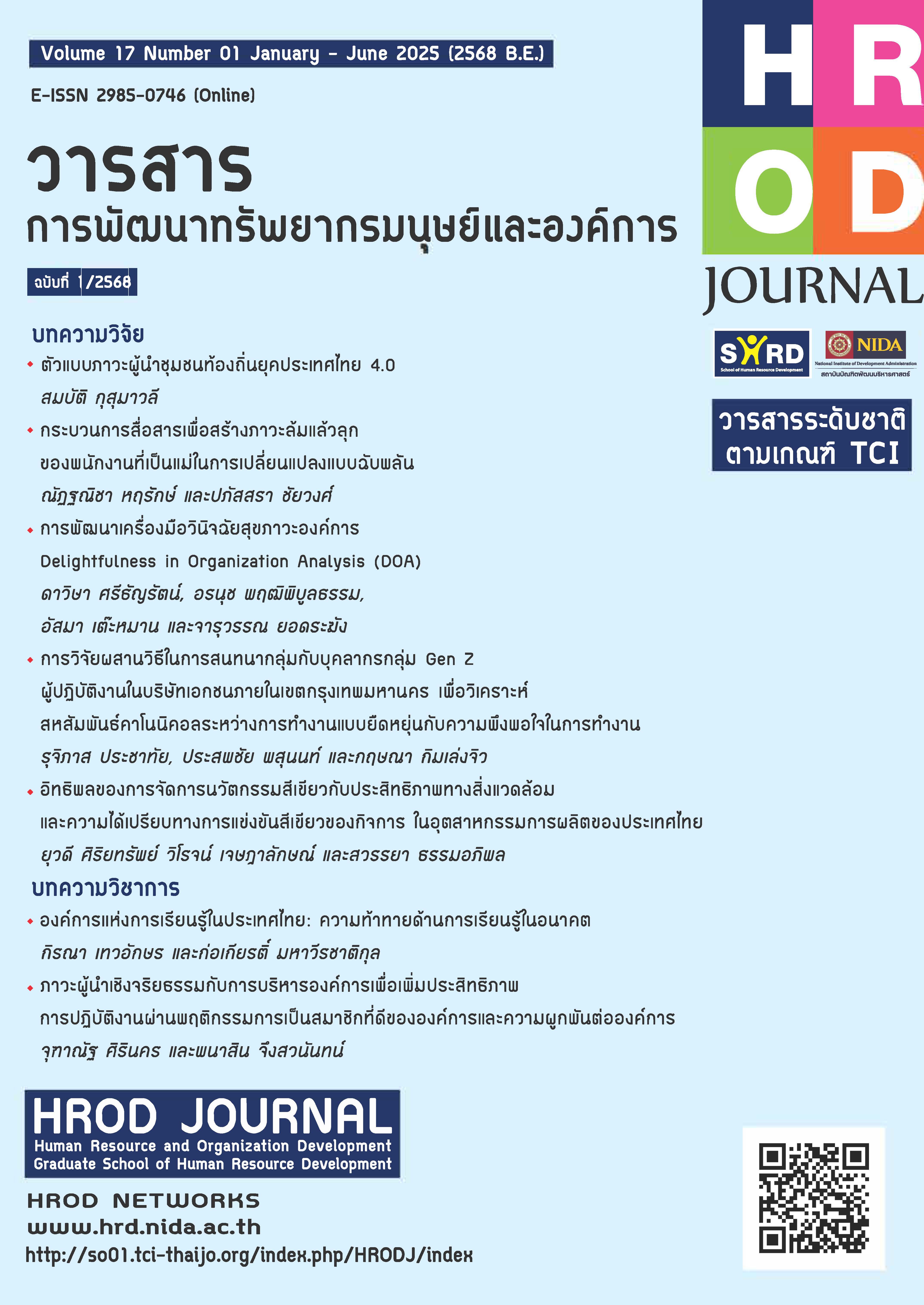
กระบวนการสื่อสารเพื่อสร้างภาวะล้มแล้วลุกของพนักงานที่เป็นแม่ ในการเปลี่ยนแปลงแบบฉับพลัน
Article Sidebar
Main Article Content
บทคัดย่อ
การวิจัยครั้งนี้มีวัตถุประสงค์เพื่อศึกษากระบวนการสื่อสารเพื่อสร้างภาวะล้มแล้วลุกของพนักงานที่เป็นแม่เมื่อเผชิญการเปลี่ยนแปลงแบบฉับพลัน ใช้การสัมภาษณ์เชิงลึกเป็นเครื่องมือหลักในการเก็บข้อมูลจากกลุ่มตัวอย่างจำนวน 20 คน โดยสุ่มตัวอย่างแบบเจาะจงและสมัครใจจากพนักงานหญิงตำแหน่งบริหารและปฏิบัติการในองค์กรไทยประเภทแสวงผลกำไรขนาดใหญ่ ผลการวิจัยพบการสื่อสารในระดับภายในตนเอง 4 ลักษณะ ได้แก่ การบอกให้ตนเอง 1) คิดหาวิธีแก้ 2) อดทน 3) มองอุปสรรคเป็นความท้าทาย และ 4) มองการเปลี่ยนแปลงเป็นเรื่องธรรมดา นำไปสู่การสร้างภาวะล้มแล้วลุก 5 กระบวนการ ได้แก่ 1) การสร้างความปกติใหม่ 2) การมองที่การกระทำในเชิงบวก 3) การสร้างตรรกะเพื่อให้สามารถอดทนได้ในสภาวะนั้นๆ 4) การยึดในค่านิยมของคนในกลุ่ม และ 5) การต่อรองหรือให้ความหมายใหม่กับอัตลักษณ์ของตน ในระดับการสื่อสารระหว่างบุคคลและกลุ่มย่อย พบการสื่อสารกับเครือข่ายของตนใน 2 ลักษณะ คือ 1) การสื่อสารเพื่อรักษาความสัมพันธ์และใช้ประโยชน์จากเครือข่าย และ 2) การสื่อสารเพื่อรับการสนับสนุนทางด้านอารมณ์ และในระดับการสื่อสารองค์กรพบว่า วัฒนธรรมหรือนโยบายองค์กรที่ไม่ปิดกั้นการสื่อสารเกี่ยวกับอารมณ์และการแสดงออกถึงอัตลักษณ์แม่ มีส่วนช่วยให้พนักงานที่เป็นแม่สามารถสร้างภาวะล้มแล้วลุกได้
Article Details

อนุญาตภายใต้เงื่อนไข Creative Commons Attribution-NonCommercial-NoDerivatives 4.0 International License.
1) เนื้อหาทั้งหมดของบทความที่ลงตีพิมพ์ในวารสารการพัฒนาทรัพยากรมนุษย์และองค์การ เจ้าของผลงานมีการคิด ค้นคว้า ทบทวนวิเคราะห์ สรุป เรียบเรียงและอ้างอิงข้อมูลโดยผู้แต่งเอง กองบรรณาธิการไม่มีส่วนร่วมรับผิดชอบ
2) บทความที่ตีพิมพ์ในวารสารนี้ ต้องไม่เคยได้รับการตีพิมพ์เผยแพร่ที่ใดมาก่อน และไม่อยู่ระหว่างการเสนอเพื่อพิจารณาตีพิมพ์ในวารสารฉบับอื่น หากตรวจพบว่า มีการตีพิมพ์ซ้ำซ้อน ถือเป็นความรับผิดชอบของผู้แต่งแต่เพียงผู้เดียวในการละเมิดลิขสิทธิ์
3) ผลงานที่ได้รับการตีพิมพ์ในวารสารวิชาการ ถือเป็นกรรมสิทธิ์ของวารสารห้ามนำข้อความทั้งหมดหรือบางส่วนไปพิมพ์ซ้ำ เว้นเสียแต่ว่าจะได้รับอนุญาตจากทางกองบรรณาธิการวารสารฯ
เอกสารอ้างอิง
คิม จูฮวัน. (2564). Resilience: ยืนหยัดได้ไม่ว่าจะเกิดอะไรขึ้น. สำนักพิมพ์อมรินทร์ How to.
ชุติมา โลมรัตนานนท์, & ภาวิกา ศรีรัตนบัลล์. (2556). อุดมคติและความเป็นจริงเรื่องความเป็นแม่ของผู้หญิงทำงาน [Ideals and realities of motherhood among working women]. วารสารสังคมศาสตร์ มหาวิทยาลัยศรีนครินทรวิโรฒ, 16. https://ejournals.swu.ac.th/index.php/JOS/article/view/3808
วริษฐา แซ่เจีย. (2564, 29 ตุลาคม). ลาออกจากที่ที่ทำให้ชีวิตมีปัญหา รวมเหตุผลที่ทำให้เกิด ‘The Great Resignation’. The MATTER. https://thematter.co/quick-bite/the-great-resignation-is-coming/156273
บังอร เบ็ญจาธิกุล. (2555). ความขัดแย้งในองค์การ บริหารไม่ยาก. วารสารวิชาการมหาวิทยาลัยกรุงเทพธนบุรี, 1(2), 25. https://so01.tci-thaijo.org/index.php/bkkthon/article/view/33889
พรทิพย์ วชิรดิลก. (2557). ปัจจัยทำนายความสามารถในการยืนหยัดเผชิญวิกฤตของนักศึกษาพยาบาล. วารสารการพยาบาลจิตเวชและสุขภาพจิต, 28(2), 17–31. https://he02.tci-thaijo.org/index.php/JPNMH/article/view/24625
ภัทรพรรณ ทำดี. (2564). มองรอบทิศกับชีวิตและสุขภาพของผู้หญิง: แนวทางในการส่งเสริมการเข้าถึงบริการสุขภาพ. วารสารสังคมศาสตร์และมนุษยศาสตร์, 47(2), 7–29. https://so04.tci-thaijo.org/index.php/socku/article/view/249777
โสภิณ แสงอ่อน, พัชรินทร์ นินทจันทร์, และ ทัศนา ทวีคูณ. (2561). ความแข็งแกร่งในชีวิตและภาวะซึมเศร้าของประชาชนในชุมชนแห่งหนึ่งของจังหวัดปทุมธานี. วารสารการพยาบาลจิตเวชและสุขภาพจิต, 32(2), 84–99. https://he02.tci-thaijo.org/index.php/JPNMH/article/view/138697/103072
Accenture. (2020). Supporting our people during the pandemic. Accenture. https://www.accenture.com/us-en/about/corporate-citizenship/employee-initiatives
Bowornkittikun, A. (2020). Influence of bully victimization on depressive mood with self-compassion and resilience as mediators [Master’s thesis, Chulalongkorn University]. CUIR. http://cuir.car.chula.ac.th/handle/123456789/75696
Broad, G. M., Ball-Rokeach, S. J., Ognyanova, K., Stokes, B., Picasso, T., & Villanueva, G. (2013). Understanding communication ecologies to bridge communication research and community action. Journal of Applied Communication Research, 41(4), 325–345. https://doi.org/10.1080/00909882.2013.844848
Buzzanell, P. M. (2010). Resilience: Talking, resisting, and imagining new normalcies into being. Journal of Communication, 60(1), 1–14. https://doi.org/10.1111/j.1460-2466.2009.01469.x
Calarco, J. M., Meanwell, E., Anderson, E. M., & Knopf, A. S. (2021). By default: How mothers in different-sex dual-earner couples account for inequalities in pandemic parenting. Socius: Sociological Research for a Dynamic World, 7, 1–17. https://doi.org/10.1177/23780231211038783
Deloitte. (2020). Combating COVID-19 with an agile change management approach. https://www2.deloitte.com/content/dam/Deloitte/in/Documents/human-capital/in-hc-consulting-deloitte-change-management-pov-on-covid-noexp.pdf
Duhigg, C. (2016, February 28). What Google learned from its quest to build the perfect team. The New York Times Magazine. https://www.nytimes.com/2016/02/28/magazine/what-google-learned-from-its-quest-to-build-the-perfect-team.html
Errida, A., & Lotfi, B. (2021). The determinants of organizational change management success: Literature review and case study. International Journal of Engineering Business Management, 13, 1–13. https://doi.org/10.1177/18479790211016273
Harrison, A. (2020, December 3). How Microsoft survived the pandemic and thrived in the remote-work era. The Verge. https://www.microsoft.com/en-us/worklab/pandemic-lost-and-gained
Hintz, E. A., Betts, T., & Buzzanell, P. M. (2023). Caring for patients without personal protective equipment (PPE): Material conditions as multidimensional cascading triggers for resilience processes. Health Communication, 38(2), 371–380. https://doi.org/10.1080/10410236.2021.1953727
Jablin, F. M., & Sias, P. M. (2001). The new handbook of organizational communication: Advances in theory, research, and methods (F. M. Jablin & L. L. Putnam, Eds.). Sage Publications.
Riess, H. (2021). Institutional resilience: The foundation for individual resilience, especially during COVID-19. Global Advances in Health and Medicine, 10, 1–5. https://doi.org/10.1177/21649561211006728
Scharp, K. M., Geary, D. E., Wolfe, B. H., Wang, T. R., & Fesenmaier, M. A. (2020). Understanding the triggers and communicative processes that constitute resilience in the context of migration to the United States. Communication Monographs, 88(4), 395–417. https://doi.org/10.1080/03637751.2020.1856395
Thomas, R., Yee, L., Cooper, M., Krivkovich, A., Urban, K. M., Rambachan, I., Cardazone, G., Liu, W. W., Noble-Tolla, M., Williams, M., Mahajan, S., Robinson, N., Edwards, B., & Nguyen, H. (2022). Women in the workplace 2022. LeanIn.Org and McKinsey & Company. https://www.mckinsey.com/~/media/mckinsey/featured%20insights/diversity%20and%20inclusion/women%20in%20the%20workplace%202022/women-in-the-workplace-2022.pdf
Trenerry, B., Chng, S., Wang, Y., Suhaila, Z. S., Lim, S. S., Lu, H. Y., & Oh, P. H. (2021). Preparing workplaces for digital transformation: An integrative review and framework of multi-level factors [Review]. Frontiers in Psychology, 12, Article 620766. https://doi.org/10.3389/fpsyg.2021.620766
Turner, L. H., Ekachai, D., & Slattery, K. (2022). How working mothers juggle jobs and family during COVID-19: Communicating pathways to resilience. Journal of Family Communication, 22(2), 138–155. https://doi.org/10.1080/15267431.2022.2058510
Zagefka, H., Houston, D., Duff, L., & Moftizadeh, N. (2021). Combining motherhood and work: Effects of dual identity and identity conflict on well-being. Journal of Child and Family Studies, 30(10), 2452–2460. https://doi.org/10.1007/s10826-021-02070-7
