
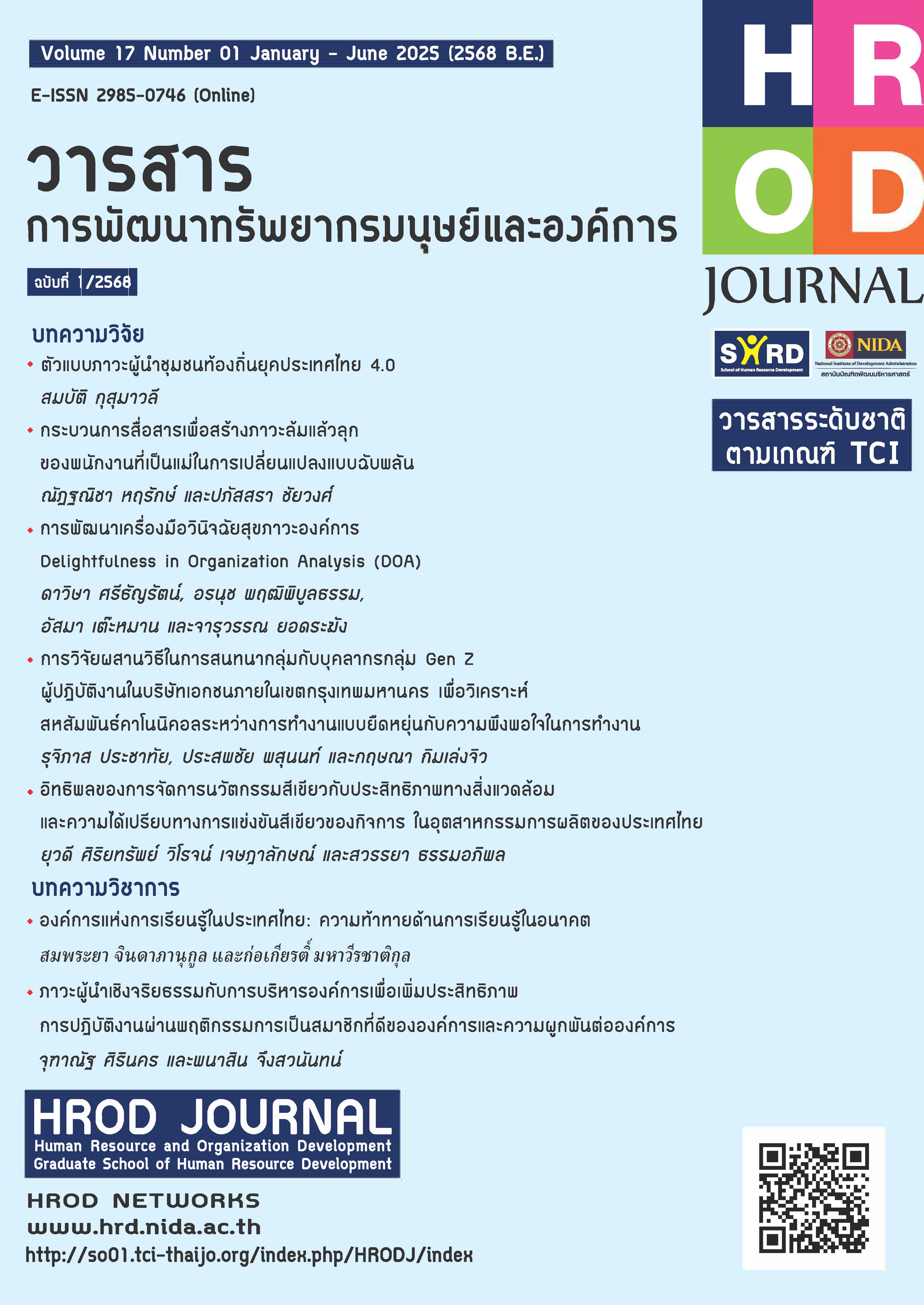
The Influence of Green Innovation Management on Environmental Efficiency and Green Competitive Advantage in Thailand’s Manufacturing Industry
Article Sidebar
Main Article Content
Abstract
This study aims to examine the influence of green innovation management on environmental efficiency and green competitive advantage, as well as to investigate the mediating role of environmental efficiency in the relationship between green innovation management and green competitive advantage. Data were collected from top executives of firms in Thailand’s manufacturing industry using a mail survey, yielding 269 valid responses. The findings reveal that green innovation management has a positive effect on both environmental efficiency and green competitive advantage. Additionally, environmental efficiency positively influences green competitive advantage. Furthermore, environmental efficiency was found to significantly mediate the relationship between green innovation management and green competitive advantage at the 0.01 significance level. The results of this study provide practical guidelines for top executives to emphasize green innovation management as a means to enhance environmental efficiency and to foster sustainable green competitive advantage for their organizations.
Article Details

This work is licensed under a Creative Commons Attribution-NonCommercial-NoDerivatives 4.0 International License.
1) The content of article in HROD journal is the author’s wholly responsibility to research, analyze, summarize, compile, and reference data. The editorial department will not be responsible in anyway.
2) The submitted articles in HROD journal must be unpublished before and must not be currently under consideration for publication elsewhere. If it is detected for its repetition, the author must be responsible for infringement of copyright.
3) Authors will be asked to transfer copyright of the article to the Publisher. The article is prohibited to reproduce all or part of the text, unless allowed.
References
กรมโรงงานอุตสาหกรรม. (2562). คู่มืออุตสาหกรรมสีเขียว. https://greenindustry.diw.go.th/webgi/wp-content/uploads/2022/06/GI_Manual_Thai.pdf
กรมโรงงานอุตสาหกรรม. (2565). รายชื่อผู้ประกอบกิจการที่ได้รับการรับรอง GI 1-5. https://greenindustry.diw.go.th/webgi/nameindustry_list/
ณภัทชา ปานเจริญ, ทรงกลด พลพวก, วิมลกานต์ นิธิศิริวริศกุล, และนฤมล วลีประทานพร. (2563). นวัตกรรมสีเขียวและการจัดการด้านสิ่งแวดล้อมเพื่อความยั่งยืน: บทบาทของความได้เปรียบทางการแข่งขันสำหรับผู้ประกอบการไทย. วารสารการบริหารการปกครองและนวัตกรรมท้องถิ่น, 4(2), 339–356.
ณัฐพร ยงวงศ์ไพบูลย์. (2564). แนวทางการพัฒนาระบบการจัดการอุตสาหกรรมเหล็กไทยไปสู่การเป็นอุตสาหกรรมสีเขียวอย่างยั่งยืน. วารสารรังสิตบัณฑิตศึกษาในกลุ่มธุรกิจและสังคมศาสตร์, 7(1), 15-29.
บุญชม ศรีสะอาด. (2554). หลักการวิจัยเบื้องต้น. สุวิริยาสาส์น.
ภัทรภร โอบอ้อม. (2563). อุตสาหกรรมสีเขียวและโรงงานสีเขียวในประเทศไทย [วิทยานิพนธ์ปรัชญาดุษฎีบัณฑิต, มหาวิทยาลัยรังสิต].
สิญา อุทัย. (2552). บทบาทของสหภาพยุโรปต่อปัญหาการเปลี่ยนแปลงสภาพภูมิอากาศโลก. วารสารยุโรปศึกษา, 17(1), 62–85.
สำนักงานเลขานุการของคณะกรรมการยุทธศาสตร์ชาติ. (2561). ยุทธศาสตร์ชาติ พ.ศ. 2561–2580. สำนักงานคณะกรรมการพัฒนาการเศรษฐกิจและสังคมแห่งชาติ.
เสาวณี จันทะพงษ์. (2566, 5 กันยายน). ความเสี่ยงสภาพภูมิอากาศโลกร้อน โลกเดือด: ทางแยกการรับมือกู้โลก. คอลัมน์แจงสี่เบี้ย, หนังสือพิมพ์กรุงเทพธุรกิจ. https://www.bot.or.th/th/research-and-publications/articles-and-publications/articles/chaengsibia/article-2023sep05.html
Aaker, D., Kumar, V., & Day, G. (2001). Marketing research. John Wiley & Sons.
Ahmed, M., Guo, Q., Qureshi, M. A., Raza, S. A., Khan, K., & Salam, J. (2021). Do green HR practices enhance green motivation and proactive environmental management maturity in hotel industry? International Journal of Hospitality Management, 94, 102852. https://doi.org/10.1016/j.ijhm.2020.102852
Amabile, T. M. (1997). Motivating creativity in organizations: On doing what you love and loving what you do. California Management Review, 40(1), 39–58. https://doi.org/10.2307/41165921
Andersén, J. (2021). A relational natural-resource-based view on product innovation: The influence of green product innovation and green suppliers on differentiation advantage in small manufacturing firms. Technovation, 104, 102254. https://doi.org/10.1016/j.technovation.2021.102254
Bartlett, D., & Trifilova, A. (2010). Green technology and eco-innovation: Seven case-studies from a Russian manufacturing context. Journal of Manufacturing Technology Management, 21, 910–929. https://doi.org/10.1108/17410381011086757
Cao, H., & Chen, Z. (2019). The driving effect of internal and external environment on green innovation strategy: The moderating role of top management’s environmental awareness. Nankai Business Review International, 10(3), 342–361. https://doi.org/10.1108/NBRI-05-2018-0028
Chang, C.-H., & Chen, Y.-S. (2013). Green organizational identity and green innovation. Management Decision, 51(5), 1056–1070. https://doi.org/10.1108/MD-09-2011-0314
Chen, Y.-S., Lai, S.-B., & Wen, C.-T. (2006). The influence of green innovation performance on corporate advantage in Taiwan. Journal of Business Ethics, 67(4), 331–339. https://doi.org/10.1007/s10551-006-9025-5
Chen, Y.-S. (2008). The driver of green innovation and green image: Green core competence. Journal of Business Ethics, 81(3), 531–543. https://doi.org/10.1007/s10551-007-9522-1
Chen, Y. S. (2011). Green organizational identity: Sources and consequence. Management Decision, 49(3), 384–404. https://doi.org/10.1108/00251741111120761
Chiou, T.-Y., Chan, H. K., Lettice, F., & Chung, S. H. (2011). The influence of greening the suppliers and green innovation on environmental performance and competitive advantage in Taiwan. Transportation Research Part E: Logistics and Transportation Review, 47(6), 822–836. https://doi.org/10.1016/j.tre.2011.05.016
Conding, J., Habidin, N., Zubir, A., Hashim, S., & Jaya, N. (2012). The structural analysis of green innovation (GI) and green performance (GP) in Malaysian automotive industry. Research Journal of Finance and Accounting, 3(6), 172–178.
Dangelico, R. M. (2016). Green product innovation: Where we are and where we are going. Business Strategy and the Environment, 25(8), 560–576. https://doi.org/10.1002/bse.1886
Durif, F., Boivin, C., & Julien, C. (2010). In search of a green product definition. Innovative Marketing, 6(1), 25–33.
Eiadat, Y., Kelly, A., Roche, F., & Eyadat, H. (2008). Green and competitive?: An empirical test of the mediating role of environmental innovation strategy. Journal of World Business, 43(2), 131–145.
Fatoki, O. (2021). Environmental orientation and green competitive advantage of hospitality firms in South Africa: Mediating effect of green innovation. Journal of Open Innovation: Technology, Market, and Complexity, 7(4), 223. https://www.mdpi.com/2199-8531/7/4/223
Ge, B., Yang, Y., Jiang, D., Gao, Y., Du, X., & Zhou, T. (2018). An empirical study on green innovation strategy and sustainable competitive advantages: Path and boundary. Sustainability, 10(10), 3631. https://www.mdpi.com/2071-1050/10/10/3631
Hair, J. F., Black, W. C., Babin, B. J., Anderson, R. E., & Tatham, R. L. (2006). Multivariate data analysis (6th ed.). Pearson Prentice Hall.
Hair, J. F., Hult, G. T. M., Ringle, C., & Sarstedt, M. (2017). A primer on partial least squares structural equation modeling (PLS-SEM) (2nd ed.). Sage Publications.
Hair, J. F., Sarstedt, M., Ringle, C. M., & Gudergan, S. P. (2021). Advanced issues in partial least squares structural equation modeling (PLS-SEM) (2nd ed.). Sage Publications.
Hart, S. L. (1995). A natural-resource-based view of the firm. The Academy of Management Review, 20(4), 986–1014. https://doi.org/10.2307/258963
Hart, S. L. (1997). Beyond greening: Strategies for a sustainable world. Harvard Business Review, 75(1), 66–76.
Henseler, J., Ringle, C. M., & Sarstedt, M. (2015). A new criterion for assessing discriminant validity in variance-based structural equation modeling. Journal of the Academy of Marketing Science, 43(1), 115–135. https://doi.org/10.1007/s11747-014-0403-8
Junsheng, H., Masud, M. M., Akhtar, R., & Rana, M. S. (2020). The mediating role of employees’ green motivation between exploratory factors and green behaviour in the Malaysian food industry. Sustainability, 12(2), 509. https://www.mdpi.com/2071-1050/12/2/509
Klassen, R. D., & Whybark, D. C. (1999). The impact of environmental technologies on manufacturing performance. Academy of Management Journal, 42(6), 599–615. https://doi.org/10.5465/256982
Krejcie, R. V., & Morgan, D. W. (1970). Determining sample size for research activities. Educational and Psychological Measurement, 30(3), 607–610.
Li, S., Jayaraman, V., Paulraj, A., & Shang, K.-C. (2016). Proactive environmental strategies and performance: Role of green supply chain processes and green product design in the Chinese high-tech industry. International Journal of Production Research, 54(7), 2136–2151. https://doi.org/10.1080/00207543.2015.1111532
Lin, Y.-H., Kulangara, N., Foster, K., & Shang, J. (2020). Improving green market orientation, green supply chain relationship quality, and green absorptive capacity to enhance green competitive advantage in the green supply chain. Sustainability, 12(18), 7251. https://doi.org/10.3390/su12187251
Liu, Z., Mei, S., & Guo, Y. (2021). Green human resource management, green organization identity and organizational citizenship behavior for the environment: The moderating effect of environmental values. Chinese Management Studies, 15(2), 290–304. https://doi.org/10.1108/CMS-10-2019-0366
Neves, L., & Borges, R. (2018). Sustainable competitive advantage needs green human resource practices: A framework for environmental management. Revista de Administração Contemporânea, 22(5), 763–781. https://doi.org/10.1590/1982-7849rac2018170345
Organisation for Economic Co-operation and Development (OECD). (2011). Fostering innovation for green growth. OECD Publishing.
Omar, K. M., Arbab, A. M., & Abdulrahman, K. M. (2018). Motivation effect on human resource management performance in Bahraini market regulatory authority. Human Resource Management Research, 8(2), 34–41.
Rovinelli, R. J., & Hambleton, R. K. (1977). On the use of content specialists in the assessment of criterion-referenced test item validity. Tijdschrift voor Onderwijs Research, 2, 49–60.
Shan, S., Genç, S. Y., Kamran, H. W., & Dinca, G. (2021). Role of green technology innovation and renewable energy in carbon neutrality: A sustainable investigation from Turkey. Journal of Environmental Management, 294, 113004. https://doi.org/10.1016/j.jenvman.2021.113004
Singh, S. K., Di Giudice, M., Chierici, R., & Graziano, D. (2020). Green innovation and environmental performance: The role of green transformational leadership and green human resource management. Technological Forecasting and Social Change, 150, 119762. https://doi.org/10.1016/j.techfore.2019.119762
Soewarno, N., Tjahjadi, B., & Fithrianti, F. (2019). Green innovation strategy and green innovation. Management Decision, 57(11), 3061–3078. https://doi.org/10.1108/MD-05-2018-0563
Sun, Y., & Sun, H. (2021). Green innovation strategy and ambidextrous green innovation: The mediating effects of green supply chain integration. Sustainability, 13(9), 4876. https://www.mdpi.com/2071-1050/13/9/4876
Wang, H., Khan, M. A. S., Anwar, F., Shahzad, F., Adu, D., & Murad, M. (2021). Green innovation practices and its impacts on environmental and organizational performance. Frontiers in Psychology, 11, 553625. https://doi.org/10.3389/fpsyg.2020.553625
Wong, C. Y., Wong, C. W. Y., & Boon-itt, S. (2020). Effects of green supply chain integration and green innovation on environmental and cost performance. International Journal of Production Research, 58(15), 4589–4609. https://doi.org/10.1080/00207543.2020.1756510
Wong, S. K.-S. (2012). The influence of green product competitiveness on the success of green product innovation. European Journal of Innovation Management, 15(4), 468–490. https://doi.org/10.1108/14601061211272385
Xing, X., Wang, J., & Tou, L. (2019). The relationship between green organization identity and corporate environmental performance: The mediating role of sustainability exploration and exploitation innovation. International Journal of Environmental Research and Public Health, 16, 921. https://doi.org/10.3390/ijerph16060921
