
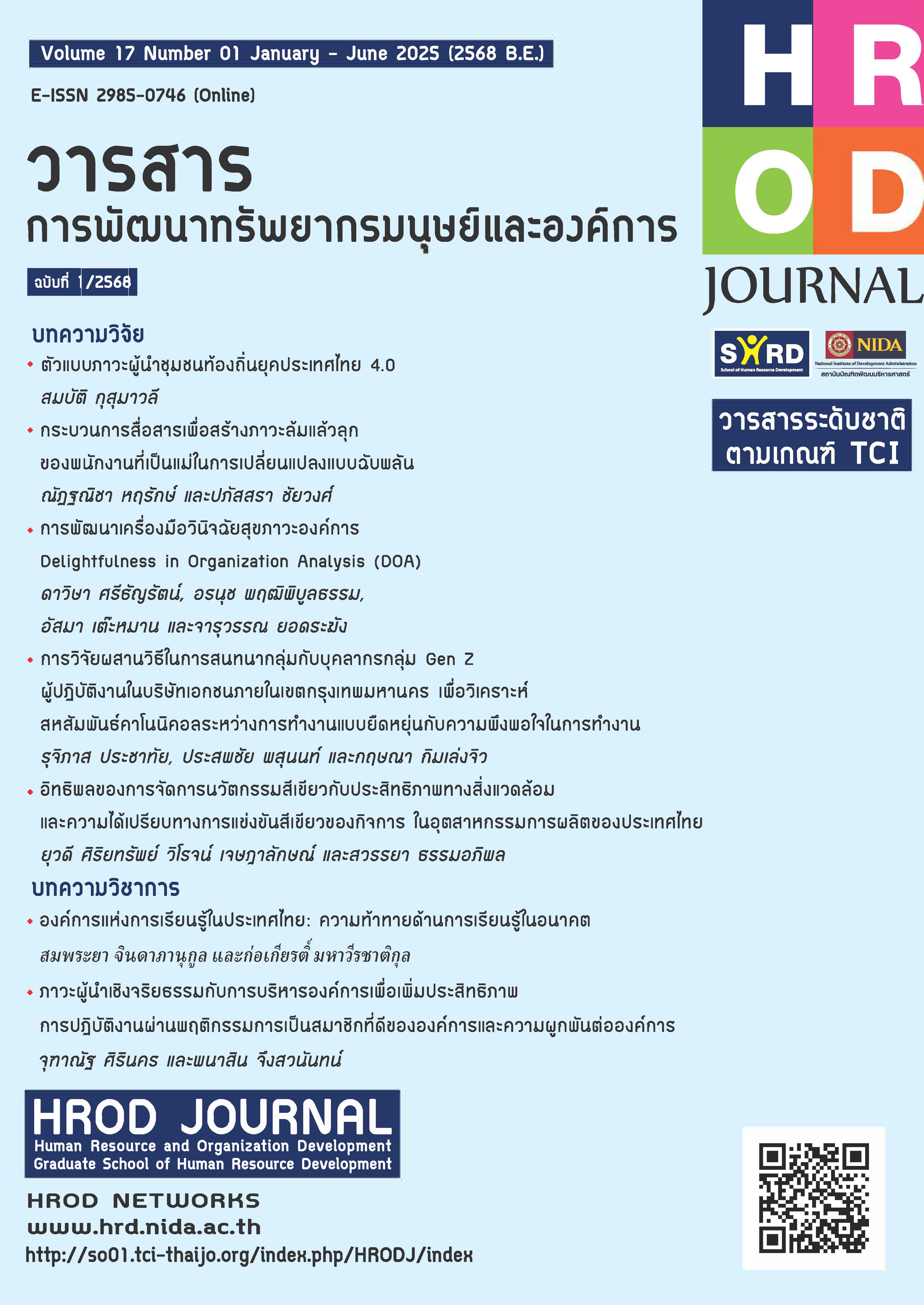
Development of Organizational Well-being Diagnosis Tool: Delightfulness in Organization Analysis (DOA)
Article Sidebar
Main Article Content
Abstract
This research aims to develop a diagnostic tool for organizational well-being under the context of the new normal, to serve as an instrument for 1. assessing the level of well-being and 2. identifying factors that organizations can manage to promote well-being that is appropriate to the Thai context. The study employs a sequential mixed-methods approach, comprising a systematic literature review, qualitative data collection and analysis, and quantitative data collection and analysis, to derive a framework for understanding organizational well-being with a forward-looking perspective, rather than focusing on past organizational well-being models. After gathering quantitative data from 1,500 employees across 50 organizations in Thailand, representing 14 sectors, the results reveal that the model was fitted with the empirical data, confirming that the model reflects what organizations can do to promote employee well-being based on the concept of the 9 performance variables, comprising of three components. Additionally, the model for measuring employee well-being was confirmed to consist of five components. The findings of this study highlight the interpretation of organizational well-being within Thai organizations, reflecting management practices at various organizational levels which contribute to individual well-being across five domains. The results indicate that organizational well-being is not solely the result of health promotion activities, but requires systematic processes and a coherent connection between goals, design, and implementation.
Article Details

This work is licensed under a Creative Commons Attribution-NonCommercial-NoDerivatives 4.0 International License.
1) The content of article in HROD journal is the author’s wholly responsibility to research, analyze, summarize, compile, and reference data. The editorial department will not be responsible in anyway.
2) The submitted articles in HROD journal must be unpublished before and must not be currently under consideration for publication elsewhere. If it is detected for its repetition, the author must be responsible for infringement of copyright.
3) Authors will be asked to transfer copyright of the article to the Publisher. The article is prohibited to reproduce all or part of the text, unless allowed.
References
คิด. (2565, 27 มกราคม). “ที่ทำงาน” ยุคใหม่ ไม่ใช่แค่ดูแล “สุขภาพกาย” แต่ต้องดูแล “สุขภาพใจ” ให้พนักงาน. เข้าถึงเมื่อ กรกฎาคม 26, 2567, https://shorturl.at/JFk0v
จิรประภา อัครบวร, รัตนศักดิ์ เจริญทรัพย์, และจารุวรรณ ยอดระฆัง. (2558). การวินิจฉัยองค์การด้วยเครื่องมือ 9 Cells: กรณีศึกษาส่วนราชการระดับกรมและจังหวัด ปี พ.ศ.2558. สำนักงานคณะกรรมการพัฒนาระบบราชการ.
จิรประภา อัครบวร. (2566). การบริหารผลการปฏิบัติงานเชิงกลยุทธ์: เครื่องมือการพัฒนาองค์การ. (พิมพ์ครั้งที่ 3). กรกรกการพิมพ์ จำกัด
พันธนันท์ ถาวรศักดิ์, วรรณนิภา จีนท่าจันทร์, และธนัสถา โรจนตระกูล. (2567). แนวทางการส่งเสริมสุขภาวะและความปลอดภัยของทรัพยากรมนุษย์ในองค์การ. วารสารการเรียนรู้เชิงสร้างสรรค์ยุคใหม่, 9(5), 498–510. https://so06.tci-thaijo.org/index.php/jomld/article/download/267269/183092/1119690
สำนักงานกองทุนสนับสนุนการสร้างเสริมสุขภาพ. (2565). แผนหลัก (พ.ศ. 2566-2570). https://www.thaihealth.or.th/e-book/แผนหลัก-สสส-2566-2570/
สำนักงานกองทุนสนับสนุนการสร้างเสริมสุขภาพ (สสส.). (ม.ป.ป.). Happy 8 ความสุข การเสริมสร้างคุณภาพชีวิต กับการทำงานอย่างมีความสุข. เข้าถึงเมื่อ กรกฎาคม 26, 2567, https://happy8workplace.thaihealth.or.th/happy-8
สุภมาส อังศุโชติ, สมถวิล วิจิตรวรรณา, และรัชนีกูล ภิญโญภานุวัฒน์ (2551). สถิติวิเคราะห์สําหรับการวิจัยทางสังคมศาสตร์และพฤติกรรมศาสตร์: เทคนิคการใช้โปรแกรม LISREL. เจริญดีมั่นคงการพิมพ์
Agah, J., Ocheni, C., Ezugwu, I., Nnaji, A., Nnenanya, G., & Eeke, J. (2024). Application of item objective congruence index (IOC-Index) for proper alignment of 2020 Physics WASSCE items with objectives and content. ASSEREN Journal of Education, 9(1), 57–63.
AON. (2024, January). Five big human resources trends to watch in 2024. Retrieved July 26, 2024, from https://shorturl.at/iREwc
Clifton, J., & Herter, J. (2021). Wellbeing at work: How to build resilient and thriving teams. Gallup Press.
de Souza, C. M., & Hidalgo, M. P. L. (2012). World Health Organization 5-item well-being index: Validation of the Brazilian Portuguese version. European Archives of Psychiatry and Clinical Neuroscience, 262, 239–244. https://doi.org/10.1007/s00406-011-0255-x
Ernst & Young LLP. (2024, 06 Mar). The future of workplace wellbeing: Trends to watch in 2024. Retrieved July 26, 2024, from https://shorturl.at/Ax9Ar
Hair Jr., J. F., Black, W. C., Babin, B. J., Anderson, R. E., & Tatham, R. L. (1998). Multivariate data analysis. New Jersey, 5(3), 207-219.
Hair, J. F., Hult, G. T. M., Ringle, C. M., & Sarstedt, M. (2014). A primer on partial least squares structural equation modeling. Sage.
Hinkin, T. R. (2005). Scale development principles and practices. In R. A. Swanson & E. F. Holton III (Eds.), Research in organizations (pp. 161–179). Berrett-Koehler.
Kidd, J. M. (2008). Exploring the components of career wellbeing and the emotions associated with significant career experiences. Journal of Career Development, 35(2), 166–186. https://doi.org/10.1177/0894845308325647
McFillen, J., O’Neil, D., Balzer, W., & Varney, G. (2012). Organizational Diagnosis: An evidence-based approach. Journal of Change Management, 13, 1-24. https://doi.org/10.1080/14697017.2012.679290
Norful, A. A., Brewer, K. C., Cahir, K. M., & Dierkes, A. M. (2024). Individual and organizational factors influencing well-being and burnout amongst healthcare assistants: A systematic review. International Journal of Nursing Studies Advances, 6, 1–23. https://doi.org/10.1016/j.ijnsa.2024.100187
Organisation for Economic Co-operation and Development. (n.d.). Measuring well-being and progress. https://www.oecd.org/en/topics/measuring-well-being-and-progress.html
Parker, G. B., & Hyett, M. P. (2011). Measurement of well-being in the workplace: The development of the Work Well-Being Questionnaire. The Journal of Nervous and Mental Disease, 199(6), 394–397. https://doi.org/10.1097/NMD.0b013e31821cd3b9
Ruona, W. E. A. (2005). Analyzing qualitative data. In R. A. Swanson & E. F. Holton III (Eds.), Research in organizations (pp. 233–263). Berrett-Koehler.
Rummler, G. A., & Brache, A. P. (2013). Improving performance: How to manage the white space on the organization chart (3rd ed.). Jossey-Bass.
Rurkkhum, S. (2024). A bundle of human resource practices and employee resilience: The role of employee well-being. Asia-Pacific Journal of Business Administration, 16(3), 716–731. https://doi.org/10.1108/APJBA-01-2022-0050
Sejen, L., Maselli, M., & Ball, J. (2019). 6 Steps to Ensure Employee Well-being in Your Company, World Economic Forum Annual Meeting. https://www.weforum.org/stories/2019/01/ensure-employee-well-being-in-company/
UNESCO. (2022). What you need to know about UNESCO’s Happy Schools Project. https://www.unesco.org/en/articles/what-you-need-know-about-unescos-happy-schools-project
