
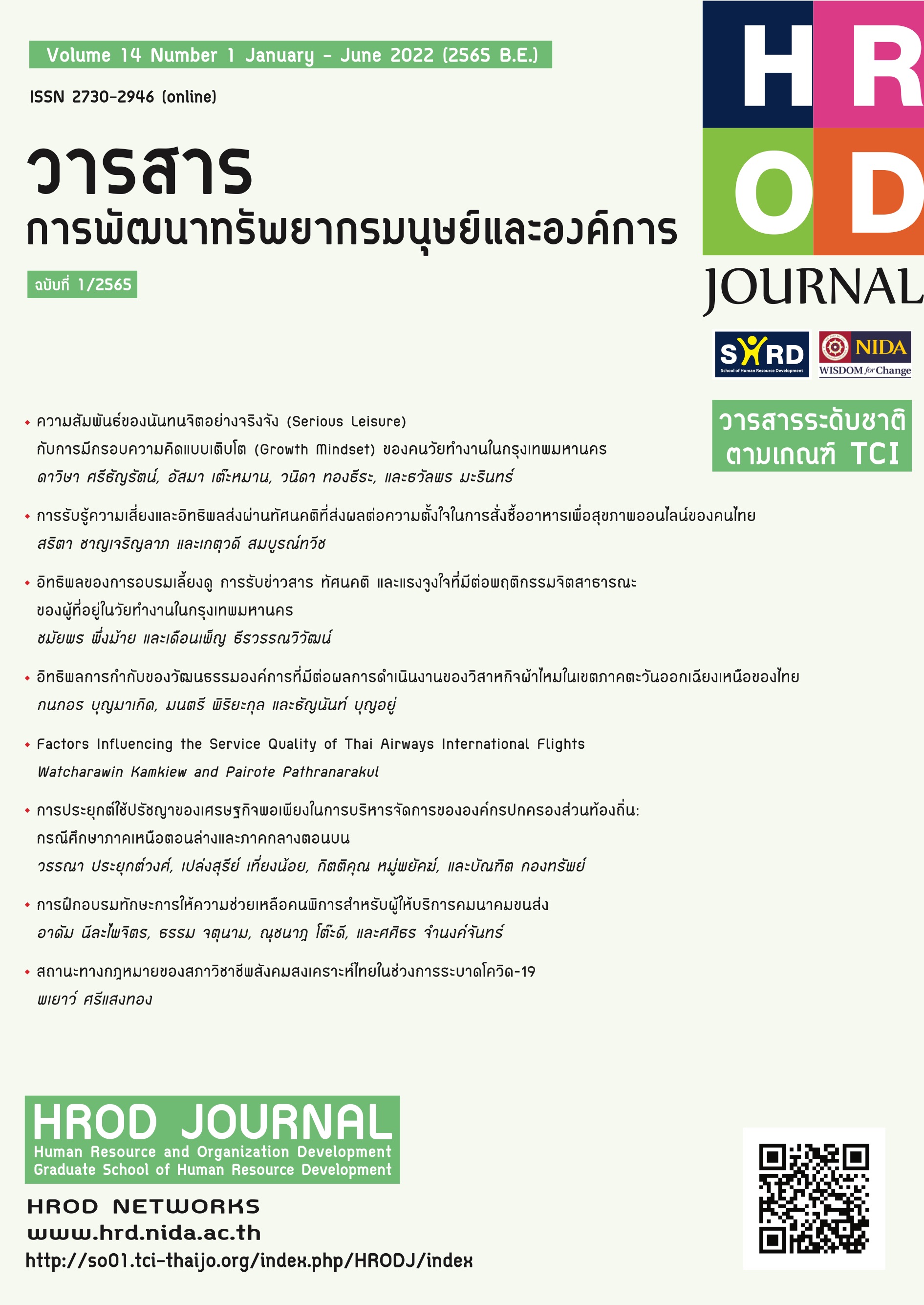
อิทธิพลการกำกับของวัฒนธรรมองค์การที่มีต่อผลการดำเนินงานของ วิสาหกิจผ้าไหมในเขตภาคตะวันออกเฉียงเหนือของไทย
Article Sidebar
Main Article Content
บทคัดย่อ
การวิจัยครั้งนี้จึงมุ่งตอบคำถามการวิจัยว่า 1) อิทธิพลตามเส้นทางการแบ่งปันความรู้สู่ผลการดำเนินงานจะเปลี่ยนแปลงไปตามความแข็งแกร่งของอิทธิพลวัฒนธรรมองค์การหรือไม่ และ2) เมื่อความคิดเชิงสร้างสรรค์เป็นปัจจัยเชื่อมโยงการแบ่งปันความรู้สู่ผลการดำเนินขององค์การ และอิทธิพลตามเส้นทางอ้อมจะเปลี่ยนแปลงไปตามความแข็งแกร่งของอิทธิพลวัฒนธรรมองค์การหรือไม่ โดยการวิจัยครั้งนี้เป็นการวิจัยแบบผสมผสานระหว่างการวิจัยเชิงปริมาณและการวิจัยเชิงคุณภาพ การวิจัยเชิงปริมาณได้ศึกษาจากผู้ประกอบการวิสาหกิจผ้าไหมในเขตภาคตะวันออกเฉียงเหนือของไทย จำนวน 106 แห่ง วิเคราะห์ค่าความถี่ ค่าร้อยละ ค่าเฉลี่ย ส่วนเบี่ยงเบนมาตรฐาน ค่าสัมประสิทธิ์ความแปรผัน และการวิเคราะห์เส้นทางด้วยโปรแกรม Process ส่วนการวิจัยเชิงคุณภาพใช้การสัมภาษณ์เชิงลึกแบบกึ่งโครงสร้างจากผู้ประกอบการหรือผู้เชี่ยวชาญเกี่ยวกับวิสาหกิจผ้าไหมในเขตภาคตะวันออกเฉียงเหนือของไทย จำนวน 10 ท่าน ผลการวิจัยพบว่า 1) อิทธิพลทางตรงที่กำกับเส้นทางการแบ่งปันความรู้ไปสู่ผลการดำเนินงานขององค์การด้วยวัฒนธรรมองค์การจะมีค่าสูงขึ้นเมื่อวัฒนธรรมองค์การมีความแข็งแกร่งขึ้น และ 2) อิทธิพลทางอ้อมที่กำกับเส้นทางการแบ่งปันความรู้ไปสู่ผลการดำเนินงานขององค์การ และความคิดเชิงสร้างสรรค์ไปสู่ผลการดำเนินงานขององค์การด้วยวัฒนธรรมองค์การมีค่าสูงขึ้นไม่แตกต่างกันมาก แม้ว่าวัฒนธรรมองค์การจะมีความแข็งแกร่งขึ้น
Article Details

อนุญาตภายใต้เงื่อนไข Creative Commons Attribution-NonCommercial-NoDerivatives 4.0 International License.
1) เนื้อหาทั้งหมดของบทความที่ลงตีพิมพ์ในวารสารการพัฒนาทรัพยากรมนุษย์และองค์การ เจ้าของผลงานมีการคิด ค้นคว้า ทบทวนวิเคราะห์ สรุป เรียบเรียงและอ้างอิงข้อมูลโดยผู้แต่งเอง กองบรรณาธิการไม่มีส่วนร่วมรับผิดชอบ
2) บทความที่ตีพิมพ์ในวารสารนี้ ต้องไม่เคยได้รับการตีพิมพ์เผยแพร่ที่ใดมาก่อน และไม่อยู่ระหว่างการเสนอเพื่อพิจารณาตีพิมพ์ในวารสารฉบับอื่น หากตรวจพบว่า มีการตีพิมพ์ซ้ำซ้อน ถือเป็นความรับผิดชอบของผู้แต่งแต่เพียงผู้เดียวในการละเมิดลิขสิทธิ์
3) ผลงานที่ได้รับการตีพิมพ์ในวารสารวิชาการ ถือเป็นกรรมสิทธิ์ของวารสารห้ามนำข้อความทั้งหมดหรือบางส่วนไปพิมพ์ซ้ำ เว้นเสียแต่ว่าจะได้รับอนุญาตจากทางกองบรรณาธิการวารสารฯ
เอกสารอ้างอิง
กรมพัฒนาธุรกิจการค้า. (2562). เส้นทางสายไหมภาคตะวันออกเฉียงเหนือ. วารสารกรมพัฒนาธุรกิจการค้า, 10(56), 14-19.
กรมโรงงานอุตสาหกรรม. (2561, เมษายน 4). ข้อมูลโรงงานแยกตามพื้นที่. จาก http://www.diw.go.th/hawk/content.php?mode=data1search.
เกศินี บัวดิศ. (2560). ผ้าทอพื้นเมืองของชาวอีสาน. วารสารพื้นถิ่นโขง ชี มูล, 3(1), 55-84.
ณัฐพันธ์ สุทสสนวิภาณี, สุวิน ทองปั้น และจรัส ลีกา. (2562). การวิเคราะห์ความงามผ้าไหมนครชัยบุรินทร์ ตามทฤษฎีวัตถุวิสัย. วารสารบัณฑิตศึกษามหาจุฬาขอนแก่น, 6(1), 223-235.
ธัญนันท์ บุญอยู่, สุชารัตน์ บุญอยู่ และกนกอร บุญมาเกิด. (2563). อิทธิพลของการกล้าเผชิญความเสี่ยงที่อยู่ในฐานะตัวแปรปฏิสัมพันธ์ระหว่างทุนมนุษย์สู่ผลการดำเนินงานของอุตสาหกรรมผลิตเครื่องปรับอากาศในเขตกรุงเทพมหานคร. วารสารวิจัยมหาวิทยาลัยเวสเทิร์น มนุษยศาสตร์และสังคมศาสตร์, 6(2), 115-123.
หทัยรัตน์ บุณยรัตพันธุ์. (2559). ปัญหาของกลุ่มผ้าไหมมัดหมี่ในตำบลศรีบุญเรือง อำเภอชนบท จังหวัดขอนแก่น. วารสารการบริหารท้องถิ่น, 9(1), 100-117.
Ahmad, K., & Zabri, S. M. (2016). The effect of non-financial performance measurement system on firm performance. International Journal of Economics and Financial Issues, 6(6), 50-54.
Ahmed, F., Shahzad, K., Aslam, H., Bajwa, S. U., & Bahoo, R. (2016). The role of collaborative culture in knowledge sharing and creativity among employees. Pakistan Journal of Commerce and Social Sciences, 10(2), 335-358.
Andam, F. (2017). Knowledge sharing: Exploring the links to organizational culture. International Journal of Health Economics and Policy, 2(1), 16-26.
Cochran, W. G. (1977). Sampling techniques. (3rd ed.). John Wiley & Sons.
Ergun, E. (2018). The mediating role of empowerment on the relationship between organizational culture and innovation performance. Journal of Entrepreneurship and innovation Management, 7(1), 53-74.
Freeze, R. D., & Kulkarni, U. (2007). Knowledge management capability: Defining knowledge assets. Journal of Knowledge Management, 11(6), 94-109.
Giustiniano, L., Lombardi, S., & Cavaliere, V. (2016). How knowledge collecting fosters organizational creativity. Management Decision, 54(6), 1464-1496.
Goh, S. K., & Sandhu, M. S. (2014). The influence of trust on knowledge donating and collecting: An examination of Malaysian universities. International Education Studies, 7(2), 125-136.
Gunawan, S., & Herachwati, N. (2016). A study on the effects of knowledge share in virtual community on creative teaching behaviors and teacher efficacy. Eurasia Journal of Mathematics, Science & Technology Education, 12(4), 1101-1113.
Hasnain, A., Shahid, M. S., Khalil, M. K., & Qureshi, Z. A. (2017). Impact of knowledge sharing and organizational innovative capabilities on firm performance mediating impact of corporate entrepreneurship. Journal of Business Studies, 13(2), 60-71.
Hemmatinezhad, M. A., Shafiee, S., Sharari, M., & Hemmatinezded, M. (2012). The relation between organizational culture and creativity: A case study on physical education experts in Education Administrations. International Journal of Sport Studies, 2(1), 69-78.
Henseler, J., Ringle, C. M., & Sarstedt, M. (2015). A new criterion for assessing discriminant validity in variance-based structural equation modeling. Journal of the Academy of Marketing Science, 43, 115-135.
Hair, J. F., Ringle, C. M., & Sarstedt, M. (2011). PLS-SEM: Indeed a silver bullet. Journal of Marketing Theory and Practice, 19(2), 139-152.
Islam, M. A., Jasimuddin, S. M., & Hasan, I. (2015). Organizational culture, structure technology infrastructure and knowledge sharing: Empirical evidence form MNCs based in Malaysia. Emerald Group Publishing Limited, 45(1), 67-88.
Javeed, S. A., & Lefen, L. (2019). An analysis of corporate social responsibility and firm performance with moderating effects of CEO power and ownership structure: A case study of the Manufacturing sector of Pakistan. Sustainability, 11, 1-25.
Joseph, O. O., & Kibera, F. (2019). Organizational culture and performance: Evidence from microfinance institutions in Kenya. Sage Open, 1-11.
Kucharska, W. (2017). Relationship between trust and collaborative culture in the context of tacit knowledge sharing. Journal of Entrepreneurship, Management and Innovation, 13(4), 61-78.
Liao, S. H., & Chen, C. C. (2016, March 10). Is team knowledge sharing really a matter on employee creativity performance? A contextual model perspective. Retrieved from http://www. worldresearchlibrary.org/up_proc/pdf/165-145439360778-81.pdf.
Lubit, R. (2001). Tacit knowledge and knowledge management: The keys to sustainable competitive advantage. Organizational Dynamics, 29(4), 164-178.
Marsh, H. W., Hau, K. T., Balla, J. R., & Grayson, D. (1998). Is more ever to much? The number of indicators per factor in confirmatory factor analysis. Multivariate Behavioral Research, 33, 181-220.
Martins, E. C., & Terblanche, F. (2003). Building organizational culture that stimulates creativity and innovation. European Journal of Innovation Management, 6(1), 64-74.
Mashaal, I. A., Ai-Bourini, E. S., Shaheen, H. R., & Hararah, N. A. (2018). The impact of the brain keys program implementation to the creative thinking development. American International Journal of Contemporary Research, 8(4), 137-148.
Mehraban, M., Hoseinzadeh, D., & Esmaili, S. (2013). Studding the effect of organizational culture on creativity: Mediating role of knowledge management. Applied mathematics in Engineering, Management and Technology, 1(4), 269-277.
Mihaela, H. (2017). Drivers of firm performance: Exploring quantitative and qualitative approaches. Studies in Business and Economics, 12(1), 79-84.
Muqadas, F., Ilyas, M., Aslam, U., & Rehman, U. U. (2016, March 1). Antecedents of knowledge sharing and its impact on employees’ creativity and work performance. Retrieved from http://journals.iobmresearch.com/index.php/PBR/article/download/937/187.
Nazarian, A., Atkinson, P., & Foroudi, P. (2017). Influence of national culture and balanced organizational culture on the hotel industry’s performance. International Journal of Hospitality Management, 63, 22-32.
Nguyen, T. P. L., Doan, X. H., Tran, M. D., Le, T. T., & Nguyen, T. Q. (2019). Knowledge sharing and individual performance: The case of Vietnam. Uncertain Supply Chain Management, 7, 483-494.
Obeidat, B. Y., Abdallah, A. B., Aqqad, N. O., Akhoershiedah, A. H. O., & Maqableh, M. (2017). The effect of intellectual capital on organizational performance: The mediating role of knowledge sharing. Communications and Network, 9, 1-28.
Quang, N. H. (2017). Organizational culture model of Vietnam airlines. International Journal of Current Research, 9(10), 59468-59472.
Quy, V. T. (2018). Organizational culture and firm performance: A comparative study between local and foreign companies located in Ho Chi Minh City. International Journal of Scientific Research and Innovative Technology, 5(2), 45-53.
Rastgoo, P. (2017). The impact of organizational culture on creativity: The mediating role of knowledge management (Case study: Medical sciences and health services university in Bushehr). International Review of Management and Marketing, 7(4), 83-90.
Rezaee, G., & Amirianzadeh, M. (2017). Mediating role of knowledge management in the relationship of organizational culture with tejarat bank employees’ creativity in Shiraz branches. International Journal of Scientific Study, 5(4), 11-18.
Selvam, M., Gayathri, J., Vasanth, V., Lingaraja, K., & Marxiaoli, S. (2016). Determinants of firm performance: A subjective model. International Journal of Social Science Studies, 4(7), 90-100.
Shami, G. M., Rehman, C. A., & Dost, M. K. B. (2019). Knowledge sharing and business process: The mediating role of organizational factors. Pakistan Journal of Commerce and Social Sciences, 13(2), 436-454.
Situmorang, D. S., & Augustine, Y. (2019). The effect of risk management on firm value with firm performance as a mediation (Study in banking industries listed in IDX) for the year 2013-2017. Research Journal of Finance and Accounting, 10(8), 1-5.
Sothan, Y. (2016). A study on correlation between leader-member exchange and employee creativity: The impacts of knowledge sharing and organizational commitment. International Review of Management and Business Research, 5(2), 688-704.
Taouab, O., & Issor, Z. (2019). Firm performance: Definition and measurement models. European Scientific Journal, 15(1), 93-106.
Zhao, H., Teng, H., & Wu, Q. (2018). The effect of corporate culture on firm performance: Evidence from China. China Journal of Accounting Research, 11, 1-9.
