
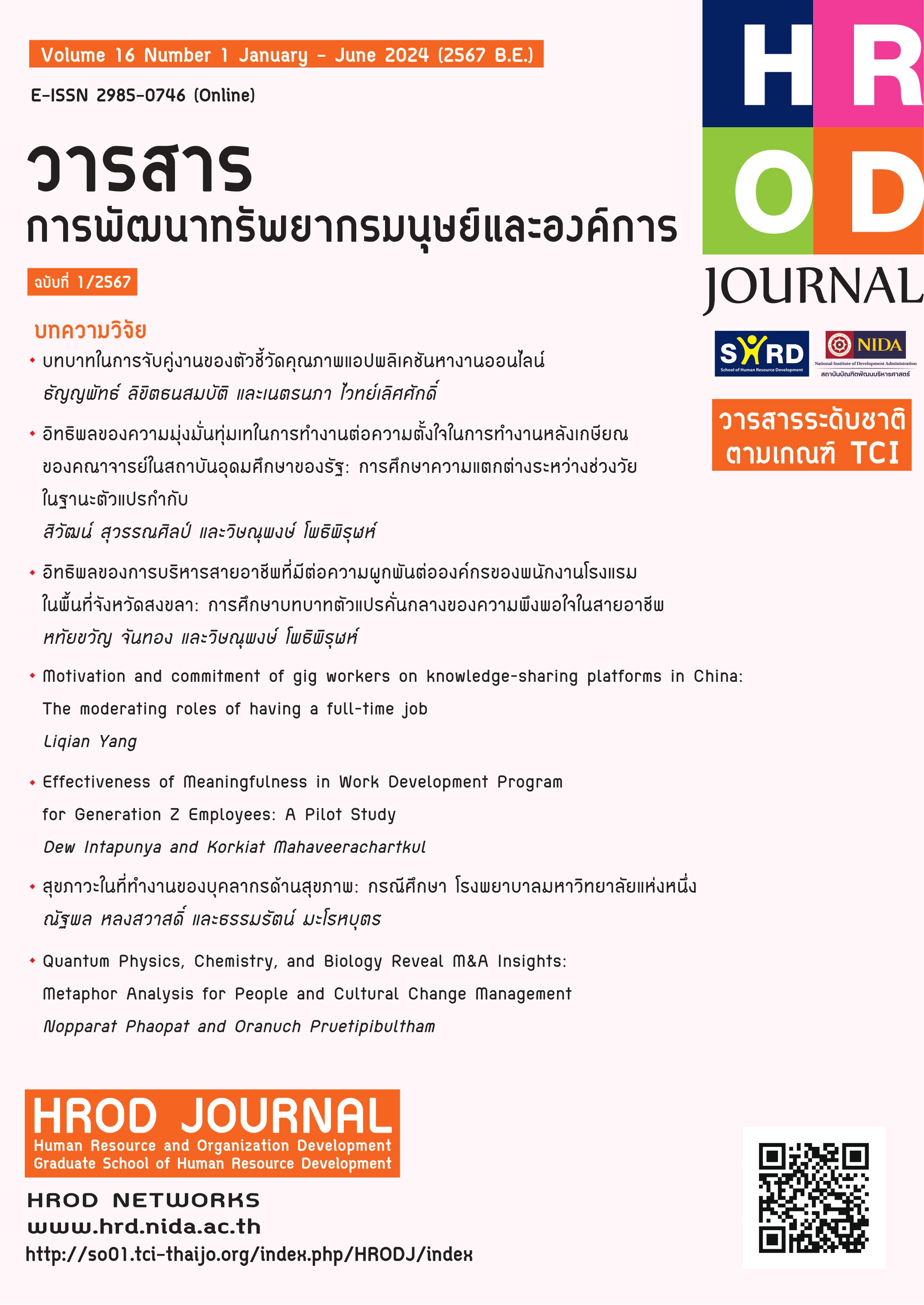
Motivation and commitment of gig workers on knowledge-sharing platforms in China: The moderating roles of having a full-time jobsharing platforms in China: moderating roles of having a full-time job
Article Sidebar
Main Article Content
Abstract
This research investigated the intrinsic motivation and extrinsic motivation associated with gig workers' commitment to knowledge-sharing platforms. The study also explored whether gig workers with or without a full-time job play a moderating role. To collect data, an online self-administered survey was used, and the respondents are gig workers from China's six largest knowledge-sharing platforms. The study ultimately received 816 valid responses. The partial least squares structural equation modeling regression was applied for data analysis. The results found that both intrinsic and extrinsic motivation are positively associated with gig workers' commitment to knowledge-sharing platforms. Moreover, it found an interesting result that gig workers who do not have a full-time job have a negative moderating effect on intrinsic motivation and commitment. It was also found that gig workers who do not have a full-time job have a stronger positive moderating effect between extrinsic motivation and commitment.
Article Details

This work is licensed under a Creative Commons Attribution-NonCommercial-NoDerivatives 4.0 International License.
1) The content of article in HROD journal is the author’s wholly responsibility to research, analyze, summarize, compile, and reference data. The editorial department will not be responsible in anyway.
2) The submitted articles in HROD journal must be unpublished before and must not be currently under consideration for publication elsewhere. If it is detected for its repetition, the author must be responsible for infringement of copyright.
3) Authors will be asked to transfer copyright of the article to the Publisher. The article is prohibited to reproduce all or part of the text, unless allowed.
References
Alamri, H., Lowell, V., Watson, W., & Watson, S. L. (2020). Using personalized learning as an instructional approach to motivate learners in online higher education: Learner self-determination and intrinsic motivation. Journal of Research on Technology in Education, 52(3), 322-352. https://doi.org/10.1080/15391523.2020.1728449
Allen, T., & Russell, J. (1999). Parental Leave of Absence: Some Not So Family‐Friendly Implications 1. Journal of applied social psychology, 29(1), 166-191. https://doi.org/10.1111/j.1559-1816.1999.tb01380.x
Altindis, S. (2011). Job motivation and organizational commitment among the health professionals: A questionnaire survey. African Journal of Business Management, 5(21), 8601-8609. https://www.researchgate.net/profile/Selma-Altindis/publication/267809873
Ashford, S. J., Caza, B. B., & Reid, E. M. (2018). From surviving to thriving in the gig economy: A research agenda for individuals in the new world of work. Research in Organizational Behavior, 38, 23-41. https://doi.org/10.1016/j.riob.2018.11.001
Burke, A., & Cowling, M. (2020). The relationship between freelance workforce intensity, business performance and job creation. Small Business Economics, 55(2), 399-413. https://doi.org/10.1007/s11187-019-00241-x
Cooper, D. R., Schindler, P. S., & Sun, J. (2006). Business research methods in academic writing Academy of Management Annals, 9(3), 1089-1142. https://doi.org/10.5465/amle.2006.21253789
Daolin, Y. (2022). 2022 Research Report on China Gig Economy. Retrieved from https://www.sohu.com/a/553368431_120957953
Deci, E. L. (1971). Effects of externally mediated rewards on intrinsic motivation. Journal of personality and social psychology, 18(1), 105. https://doi.org/10.1037/h0030644
Deci, E. L., Olafsen, A. H., & Ryan, R. M. (2017). Self-determination theory in work organizations: The state of a science. Annual Review of Organizational Psychology and Organizational Behavior, 4, 19-43. https://doi.org/10.1146/annurev-orgpsych-032516-113108
Deci, E. L., & Ryan, R. M. (2000). The" what" and" why" of goal pursuits: Human needs and the self-determination of behavior. Psychological inquiry, 11(4), 227-268. https://doi.org/10.1207/S15327965PLI1104_01
Demir, S. (2020). The role of self-efficacy in job satisfaction, organizational commitment, motivation and job involvement. Eurasian Journal of Educational Research, 20(85), 205-224. https://doi.org/10.14689/ejer.2020.85.10
Duggan, J., Sherman, U., Carbery, R., & McDonnell, A. (2020). Algorithmic management and app‐work in the gig economy: A research agenda for employment relations and HRM. Human Resource Management Journal, 30(1), 114-132. https://doi.org/10.1111/1748-8583.12258
Farrell, A. M. (2010). Insufficient discriminant validity: A comment on Bove, Pervan, Beatty, and Shiu (2009). Journal of Business Research, 63(3), 324-327. https://doi.org/10.1016/j.jbusres.2009.05.003
Fernet, C., Austin, S., & Vallerand, R. J. (2012). The effects of work motivation on employee exhaustion and commitment: An extension of the JD-R model. Work & Stress, 26(3), 213-229. https://doi.org/10.1080/02678373.2012.713202
Friedman, G. (2014). Workers without employers: shadow corporations and the rise of the gig economy. Review of Keynesian Economics, 2(2), 171-188. https://doi.org/10.4337/roke.2014.02.03
Gerhart, B., & Fang, M. (2015). Pay, intrinsic motivation, extrinsic motivation, performance, and creativity in the workplace: Revisiting long-held beliefs. Annual Review of Organizational Psychology and Organizational Behavior, 2(1), 489-521. https://doi.org/10.1146/annurev-orgpsych-032414-111418
Gunawan, R., Haerofiatna, & Didit Haryadi. (2022). The Effect of Extrinsic Motivation, Interpersonal Trust, and Organizational Commitment in Improving Employee Performance. Enrichment : Journal of Management, 12(5), 3670-3677. https://doi.org/10.35335/enrichment.v12i5.895
Gupta, M., Behl, A., Pereira, V., Yahiaoui, D., & Varma, A. (2023). “From Full-Time to Part-Time”: Motivation model for the turbulence-hit knowledge workers. Journal of Business Research, 163, 113926. https://doi.org/10.1016/j.jbusres.2023.113926
Hair, J. F., Risher, J. J., Sarstedt, M., & Ringle, C. M. (2019). When to use and how to report the results of PLS-SEM. European business review, 31(1), 2-24. https://doi.org/10.1108/EBR-11-2018-0203
Haivas, S., Hofmans, J., & Pepermans, R. (2012). Self-Determination Theory as a Framework for Exploring the Impact of the Organizational Context on Volunteer Motivation. Nonprofit and Voluntary Sector Quarterly, 41(6), 1195-1214. https://doi.org/10.1177/0899764011433041
Holtbrügge, D., & Engelhard, F. (2016). Study abroad programs: Individual motivations, cultural intelligence, and the mediating role of cultural boundary spanning. Academy of Management Learning & Education, 15(3), 435-455. https://doi.org/10.5465/amle.2015.0128
Ingvar Jacobsen, D. (2000). Managing increased part‐time: does part‐time work imply part‐time commitment? Managing Service Quality: An International Journal, 10(3), 187-201. https://doi.org/10.1108/09604520010336713
Jabagi, N., Croteau, A.-M., Audebrand, L. K., & Marsan, J. (2019). Gig-workers’ motivation: Thinking beyond carrots and sticks. Journal of Managerial Psychology, 34(4), 192-213. https://doi.org/10.1108/JMP-06-2018-0255
Jufrizen, J., Mukmin, M., Nurmala, D., & Jasin, H. (2021). Effect of Moderation of Work Motivation on the Influence of Organizational Culture On Organizational Commitment and Employee Performance. International Journal of Business Economics (IJBE), 2(2), 86-98. https://doi.org/10.30596/ijbe.v2i2.6710
Kim, S. S., Pak, J., & Son, S. Y. (2023). Do calling-oriented employees take charge in organizations? The role of supervisor close monitoring, intrinsic motivation, and organizational commitment. Journal of vocational behavior, 140, 103-128. https://doi.org/10.1016/j.jvb.2022.103812
Kock, N., & Lynn, G. (2012). Lateral collinearity and misleading results in variance-based SEM: An illustration and recommendations. Journal of the Association for information Systems, 13(7), 468-498. https://doi.org/10.17705/1jais.00302
Kowalczyk, R., & Kucharska, W. (2020). Corporate social responsibility practices incomes and outcomes: Stakeholders' pressure, culture, employee commitment, corporate reputation, and brand performance. A Polish–German cross‐country study. Corporate Social Responsibility and Environmental Management, 27(2), 595-615. https://doi.org/10.1002/csr.1823
Kuhn, K. M., & Galloway, T. L. (2019). Expanding perspectives on gig work and gig workers. Journal of Managerial Psychology, 34(4), 186-191. https://doi.org/10.1108/JMP-05-2019-507
Lieberman, M. G., & Morris, J. D. (2014). The precise effect of multicollinearity on classification prediction. Multiple Linear Regression Viewpoints, 40(1), 5-10. https://www.researchgate.net/profile/John-Morris-25/publication/336561703
Lutz, C., & Newlands, G. (2018). Consumer segmentation within the sharing economy: The case of Airbnb. Journal of Business Research, 88, 187-196. https://doi.org/10.1016/j.jbusres.2018.03.019
Marquis, E. B., Kim, S., Alahmad, R., Pierce, C. S., & Robert Jr, L. P. (2018). Impacts of Perceived Behavior Control and Emotional Labor on Gig Workers. Journal of Information Technology, 2(4), 241-244. https://doi.org/10.1145/3272973.3274065
Moon, M. J. (2000). Organizational commitment revisited in new public management: Motivation, organizational culture, sector, and managerial level. Public performance & management review, 177-194. https://doi.org/10.2307/3381267
Mukhopadhyay, B., & Chatwin, C. (2021). Your driver is Didi and minutes away from your pick-up point: Understanding employee motivation in the gig economy of China. International Journal of Developing and Emerging Economies, 8(1), 1-16. http://hdl.handle.net/10419/232258
Pang, S., Bao, P., Hao, W., Kim, J., & Gu, W. (2020). Knowledge sharing platforms: An empirical study of the factors affecting continued use intention. Sustainability, 12(6), 23-41. https://doi.org/10.3390/su12062341
Pelletier, L. G., Fortier, M. S., Vallerand, R. J., & Briere, N. M. (2001). Associations among perceived autonomy support, forms of self-regulation, and persistence: A prospective study. Motivation and emotion, 25(4), 279-306. https://doi.org/10.1023/A:1014805132406
Penttinen, E., Halme, M., Malo, P., Saarinen, T., & Vilén, V.-M. (2019). Playing for fun or for profit: how extrinsically-motivated and intrinsically-motivated players make the choice between competing dual-purposed gaming platforms. Electronic markets, 29, 337-358. https://link.springer.com/article/10.1007/s12525-018-0298-1
Qomatish, D. D. (2022). The Influence of Competence and Innovation Commitment on Innovative Behavior: The Mediating Role of Intrinsic Motivation. Paper presented at the Eighth Padang International Conference On Economics Education, Economics, Business and Management, Accounting and Entrepreneurship. https://www.atlantis-press.com/proceedings/piceeba-8-21/125976325
Ryan, R. M., & Deci, E. L. (2000). Intrinsic and extrinsic motivations: Classic definitions and new directions. Contemporary educational psychology, 25(1), 54-67. https://doi.org/10.1006/ceps.1999.1020
Setrojoyo, S. M., Rony, Z. T., Sutrisno, S., Naim, S., Manap, A., & Sakti, B. P. (2023). The Effect of Intrinsic Motivation, Organizational Culture on Employee Performance with Organizational Commitment as an Intervening Variable. International Journal of Professional Business Review: Int. J. Prof. Bus. Rev., 8(7), 52-73. https://dialnet.unirioja.es/servlet/articulo?codigo=9060789
Süß, S., & Kleiner, M. (2010). Commitment and work-related expectations in flexible employment forms: An empirical study of German IT freelancers. European Management Journal, 28(1), 40-54. https://doi.org/10.1016/j.emj.2009.02.002
Vallas, S., & Schor, J. B. (2020). What do platforms do? Understanding the gig economy. Annual Review of Sociology, 46, 273-294. https://doi.org/10.1146/annurev-soc-121919-054857
Wheelahan, L., & Moodie, G. (2022). Gig qualifications for the gig economy: micro-credentials and the ‘hungry mile’. Higher Education, 83(6), 1279-1295. https://link.springer.com/article/10.1007/s10734-021-00742-3
Wiersma, U. J. (1992). The effects of extrinsic rewards in intrinsic motivation: A meta‐analysis. Journal of Occupational and Organizational Psychology, 65(2), 101-114. https://doi.org/10.1111/j.2044-8325.1992.tb00488.x
Wu, Q., Zhang, H., Li, Z., & Liu, K. (2019). Labor control in the gig economy: Evidence from Uber in China. Journal of Industrial Relations, 61(4), 574-596. https://doi.org/10.1177/0022185619854472
Yanle, S. J., Xiaoyin Liu, Ruyi Lu. (2023). From "employment relationship" to "business cooperation", more than 200 million people have entered the gig economy. Retrieved from https://finance.sina.cn/china/gncj/2023-09-04/detail-imzknmas0195966.d.html?vt=4&cid=79649&node_id=79649
